310.14(A)(2) Selection of Conductor Ampacity.
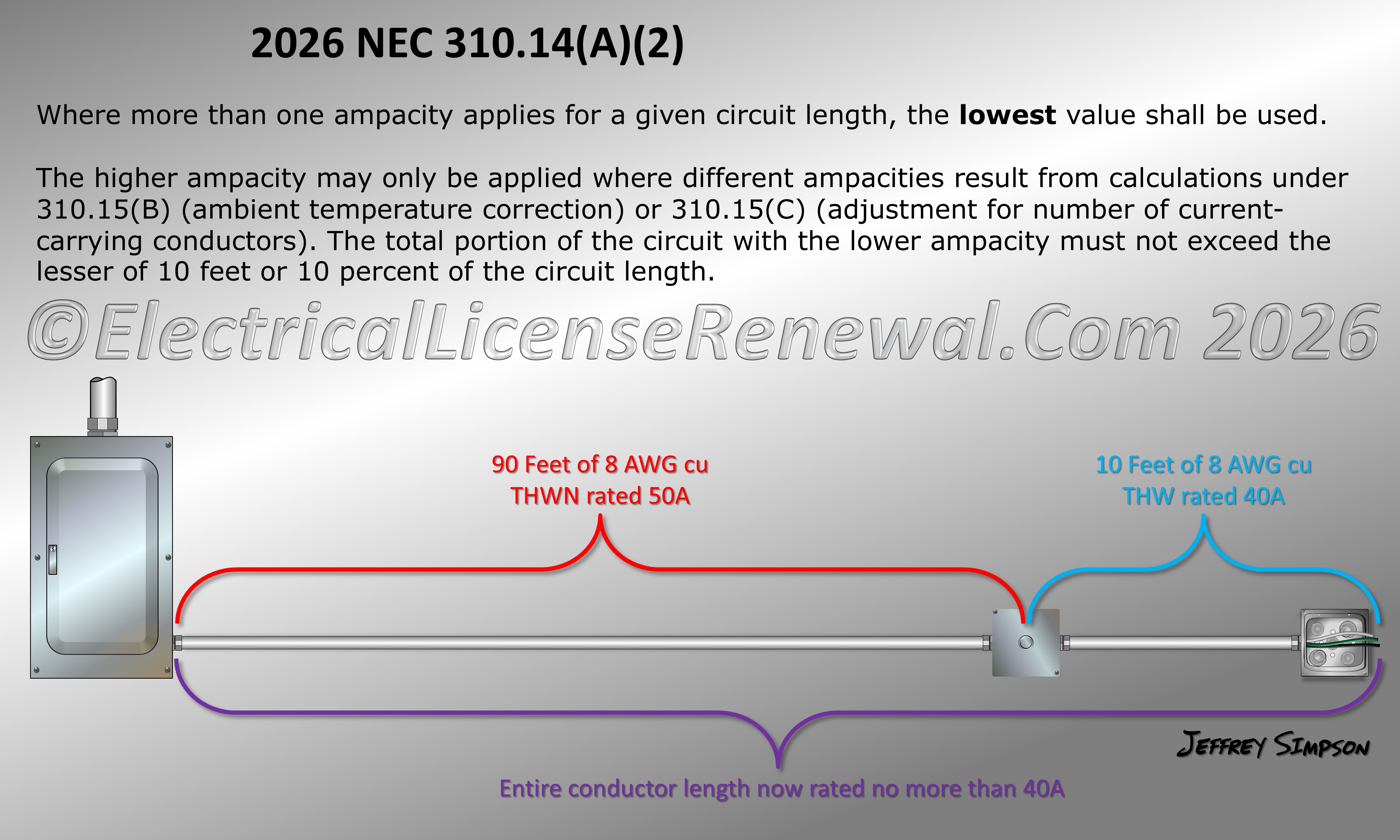
Unless the exception applies, where more than one ampacity applies for a given circuit length, the lowest value shall be used.
Code Change Summary: Section 310.14(A)(2) was revised to clarify that its exception applies only when different ampacities result from correction or adjustment factors, not from changes in conductor size or material.
SME commentary: The 2026 NEC® includes a significant clarification in Section 310.14(A)(2), which addresses how to determine ampacity when more than one value applies to a conductor along its length. In the 2023 edition, the text permitted the higher ampacity of a conductor to be used if the portion of the circuit with lower ampacity did not exceed the lesser of 10 feet or 10 percent of the total circuit length. While this was intended only for cases where different ampacities resulted from applying correction or adjustment factors under 310.15(B) or 310.15(C), the wording left room for broader interpretations that were never the intent of the rule.
In the 2026 NEC®, the exception has been reformatted into list items and revised to state explicitly that the higher ampacity may only be applied where different ampacities result from calculations under 310.15(B) (ambient temperature correction) or 310.15(C) (adjustment for number of current-carrying conductors). The total portion of the circuit with the lower ampacity must still not exceed the lesser of 10 feet or 10 percent of the circuit length, but the scope of the exception is now narrowly limited to its intended applications.
This clarification is important because in practice, different ampacities can arise from more than just correction and adjustment factors. They may result from a change in conductor size, a change in conductor material, or splicing to a conductor with a different insulation type. The revised text makes it clear that such changes are not covered by the exception. For example, an installer cannot transition from #8 AWG THWN copper conductor rated at 50 amps to #8 AWG TW copper conductor rated at 40 amps and rely on the higher ampacity of the THWN conductor while ignoring the limiting ampacity of the type TW insulated conductor. In that scenario, the ampacity must be based on the conductor with the lower temperature rating, without benefit of the exception.
Without this revision, the 2023 wording could also be misapplied to different conductor sizes. For instance, one could argue that inserting 10 feet of #8 AWG copper (rated 50 amperes) into a 100-foot feeder using 1 AWG copper (rated 130 amperes) would still permit the circuit to be rated for the higher 125-ampere value since the smaller conductor made up less than 10 percent of the length. This was never the intent of the NEC®, and the 2026 revision ensures that only correction and adjustment factor differences can invoke the exception.
By clarifying the intent of the exception, Section 310.14(A)(2) now eliminates ambiguity and helps ensure that ampacity determinations are applied consistently across the industry. Electricians, engineers, and inspectors can be confident that reduced conductor sizes or changes in conductor material are not mistakenly used to justify higher ampacity ratings.
Below is a preview of the NEC®. See the actual NEC® text at NFPA.ORG for the complete code section. Once there, click on their link to free access to the 2026 NEC® edition of NFPA 70.
2023 Code Language:
310.14(A)(2) Selection of Ampacity. Where more than one ampacity applies for a given circuit length, the lowest value shall be used.
Exception: Where different ampacities apply to portions of a circuit, the higher ampacity shall be permitted to be used if the total portions of the circuit with lower ampacity does not exceed the lesser of 10 feet or 10 percent of the total circuit.
2026 Code Language:
310.14(A)(2) Selection of Ampacity. Where more than one ampacity applies for a given circuit length, the lowest value shall be used.
Exception: Where different ampacities resulting from 310.15(B) or 310.15(C) calculations apply to portions of a circuit, the higher ampacity shall be permitted to be used if the total portions of the circuit with lower ampacity does not exceed the lesser of the following:
(1) 10 feet
(2) 10 percent of the total circuit
