300.24 Bends.
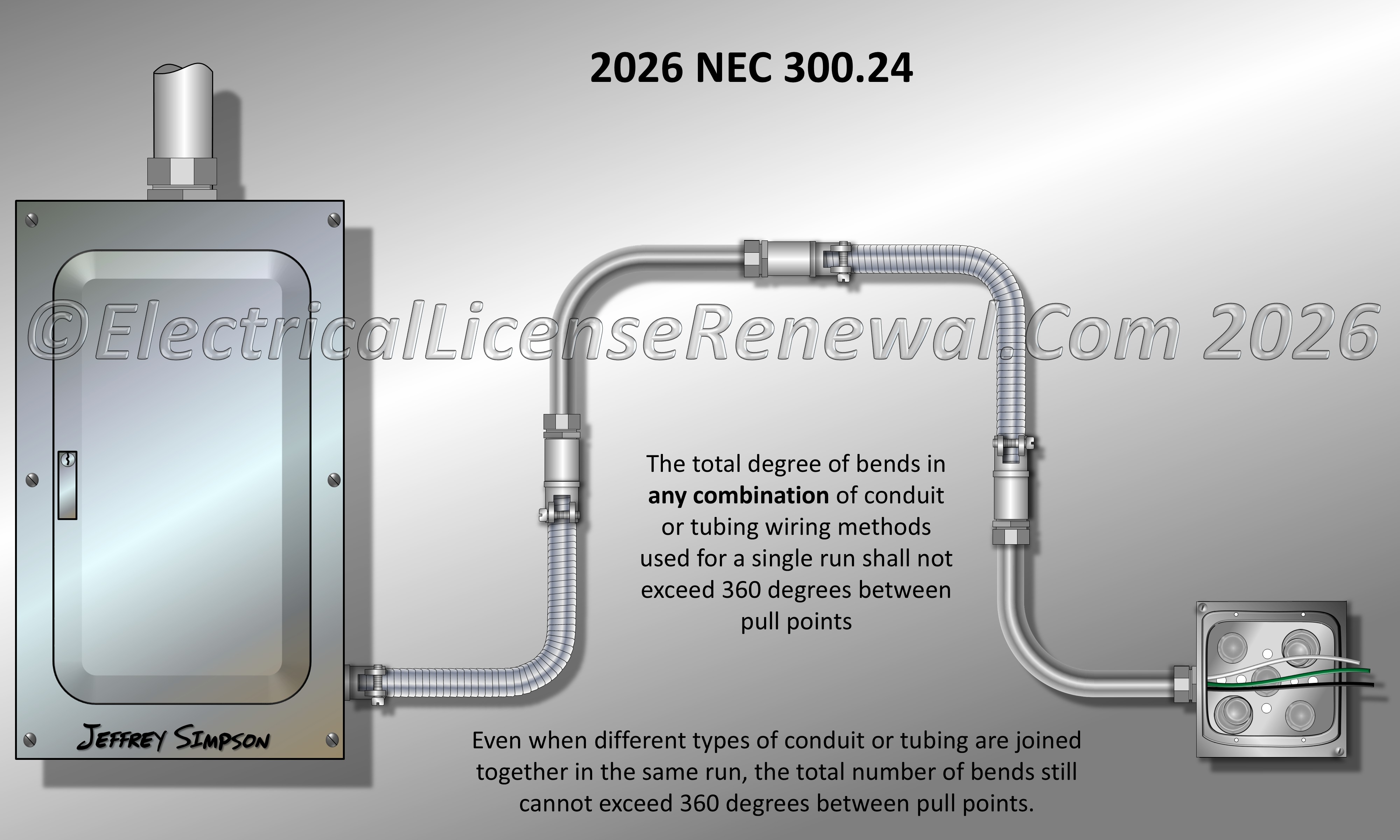
Even when different types of conduit or tubing are joined together in the same run, the total number of bends still cannot exceed 360 degrees between pull points.
Code Change Summary: New Section 300.24 limits the total degree of bends in any combination of conduit or tubing wiring methods for a single run to 360 degrees between pull points.
SME commentary: In the 2026 NEC®, Section 300.24 was added to provide a general rule that applies across all conduit and tubing wiring methods regarding the maximum number of bends permitted between pull points. The new language states that “the total degree of bends in any combination of conduit or tubing wiring methods used for a single run shall not exceed 360 degrees between pull points”.
Prior to the 2026 edition, this requirement was only found within the individual raceway articles in Chapter 3, such as Section 344.24(B) for RMC, 342.24(B) for IMC, and 352.24(B) for PVC conduit. Each of those articles limited the number of bends to 360 degrees between pull points, but the requirement did not exist in Article 300. This created a gap in enforceability when multiple different raceway types were joined together in one continuous run between pull points. Without a general rule, an installer could technically combine a run of RMC with 360 degrees of bends, followed by a run of IMC with another 360 degrees, then continue with a run of PVC conduit with yet another 360 degrees. The result would be a total of 1080 degrees of bends between pull points, which could make wire pulling extremely difficult and lead to conductor insulation or cable jacket damage.
By adding this requirement into Article 300, the NEC® now provides a universal limit that applies generally regardless of the wiring method. This ensures that when different types of conduit or tubing are joined together in the same run, the total number of bends still cannot exceed 360 degrees between pull points. Pull points include boxes, conduit bodies, or other approved fittings where conductors can be accessed. At transition points where a coupling is used to join different wiring methods, no pull point is required, but the cumulative bends must still remain within the 360-degree limit.
The intent of this revision is not to change the existing 360-degree limitation for individual raceways, but rather to extend the same requirement into Article 300 so that it applies more broadly. This general rule enhances enforceability and consistency across the Code, protecting conductors and cables from damage caused by excessive pulling tension or abrasion during installation.
For inspectors and contractors, the addition of Section 300.24 provides a clear reference point and eliminates uncertainty about whether the 360-degree limitation applies when different conduit types are joined in a single run. It ensures safe installation practices are consistently applied, no matter which combination of wiring methods is used.
Below is a preview of the NEC®. See the actual NEC® text at NFPA.ORG for the complete code section. Once there, click on their link to free access to the 2026 NEC® edition of NFPA 70.
2023 Code Language:
This code section did not exist in Article 300.
2026 Code Language:
N 300.24 Bends. The total degree of bends in any combination of conduit or tubing wiring methods used for a single run shall not exceed 360 degrees between pull points.
