300.17(F) Accessibility of Fittings.
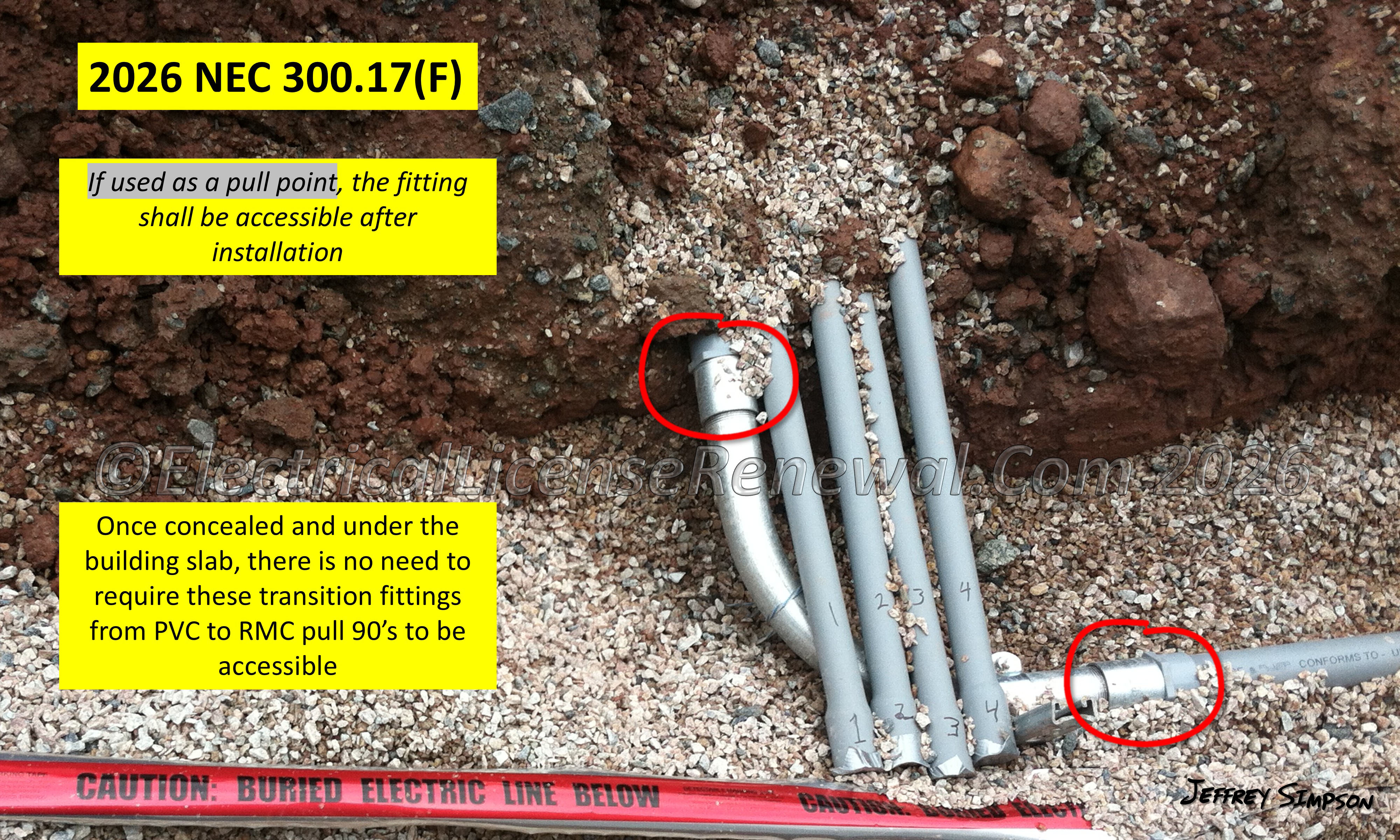
Once concealed and under the building slab, there is no need to require these transition fittings from PVC to RMC pull 90’s to be accessible.
Code Change Summary: Section 300.17(F) was revised to clarify accessibility requirements for fittings used as pull points and to remove unenforceable language.
SME commentary: In the 2026 NEC®, Section 300.17(F) (formerly 300.15(F)) has been clarified to address a potential conflict regarding the accessibility of fittings. The revised language specifies that a fitting used in place of a box or conduit body must be accessible after installation if it is used as a pull point. At the same time, the phrase “unless listed for concealed installation” has been deleted. This change removes language that referenced a type of listing that does not exist in UL 514B, the safety standard governing conduit, tubing, and cable fittings, and that has historically caused confusion and unenforceable requirements.
The practical issue stems from how fittings are used in the field. For example, if a 90-degree fitting is used in a run of flexible metal conduit (FMC) then the FMC 90 must remain accessible after installation since it is used as a pull point to help route conductors through it to their termination. This requirement is sensible since accessibility is directly tied to the intended function of the FMC fitting in that case. By contrast, if a fitting is used only as a transition point, such as an underground elbow transitioning from PVC conduit to rigid metal conduit, once assembled and buried under a building slab, there is no need for post-installation access. Requiring accessibility in such situations created a practical impossibility for installers and inspectors.
The former 2023 NEC® requirement created problems by mandating accessibility for all fittings unless they were “listed for concealment.” Since no fittings carry such a listing, compliance could not be achieved. This led to inconsistent enforcement and confusion in the field. Some inspectors attempted to apply the rule universally, while others recognized the lack of applicable product standards and granted exceptions. By eliminating this language and tying accessibility specifically to the functional use of the fitting as a pull point, the 2026 NEC® corrects the inconsistency and provides inspectors and contractors with clear, enforceable language.
It is important to recognize that this revision does not relax safety. On the contrary, it aligns the Code with product standards and actual installation practices. Fittings used as pull points must remain accessible to ensure conductor installation and maintenance can be performed safely. Where fittings serve only as transition points with no future need for access, they may be installed and left concealed, provided their access is not relied upon for pulling conductors.
This clarification in 300.17(F) improves usability of the NEC® by eliminating a requirement that could not be satisfied and by focusing accessibility where it is truly necessary. Contractors and inspectors should now find consistency in enforcement, while installations will remain both safe and compliant with product listings and NEC® intent.
Below is a preview of the NEC®. See the actual NEC® text at NFPA.ORG for the complete code section. Once there, click on their link to free access to the 2026 NEC® edition of NFPA 70.
2023 Code Language:
300.15(F) Fitting. A fitting identified for the use shall be permitted in lieu of a box or conduit body where conductors are not spliced or terminated within the fitting. The fitting shall be accessible after installation, unless listed for concealed installation.
2026 Code Language:
300.17(F) Fitting. A fitting identified for the use shall be permitted in lieu of a box or conduit body where conductors are not spliced or terminated within the fitting. If used as a pull point, the fitting shall be accessible after installation.
