300.13(E) Cable Ties Used as Means of Securement and Support.
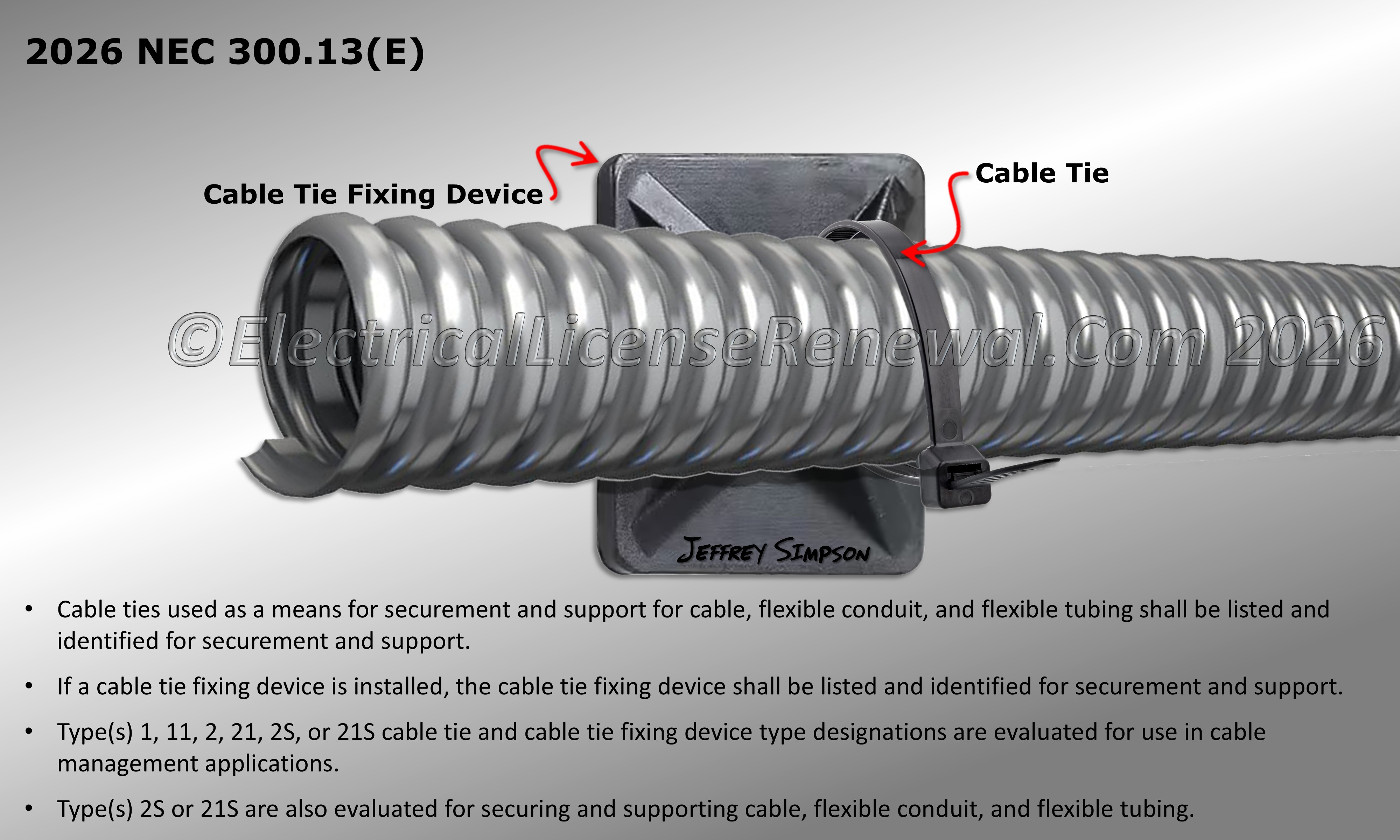
Cable ties and cable tie fixing devices.
Code Change Summary: A new section, 300.13(E), was added to establish requirements for the use of cable ties and cable tie fixing devices as means of securing and supporting wiring methods.
SME commentary: The 2026 NEC® introduces new Section 300.13(E), which provides explicit rules on how cable ties and cable tie fixing devices may be used for securing and supporting wiring methods. Prior to the 2026 NEC®, cable ties were primarily mentioned within specific wiring method articles, with a brief reference in 110.12(C) and another reference in 300.22(C)(1) concerning only the smoke and heat release properties of cable ties. They were not previously addressed in the broader general context of being used as a securing or supporting method for wiring methods.
Under the new language, cable ties used as a means of securement and support for cables, flexible conduit, and flexible tubing must be listed and identified specifically for that purpose. This requirement ensures that only products evaluated for their ability to hold wiring in place under expected environmental and mechanical stresses are permitted for Code-compliant installations. It also provides inspectors with clear authority to require listed cable ties, avoiding the common issue of generic or unlisted ties being used inappropriately.
Section 300.13(E)(2) further addresses cable tie fixing devices. If such a device is installed, it too must be listed and identified for securement and support. This detail is important because fixing devices are often used to anchor cable ties to mounting surfaces, trays, or structural members. Without a requirement for listing, there could be a wide variation in quality and performance, potentially leading to failures in securing critical wiring.
The new informational note accompanying this section clarifies the types of cable ties and fixing devices recognized for Code purposes. Type designations 1, 11, 2, 21, 2S, and 21S are evaluated for cable management applications, while Types 2S and 21S are also evaluated for securing and supporting cable, flexible conduit, and flexible tubing. This distinction is crucial, as it ensures that only the appropriate types are used when the cable tie functions as part of the structural support system rather than merely for bundling or organizing. These markings are typically on the package, not the device, so the inspector will likely ask for the package for verification in the field.
By consolidating these requirements into Article 300, which contains general requirements for wiring methods and materials, the NEC® provides a consistent reference point for Code users. Contractors now have clear direction on when cable ties are acceptable, inspectors have enforceable criteria for approval, and manufacturers are aligned with product standards that match NEC® requirements.
This change raises the bar for safety and reliability by ensuring that cable ties are not treated as generic fasteners but as engineered components subject to the same scrutiny as other securement methods.
Below is a preview of the NEC®. See the actual NEC® text at NFPA.ORG for the complete code section. Once there, click on their link to free access to the 2026 NEC® edition of NFPA 70.
2023 Code Language:
This code section did not exist.
2026 Code Language:
N 300.13(E) Cable Ties Used as Means of Securement and Support.
N (1) Cable Ties. Cable ties used as a means for securement and support for cable, flexible conduit, and flexible tubing shall be listed and identified for securement and support.
N (2) Cable Tie Fixing Devices. If a cable tie fixing device is installed, the cable tie fixing device shall be listed and identified for securement and support.
Informational Note: Types 1, 11, 2, 21, 2S, or 21S cable tie and cable tie fixing device type designations are evaluated for use in cable management applications. Types 2S or 21S are also evaluated for securing and supporting cable, flexible conduit, and flexible tubing.
