300.6(G) Fittings.
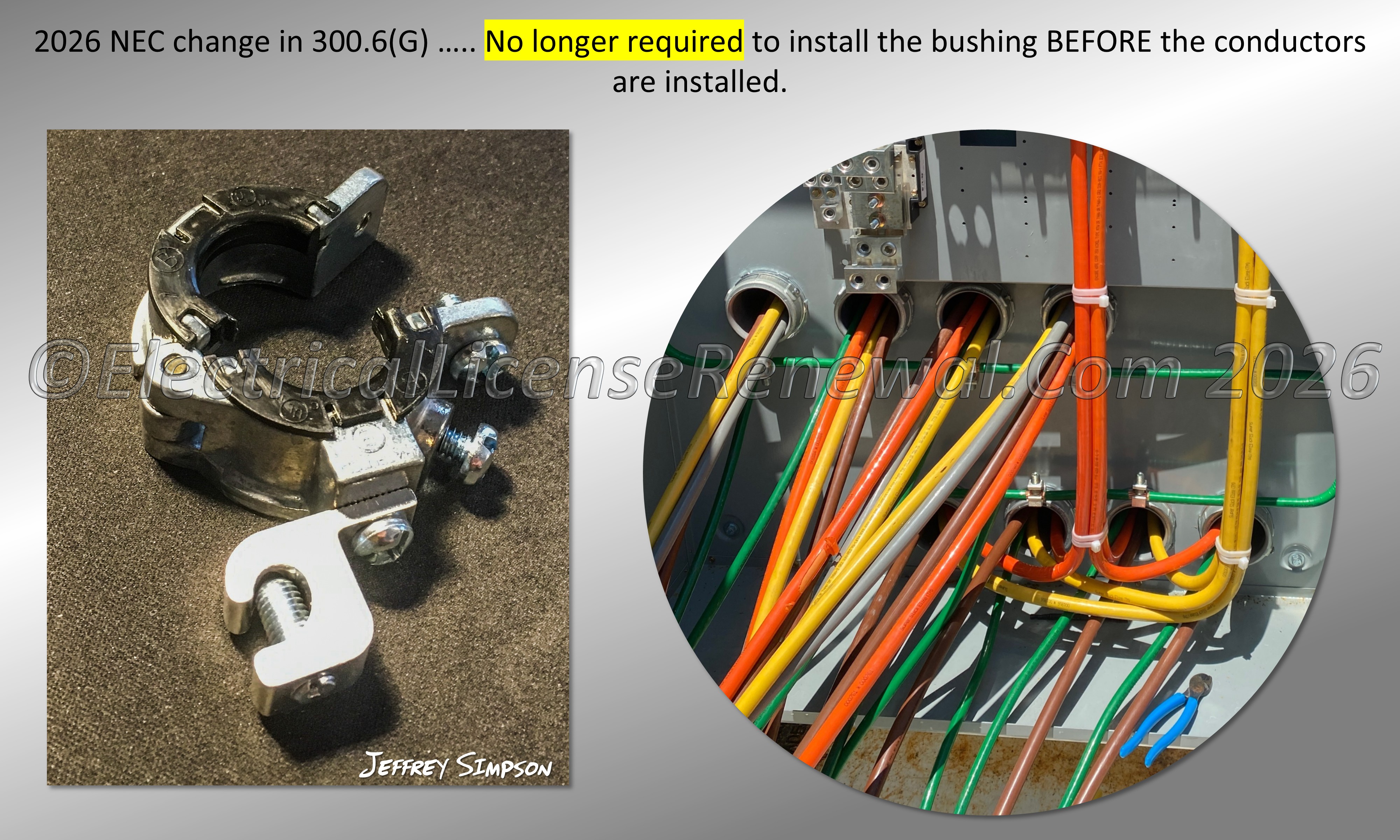
No longer required to install the bushing BEFORE the conductors are installed.
Code Change Summary: The 2026 NEC® deletes the requirement that protective bushings for 4 AWG or larger conductors be installed “prior to the installation of conductors.”
SME commentary: In the 2026 NEC®, Section 300.6(G) modifies the rules for fittings protecting insulated conductors sized 4 AWG and larger as they enter cabinets, boxes, enclosures, or raceways. The key change is the removal of the phrase “prior to the installation of conductors,” which previously mandated that protective bushings be in place before any conductors were pulled. This deletion resolves a practical problem faced by electricians in the field and eliminates language that was unnecessarily restrictive.
Under the 2023 NEC®, inspectors often red-tagged installations if a bushing was not visible before conductors 4 AWG and larger were pulled into the raceway. While the intent of the rule was to ensure that the conductors were protected from abrasion, in practice it created significant challenges, especially when large conductors had already been installed. Before the development of hinged or split bushings, a contractor might have to disconnect and remove all conductors from a termination point in order to slide a bushing over the raceway and then re-terminate the conductors. This process was time-consuming, costly, and created opportunities for damage during rework.
By deleting “prior to the installation of conductors”, the 2026 NEC® allows for flexibility without reducing the level of protection for the conductors. Bushings and other protective fittings are still required, but they may now be installed after conductors are pulled if that is more practical. This change aligns with the reality of field conditions, where mechanical pulling adapters or other equipment may temporarily occupy the raceway opening during conductor installation. These adapters often provide equivalent protection during the pull, and once the pull is complete, a permanent bushing can be installed.
The section continues to identify four acceptable methods for protecting conductors:
(1) An identified fitting with a smoothly rounded insulating surface
(2) A listed metal fitting with smoothly rounded edges
(3) Separating the conductors from the raceway or fitting using identified insulating material that is securely fastened in place
(4) Threaded hubs or bosses that provide a smooth rounded or flared entry for conductors and are integral to a cabinet, box, enclosure, or raceway.
Additional provisions prohibit the use of bushings made entirely of insulating material as the sole means of securing a fitting or raceway, and require that insulating fittings have a temperature rating not less than that of the conductor insulation. These details remain unchanged and preserve the safety intent of the section.
Ultimately, this revision makes the rule more enforceable and realistic by focusing on the outcome rather than the sequence of installation. The NEC’s objective is to ensure conductor protection from abrasion, and that goal is still fully met without mandating that bushings always be in place before a wire pull. The change reflects a balance between safety and practical installation practices, reducing unnecessary rework while maintaining the integrity of the installation.
Below is a preview of the NEC®. See the actual NEC® text at NFPA.ORG for the complete code section. Once there, click on their link to free access to the 2026 NEC® edition of NFPA 70.
2023 Code Language:
300.4(G) Fittings. Where raceways contain 4 AWG or larger insulated circuit conductors, and these conductors enter a cabinet, a box, an enclosure, or a raceway, prior to the installation of conductors, the conductors shall be protected in accordance with any of the following:
See the NEC® for remaining text.
2026 Code Language:
300.6(G) Fittings. Where raceways contain 4 AWG or larger insulated circuit conductors, and these conductors enter a cabinet, a box, an enclosure, or a raceway, the conductors shall be protected in accordance with any of the following:
See the NEC® for remaining text.
