300.4(C) Damaged Conductors and Wiring Methods.
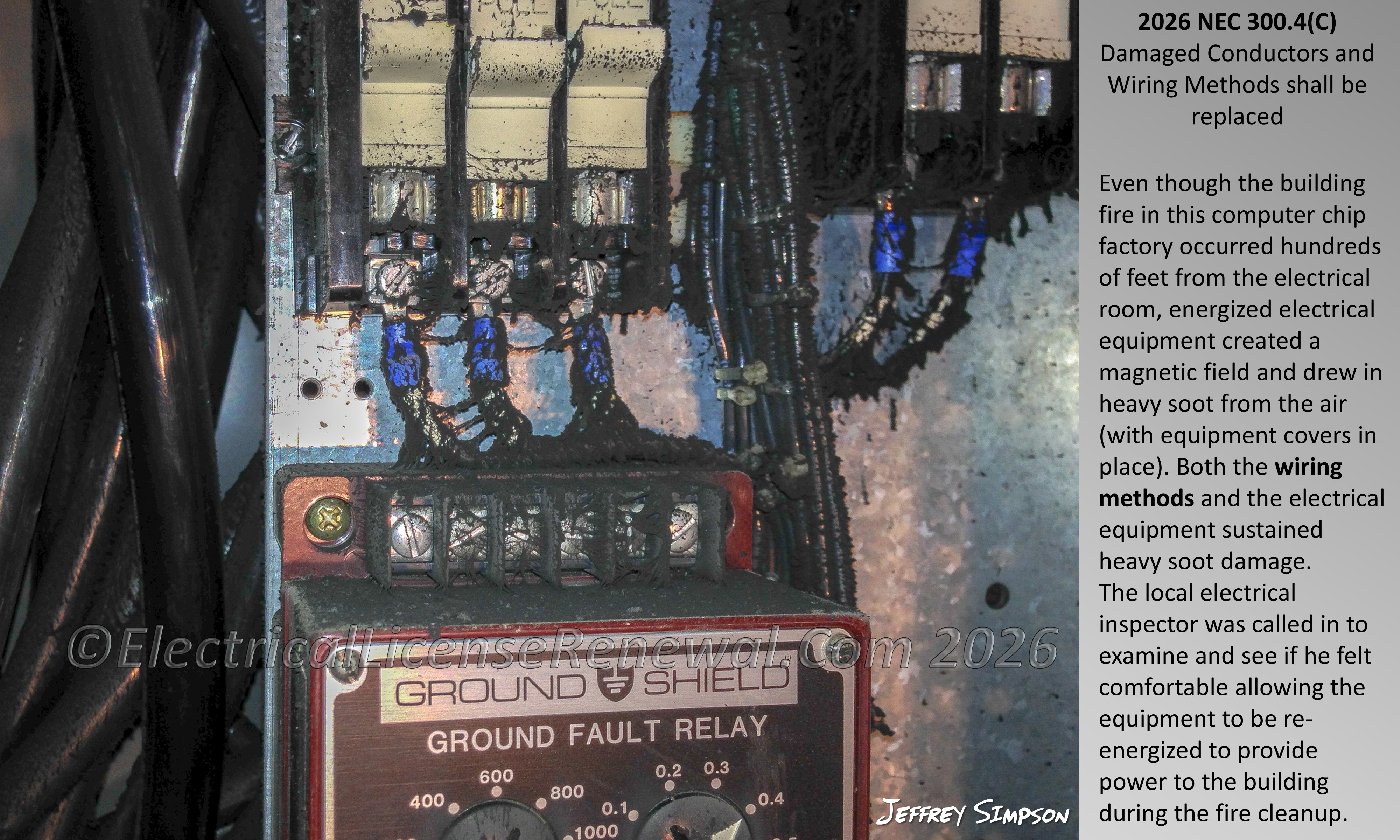
Damaged Conductors and Wiring Methods shall be replaced but at what point are the conductors considered “damaged”?
Code Change Summary: A new section, 300.4(C), was added to require replacement of damaged conductors and wiring methods.
SME commentary: The 2026 NEC® introduces new Section 300.4(C), which directly addresses a gray area in the Code by providing clear language that damaged conductors and wiring methods must be replaced rather than reused. Prior to this addition, the NEC® contained only general provisions, such as 110.7, requiring installations to be free from short circuits, ground faults, or unwanted connections to ground. However, the Code lacked specific enforceable text that authorities having jurisdiction (AHJs) could cite when requiring replacement of wiring compromised by fire, heat, water, or other corrosive influences. This new section fills that void and provides AHJs with solid backing when directing contractors to remove and replace damaged wiring.
The new language is straightforward: “Conductors and wiring methods that are no longer suitable for use due to damage, such as overheating, fire damage, corrosive influences, or water, shall be replaced.” This requirement intends to eliminate any ambiguity and ensure that wiring compromised by environmental or physical conditions is not simply left in place or re-energized without evaluation. The big issue will be determining when conductors or wiring methods are no longer suitable for the intended use due to the extent of the damage.
Two new informational notes accompany this section and point Code users to NEMA guidance documents that provide detailed evaluation procedures. Informational Note No. 1 references NEMA GD-1, which outlines how to evaluate electrical equipment and wiring exposed to water. Flooding, fire-fighting activities, hurricanes, or similar events often contaminate water with chemicals, sewage, oil, or debris, and this contamination can significantly reduce the integrity of wiring insulation and terminations. Saltwater exposure, in particular, is highly destructive because of the conductive and corrosive residues it leaves behind. Equipment re-energized without proper evaluation may fail immediately or degrade over time, creating hidden safety hazards.
Informational Note No. 2 references NEMA GD-2, which provides recommendations for equipment exposed to fire, heat, smoke, or soot. Even fires that occur in areas remote from electrical systems can still result in contamination of wiring. Smoke and soot can travel through a building and deposit conductive and corrosive residues on energized equipment. Fine metal particles within soot can infiltrate windings, contactors, relays, transformers, and similar components, leading to significant damage or eventual failure. This underscores the danger of attempting to reuse conductors or wiring methods once they have been compromised by fire or heat.
Together, these references and the new enforceable language in 300.4(C) provide contractors, inspectors, and design professionals with clarity and consistency. Rather than leaving these determinations to subjective judgment, the NEC® now requires damaged wiring to be replaced and offers widely accepted evaluation resources from NEMA to guide decisions on equipment. This improves uniformity in enforcement, reduces disputes in the field, and most importantly enhances electrical safety by preventing compromised systems from being placed back into service.
Both NEMA publications also distinguish between equipment that can be safely reconditioned and those items that must be replaced. While some listed equipment may be reconditioned under controlled circumstances and approved reconditioning programs, most conductors and wiring methods exposed to water, fire, soot, or corrosive conditions will likely require full replacement. By incorporating these resources and establishing clear enforceable language, the 2026 NEC® takes an important step forward in ensuring the long-term reliability and safety of electrical installations.
Below is a preview of the NEC®. See the actual NEC® text at NFPA.ORG for the complete code section. Once there, click on their link to free access to the 2026 NEC® edition of NFPA 70.
2023 Code Language:
This code section did not exist.
2026 Code Language:
N 300.4(C) Damaged Conductors and Wiring Methods. Conductors and wiring methods that are no longer suitable for use due to damage, such as overheating, fire damage, corrosive influences, or water, shall be replaced.
Informational Note No. 1: See NEMA GD 1-2019, Evaluating Water-Damaged Electrical Equipment, for information on electrical equipment and wiring methods damaged by water.
Informational Note No. 2: See NEMA GD 2-2021, Evaluating Fire- and Heat-Damaged Electrical Equipment, for information on electrical equipment and wiring methods damaged by fire or heat.
