250.118 Types of Equipment Grounding Conductors.
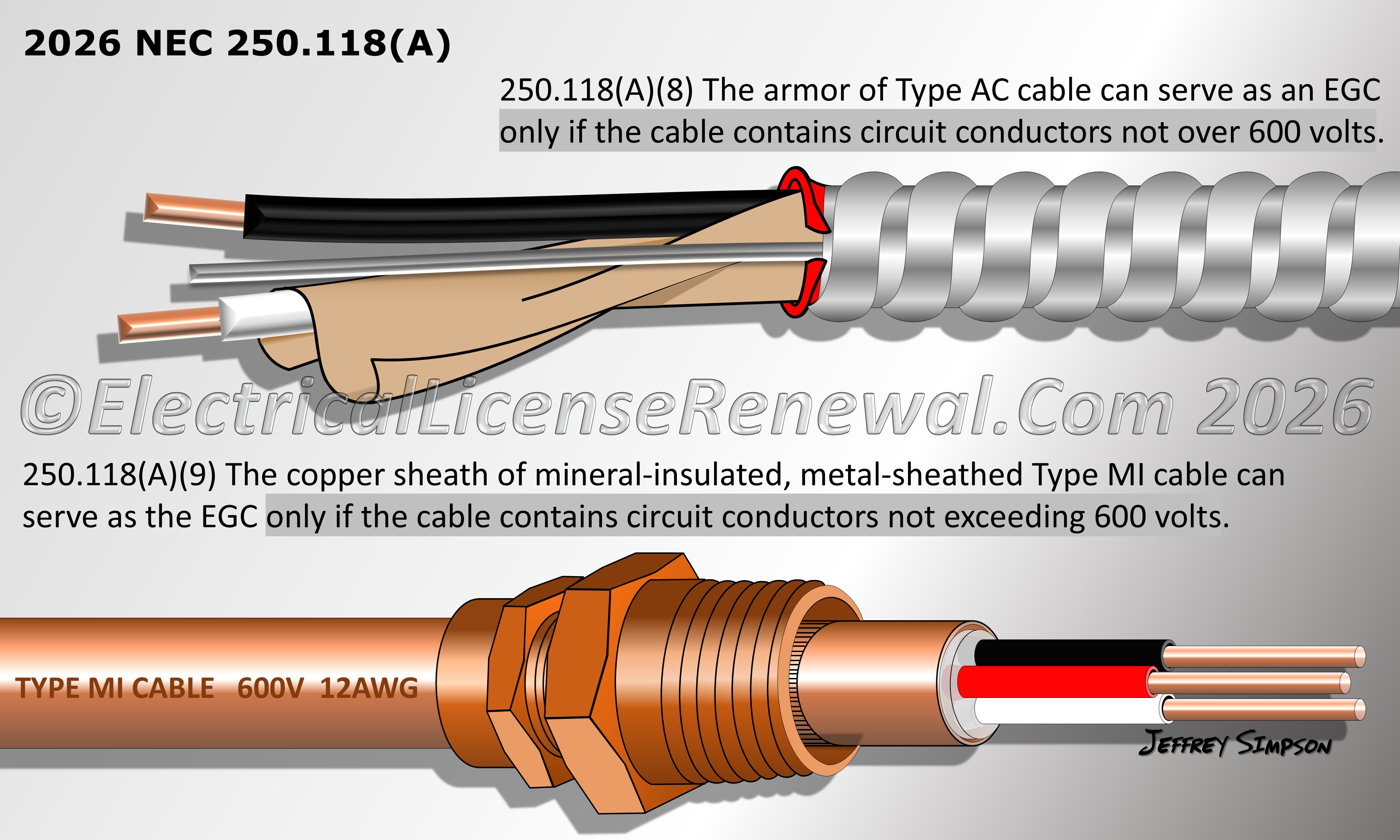
Specific wiring methods can serve as the EGC if used within a certain voltage range.
Code Change Summary: Section 250.118(A) in the 2026 NEC® was revised to specify voltage limitations for certain wiring methods permitted to serve as equipment grounding conductors.
SME commentary: For many code cycles, Section 250.118 has provided the familiar list of wiring methods that may serve as an equipment grounding conductor (EGC). Some of these wiring methods are permitted without further conditions, meaning that if the wiring method is listed in 250.118, it can be used as the EGC for the circuit. Other wiring methods in the list have specific limitations to be able to serve as an EGC, such as maximum raceway length, specific trade sizes, or maximum OCPD size for the contained circuit. In practice, however, product standards and installation requirements have always restricted the circumstances under which certain wiring methods can reliably serve that role. The 2026 NEC® revision to 250.118(A) addresses this by explicitly recognizing the voltage limitations that apply to certain wiring methods in the list.
This change is directly tied to the broader reorganization of grounding and bonding rules in Article 250. With the 2026 NEC® now clarifying that Article 250 only applies to electrical installations of 1000 volts ac or less and 1500 volts dc or less, it became necessary to align 250.118 with the revised scope of the article and to identify which wiring methods are limited to even lower voltages under their product listings. Below are the wiring methods from the list that were affected by the 2026 code change:
250.118(A)(7) Flexible metallic tubing can serve as an EGC if the tubing is terminated in listed fittings and complies with all of the following:
a. The circuit conductors contained in the tubing are protected by OCPDs rated not more than 20 amperes.
b. The combined length of flexible metal conduit, flexible metallic tubing, and liquidtight flexible metal conduit in the same effective ground-fault current path does not exceed 6 feet.
c. The tubing contains circuit conductors not exceeding 1000 volts, nominal.
250.118(A)(8) The armor of Type AC cable can serve as an EGC only if the cable contains circuit conductors not over 600 volts.
250.118(A)(9) The copper sheath of mineral-insulated, metal-sheathed Type MI cable can serve as the EGC only if the cable contains circuit conductors not exceeding 600 volts.
250.118(A) (14) Surface metal raceways listed for grounding and containing circuit conductors not exceeding 600 volts can serve as the EGC.
By adding this language, the NEC® provides needed clarity to designers, installers, and inspectors. Prior to this revision, it was easy to assume that any wiring method listed in 250.118 could serve as an EGC regardless of circuit voltage. In reality, not all wiring methods have been evaluated to function as an EGC above a specified voltage threshold. Without this clarification, installations could inadvertently exceed product ratings, resulting in unsafe equipment grounding paths and failed inspections.
The revised language also reinforces the importance of coordinating NEC® permissions with product safety standards. The NEC® lists wiring methods generally, but the ultimate limitations are often defined by the applicable UL standard. By incorporating voltage limitations from the applicable UL standard directly into 250.118(A), the Code eliminates guesswork and harmonizes its permissions with the underlying acceptable product testing conditions.
In the field, electricians using the wiring method itself as the EGC must now confirm not only that the wiring method is listed in 250.118(A), but also that the circuit voltage does not exceed the specific maximum permitted for that wiring method. This helps ensure that installations remain code-compliant and consistent with tested safety parameters.
Below is a preview of the NEC®. See the actual NEC® text at NFPA.ORG for the complete code section. Once there, click on their link to free access to the 2026 NEC® edition of NFPA 70.
2023 Code Language:
250.118 Types of Equipment Grounding Conductors.
(A) Permitted. Each equipment grounding conductor run with or enclosing the circuit conductors shall be one or more or a combination of the following:
(7) Flexible metallic tubing if the tubing is terminated in listed fittings and meeting the following conditions:
a. The circuit conductors contained in the tubing are protected by overcurrent devices rated at 20 amperes or less.
b. The combined length of flexible metal conduit, flexible metallic tubing, and liquidtight flexible metal conduit in the same effective ground-fault current path does not exceed 6 feet.
(8) Armor of Type AC cable as provided in 320.108.
(9) The copper sheath of mineral-insulated, metal-sheathed cable Type MI.
(14) Surface metal raceways listed for grounding.
2026 Code Language:
250.118 Types of Equipment Grounding Conductors.
(A) Permitted. Each equipment grounding conductor run with or enclosing circuit conductors shall be one or more, or a combination, of the following as part of an effective ground-fault current path:
(7) Flexible metallic tubing if the tubing is terminated in listed fittings and meets the following conditions:
a. The circuit conductors contained in the tubing are protected by OCPDs rated at 20 amperes or less.
b. The combined length of flexible metal conduit, flexible metallic tubing, and liquidtight flexible metal conduit in the same effective ground-fault current path does not exceed 6 feet.
c. The tubing contains circuit conductors not exceeding 1000 volts, nominal.
(8) Armor of Type AC cable as provided in 320.108 containing circuit conductors not exceeding 600 volts, nominal.
(9) The copper sheath of mineral-insulated, metal-sheathed cable Type MI containing circuit conductors not exceeding 600 volts, nominal.
(14) Surface metal raceways listed for grounding and containing circuit conductors not exceeding 600 volts, nominal.
