250.109 Metal and Nonmetallic Enclosures.
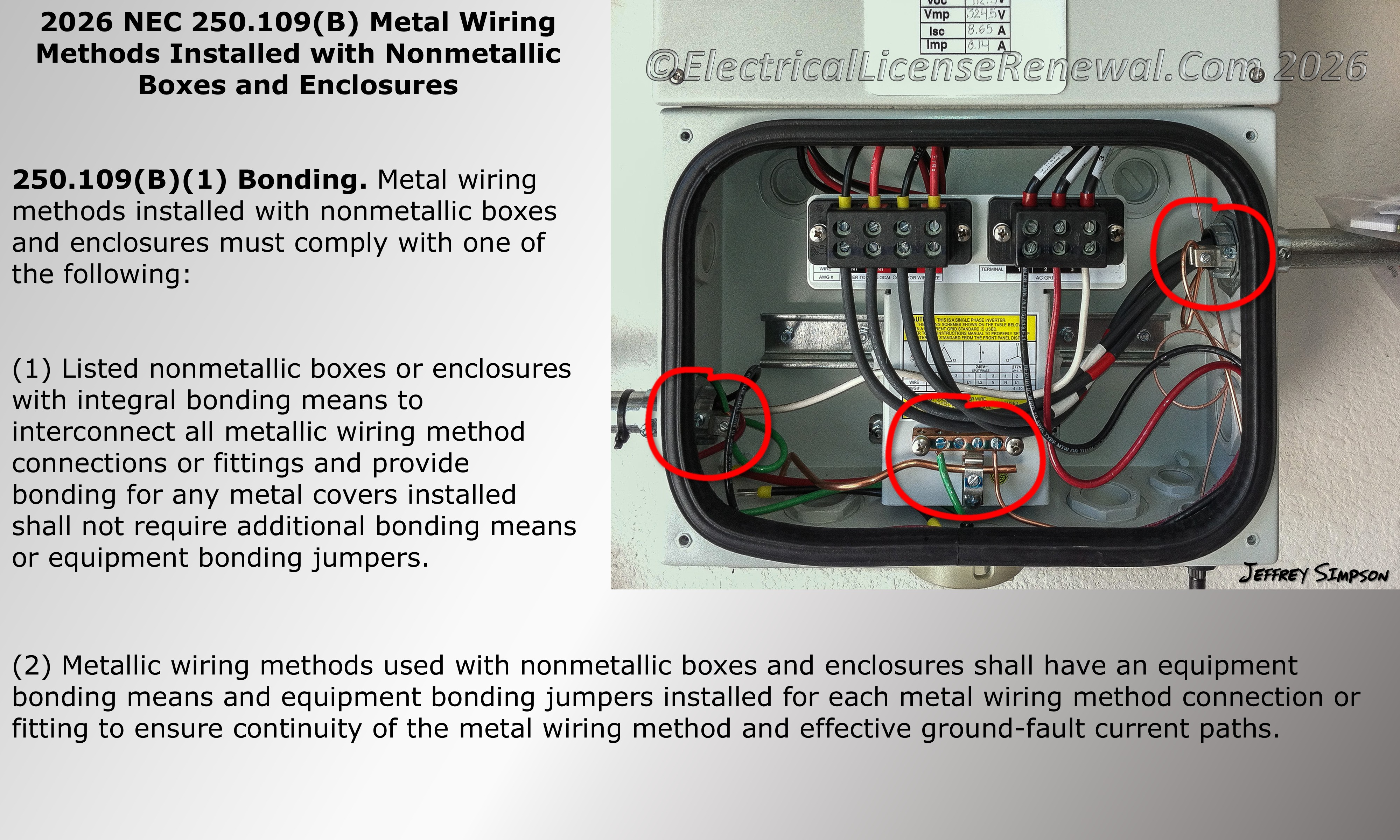
Nonmetallic enclosures (not covered in Article 314) are often used with metallic raceways.
Code Change Summary: Section 250.109 was reorganized into a list format and expanded to include bonding requirements for nonmetallic enclosures when used with metal raceways or cables.
SME commentary: In the 2026 NEC®, Section 250.109 was revised to address a gap in the rules regarding the bonding of nonmetallic enclosures when they are installed with metal raceways or cables. The previous 2023 NEC® language in 250.109 only addressed metal enclosures, allowing them to serve as part of the effective ground-fault current path when properly connected with bonding jumpers or equipment grounding conductors. While this provided clear direction for metallic enclosures, it did not fully address scenarios where nonmetallic enclosures are paired with metallic raceways or cable wiring methods.
With the rapid growth of renewable energy installations and modern electrical systems, nonmetallic enclosures have become increasingly common. For example, photovoltaic inverters, combiner boxes, and energy storage equipment often utilize nonmetallic enclosures. Similarly, nonmetallic enclosures are often encountered in residential and commercial wiring due to cost, corrosion resistance, or manufacturer design. In these cases, the raceway or cable supplying the enclosure is frequently metallic. Without clear NEC® requirements, inspectors and installers faced uncertainty in ensuring the continuity of the equipment grounding path.
The 2026 revision reorganizes Section 250.109 into two subsections: (A) Metal Enclosures and (B) Metal Wiring Methods Installed with Nonmetallic Boxes and Enclosures. Subsection (A) restates the existing requirements for metallic enclosures, but in list format for clarity. The significant change is found in subsection (B), which establishes bonding requirements when nonmetallic boxes and enclosures are installed with metallic raceways or cables.
Under 250.109(B)(1), listed nonmetallic boxes or enclosures with integral bonding means to interconnect all metal wiring method connections or fittings and provide bonding for any metal covers installed shall not be required to have additional bonding means or equipment bonding jumpers installed. For nonmetallic enclosures not listed for this purpose, 250.109(B)(2) requires metal wiring methods used with any nonmetallic boxes or enclosures to have an equipment bonding means and equipment bonding jumpers installed for each metal wiring method connection or fitting to ensure continuity of the metal wiring method and effective ground-fault current paths. An exception is provided to allow no additional bonding for nonmetallic boxes or enclosures supplied by a single metal raceway or single metal armored cable, but only if four specific conditions are met. These include: no other metallic wiring methods are connected to the box or enclosure, the metal wiring method is bonded in accordance with 250.86, installation of a properly sized wire-type equipment grounding conductor or equipment bonding jumper, and compliance with accessibility requirements in 314.29.
This revision eliminates ambiguity by establishing a consistent approach for bonding nonmetallic boxes and enclosures with metallic wiring methods. It ensures that the effective ground-fault current path is maintained regardless of the enclosure material. For installers, the change provides practical solutions that reflect real-world installations. For inspectors, it creates enforceable language to verify continuity of the grounding path without relying on interpretations or provisions outside Article 250.
Below is a preview of the NEC®. See the actual NEC® text at NFPA.ORG for the complete code section. Once there, click on their link to free access to the 2026 NEC® edition of NFPA 70.
2023 Code Language:
250.109 Metal Enclosures. Metal enclosures shall be permitted to be used to connect bonding jumpers or equipment grounding conductors, or both, together to become a part of an effective ground-fault current path. If installed, metal covers, plaster rings, extension rings, and metal fittings shall be attached to these metal enclosures to ensure an effective ground-fault current path or shall be connected with bonding jumpers or equipment grounding conductors, or both.
2026 Code Language:
250.109 Metal and Nonmetallic Enclosures. Metal enclosures shall be permitted as part of the effective ground-fault current path in accordance with 250.109(A). Metal wiring methods used in nonmetallic boxes or enclosures shall be installed in accordance with 250.109(B).
N (A) Metal Enclosures. Metal enclosures shall comply with the following:
(1) Metal enclosures shall be permitted to be used to connect bonding jumpers or equipment grounding conductors, or both, together to become part of an effective ground-fault current path.
(2) If installed, metal covers, plaster rings, extension rings, and metal fittings shall be attached to metal enclosures in a manner that will ensure an effective ground-fault current path or be connected with bonding jumpers or equipment grounding conductors, or both.
N (B) Metal Wiring Methods Installed with Nonmetallic Boxes and Enclosures. Nonmetallic boxes and enclosures installed with metal wiring methods shall comply with 250.109(B)(1) and 250.109(B)(2).
N (1) Bonding. Metal wiring methods installed with nonmetallic boxes and enclosures shall comply with one of the following:
(1) Listed nonmetallic boxes or enclosures with integral bonding means to interconnect all metal wiring method connections or fittings and provide bonding for any metal covers installed shall not be required to have additional bonding means or equipment bonding jumpers installed.
(2) Metal wiring methods used with nonmetallic boxes and enclosures shall have an equipment bonding means and equipment bonding jumpers installed for each metal wiring method connection or fitting to ensure continuity of the metal wiring method and effective ground-fault current paths.
See the actual NEC® for the exception…
