250.94(A) Intersystem Bonding Termination (IBT) Devices.
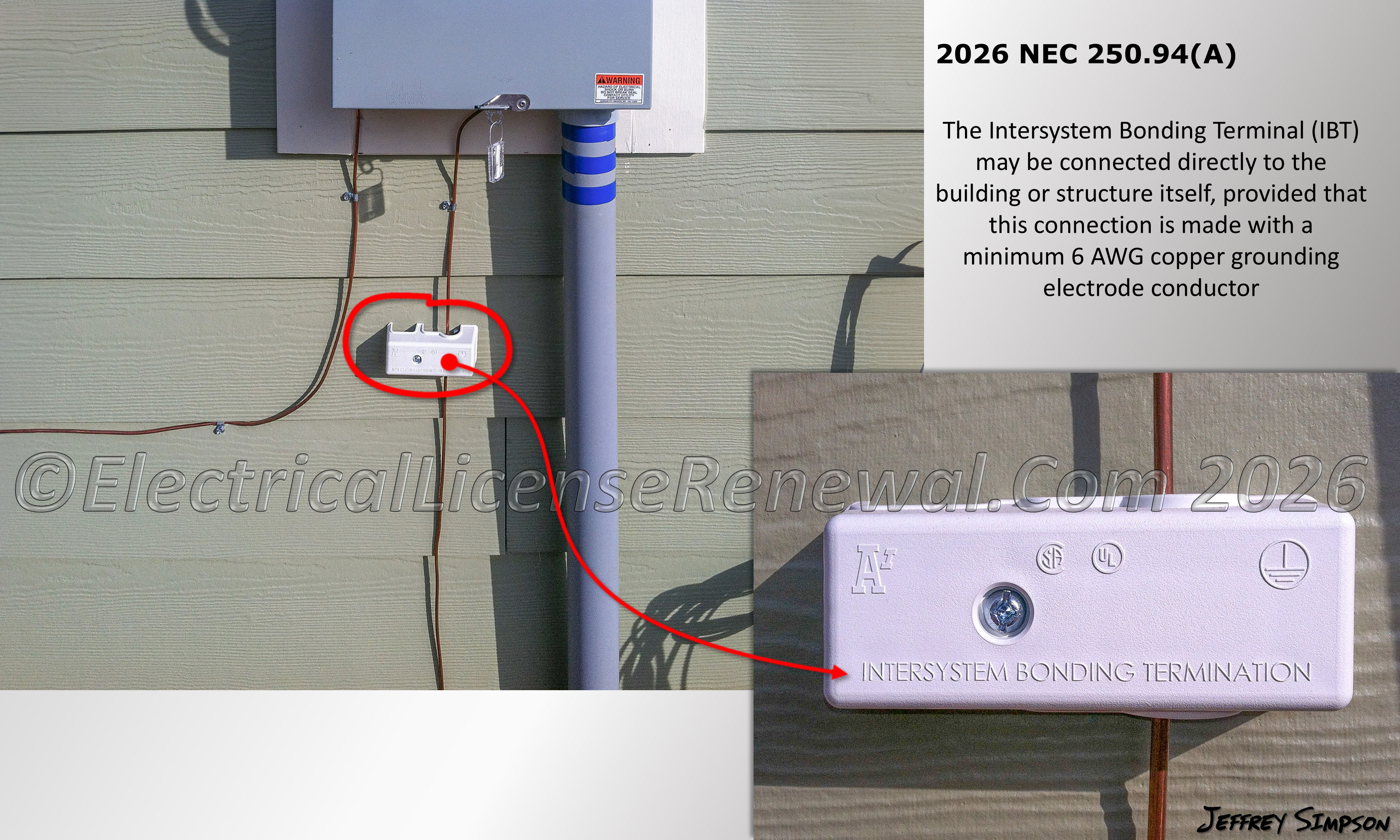
The Intersystem Bonding Terminal (IBT) may be connected directly to the building or structure itself, provided that this connection is made with a minimum 6 AWG copper grounding electrode conductor.
Code Change Summary: Section 250.94(A) was reorganized and revised to permit intersystem bonding terminations (IBTs) to be mounted directly to a building or structure, and to clarify listing requirements for IBTs.
SME commentary: In the 2026 NEC®, Section 250.94(A) underwent both reorganization and clarification that will impact how intersystem bonding terminations (IBTs) are installed and identified for the purpose. While much of the changes appear to be structural, aligning with the NEC® Style Manual, two substantive revisions warrant attention.
Historically, IBT mounting methods primarily involved metallic components such as service equipment enclosures, meter enclosures, disconnect enclosures, exposed nonflexible metal service raceways, or a direct connection to the metal enclosure housing a grounding electrode conductor with a minimum 6 AWG copper conductor. The 2023 NEC® also included an option to mount the IBT “at the service equipment.” While somewhat subjective, this phrase was often interpreted in the field to permit an IBT installed directly on the building wall just below the service enclosure. Together, these provisions ensured that the IBT was mounted in close proximity to service or feeder equipment, maintaining a secure and continuous path for bonding intersystem conductors, typically associated with communication systems.
The 2026 NEC® clarifies these provisions by adding supporting language through a new option: the IBT can now be mounted directly to the building or structure. Specifically, 250.94(A)(4)(a)(v) and 250.94(A)(4)(b)(iii) provide that the IBT may be connected directly to the building or structure itself, provided that this connection is made with a minimum 6 AWG copper grounding electrode conductor. This revision acknowledges that practical jobsite conditions do not always lend themselves to routing IBTs to a convenient metal enclosure or raceway. In many cases, mounting directly to the building surface offers both a structurally sound and code-compliant solution.
Another key revision appears in 250.94(A)(5). Previous editions required IBTs to be listed as grounding and bonding equipment, but some products were evaluated and labeled as “communications” grounding and bonding equipment. The 2026 NEC® resolves this ambiguity by stating that IBTs must be listed as grounding and bonding equipment or as communications grounding and bonding equipment. This subtle clarification is significant. It removes uncertainty for inspectors who may have questioned whether a device labeled strictly for communications bonding complied with Section 250.94. By explicitly recognizing both listing categories, the NEC® ensures consistency in product acceptance while maintaining the safety intent.
The restructuring of 250.94(A) into a clearer list format also aids usability. Each mounting method is now separately itemized, reducing the likelihood of overlooking acceptable options. For example, service equipment, meter enclosures, exposed raceways, and grounding electrode enclosures are each listed distinctly, followed by the new “building or structure” option. This format not only provides clarity for installers but also simplifies inspection.
Below is a preview of the NEC®. See the actual NEC® text at NFPA.ORG for the complete code section. Once there, click on their link to free access to the 2026 NEC® edition of NFPA 70.
2023 Code Language:
250.94(A) The Intersystem Bonding Termination Device. An intersystem bonding termination (IBT) for connecting intersystem bonding conductors shall be provided external to enclosures at the service equipment or metering equipment enclosure and at the disconnecting means for any buildings or structures that are supplied by a feeder or branch circuit. If an IBT is used, it shall comply with the following:
(1) Be accessible for connection and inspection
(2) Consist of a set of terminals with the capacity for connection of not less than three intersystem bonding conductors
(3) Not interfere with opening the enclosure for a service, building or structure disconnecting means, or metering equipment
(4) Be securely mounted as follows:
a. At the service equipment, to a metal enclosure for the service equipment, to a metal meter enclosure, or to an exposed nonflexible metal service raceway, or be connected to the metal enclosure for the grounding electrode conductor with a minimum 6 AWG copper conductor
b. At the disconnecting means for a building or structure that is supplied by a feeder or branch circuit, be electrically connected to the metal enclosure for the building or structure disconnecting means, or be connected to the metal enclosure for the grounding electrode conductor with a minimum 6 AWG copper conductor
(5) Be listed as grounding and bonding equipment
2026 Code Language:
250.94(A) Intersystem Bonding Termination (IBT) Devices. Intersystem bonding termination (IBT) devices for connecting intersystem bonding conductors shall be provided external to enclosures or at service equipment or metering equipment enclosures, provided at the disconnecting means for any buildings or structures that are supplied by a feeder or branch circuit, and comply with the following:
(1) Be accessible for connection and inspection
(2) Consist of a set of terminals with the capacity for connection of not less than three intersystem bonding conductors
(3) Not interfere with opening the enclosure for a service, building or structure disconnecting means, or metering equipment
(4) Be securely mounted as follows:
a. To any of the following at the service equipment:
(i) Metal enclosure for the service equipment
(ii) Metal meter enclosure
(iii) Exposed nonflexible metal service raceway
(iv) Metal enclosure for a grounding electrode conductor with a minimum 6 AWG copper conductor
(v) The building or structure with a minimum 6 AWG copper grounding electrode conductor
b. To any of the following at the disconnecting means for buildings or structures supplied by a feeder or branch circuit:
(i) Metal enclosure for the building or structure disconnecting means
(ii) Metal enclosure for a grounding electrode conductor with a minimum 6 AWG copper conductor
(iii) The building or structure with a minimum 6 AWG copper grounding electrode conductor
(5) Be listed as grounding and bonding equipment or as communications grounding and bonding equipment
