250.64(C) Continuous GEC.
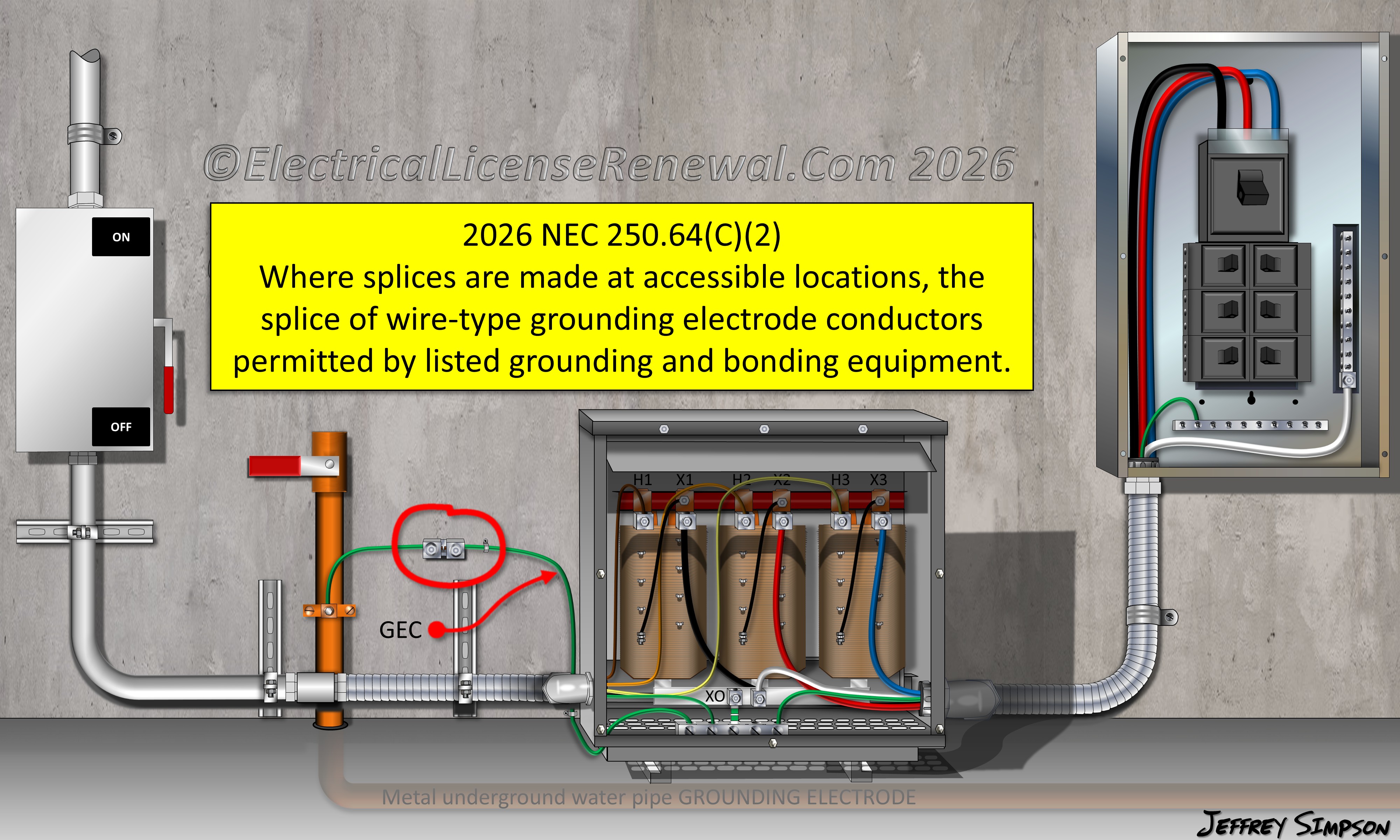
Where splices are made at accessible locations, the splice of wire-type grounding electrode conductors permitted by listed grounding and bonding equipment.
Code Change Summary: The 2026 NEC® revises 250.64(C) to permit additional splicing methods for grounding electrode conductors when made at accessible locations with listed equipment.
SME commentary: Section 250.64(C) has historically required that grounding electrode conductors (GECs) be installed in one continuous length without a splice or joint, except where permitted in specific code sections and by a limited set of prescribed methods. In the 2023 NEC®, the Code permitted splicing of wire-type grounding electrode conductors “if necessary” only by irreversible compression connectors listed as grounding and bonding equipment or by the exothermic welding process. Additional allowances were provided for busbar sections, structural metal frame connections, and metal water piping connections. The driving intent of these restrictions was to maintain reliability of the grounding electrode system by ensuring the conductor was not compromised by weak points introduced through splicing.
However, during the 2026 NEC® development cycle, several public inputs challenged the necessity of treating the GEC with stricter splicing requirements than other conductors that serve equally or more critical functions in the effective ground-fault current path (as defined in Article 100). Equipment grounding conductors, bonding jumpers, and other components of the ground-fault-return path are permitted to be spliced by a variety of listed means, without the same limitation of irreversibly splicing or exothermic welding. This raised the question: if splicing by using listed equipment is acceptable for conductors that will carry actual ground-fault current, why should the GEC, which is technically not part of the effective ground-fault current path, be subjected to a stricter requirement?
In response, the 2026 NEC® deletes the words “if necessary” and introduces a new allowance in 250.64(C)(2). The revision specifies that where splices of wire-type grounding electrode conductors are made at accessible locations, they are permitted if accomplished by listed grounding and bonding equipment. This addition does not eliminate the original methods but expands the options for installers, aligning GEC splicing rules more closely with other bonding and grounding conductors. Importantly, the requirement for accessibility ensures that any such splice can be inspected and verified for compliance, preserving confidence in the integrity of the grounding electrode system.
The change is also supported by historical context. In early wiring systems, metallic water piping was commonly used as a ground-fault current path, continuity of the GEC to the water piping without splices was considerably more critical. Today’s wiring systems are different. An “effective ground-fault current path” is required and can be established by many parallel components, including raceways, fittings, and busbars, reducing the singular importance of the GEC as it was once conceived. Modern listed connectors and bonding equipment are engineered and tested to provide reliable mechanical and electrical performance, eliminating the need for overly restrictive splicing limitations.
For electricians and inspectors, the 2026 revision provides clarity and flexibility. Installers now have more options when routing GECs around obstructions or when conductors must be extended, provided the splice is made in an accessible location and with listed equipment. Inspectors gain clear authority to verify such installations without ambiguity. The overall effect is to harmonize requirements, reduce unnecessary limitations, and recognize that modern listed connectors are capable of maintaining the reliability essential to the grounding electrode system.
Below is a preview of the NEC®. See the actual NEC® text at NFPA.ORG for the complete code section. Once there, click on their link to free access to the 2026 NEC® edition of NFPA 70.
2023 Code Language:
250.64(C) Continuous. Except as provided in 250.30(A)(5) and (A)(6), 250.30(B)(1), and 250.68(C), grounding electrode conductor(s) shall be installed in one continuous length without a splice or joint. If necessary, splices or connections shall be made as permitted in the following:
(1) Splicing of the wire-type grounding electrode conductor shall be permitted only by irreversible compression-type connectors listed as grounding and bonding equipment or by the exothermic welding process.
(2) Sections of busbars shall be permitted to be connected together to form a grounding electrode conductor.
(3) Bolted, riveted, or welded connections of structural metal frames of buildings or structures.
(4) Threaded, welded, brazed, soldered or bolted-flange connections of metal water piping.
2026 Code Language:
250.64(C) Continuous. Except as provided in 250.30(A)(5), 250.30(A)(6), 250.30(B)(1), and 250.68(C), grounding electrode conductors shall be installed in one continuous length without splices or joints. Splices or connections shall be permitted to be made by any of the following:
(1) Splicing of wire-type grounding electrode conductors permitted by irreversible compression-type connectors listed as grounding and bonding equipment or by the exothermic welding process
(2) Where splices are made at accessible locations, the splice of wire-type grounding electrode conductors permitted by listed grounding and bonding equipment.
(3) Sections of busbars permitted to be connected together to form grounding electrode conductors
(4) Bolted, riveted, or welded connections of structural metal frames of buildings or structures
(5) Threaded, welded, brazed, soldered or bolted-flange connections of metal water piping
