700.28 Selective Coordination.
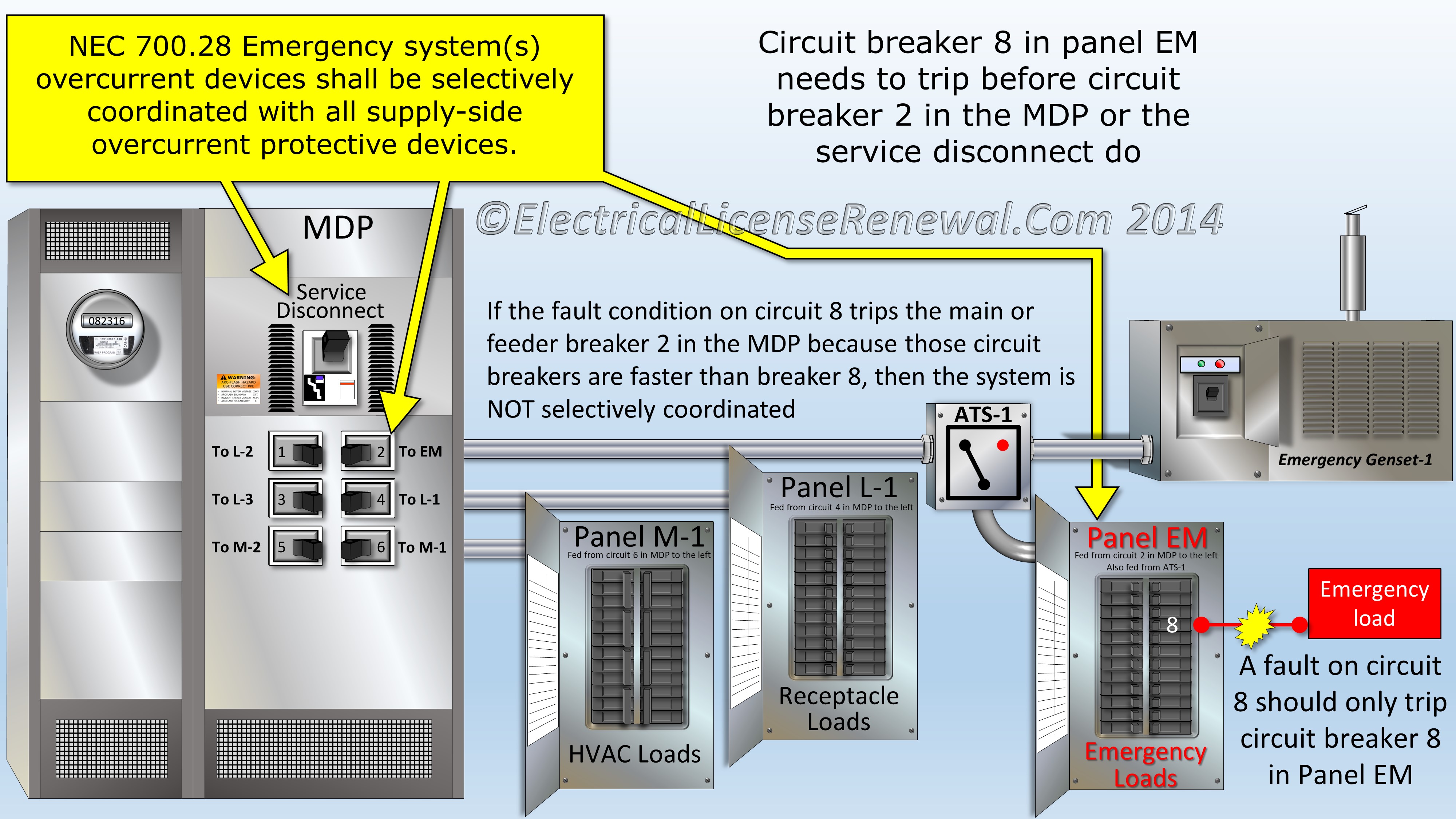
Code Change Summary: The selective coordination requirements in Article 700 have been expanded.
The previous selective coordination requirements located in 700.27 have been modified and moved to 700.28. As well, selective coordination is now required to be chosen by a licensed professional engineer or other qualified persons engaged primarily in the design, installation, or maintenance of electrical systems.
In the NEC®, there are only a small handful of places where selective coordination is required at all. Placing the responsibility of selective coordination in the hands of electrical design professionals will ensure a safer environment and continuity of operations where it matters most.
Two overcurrent devices are selectively coordinated when the downstream overcurrent device closest to the fault opens before the upstream overcurrent device can.
A faulty coffee pot in the break room of a hospital should only trip the 20-amp branch circuit breaker directly ahead of it in the electric panel rather than causing the main 200-amp breaker protecting the entire panelboard to trip. Poor coordination could potentially and unnecessarily shut down all loads supplied from the panel. If critical loads serving patient rooms are shut down unnecessarily because of poor coordination between overcurrent devices, then patients are at risk.
Below is a preview of the NEC®. See the actual NEC® text at NFPA.ORG for the complete code section. Once there, click on the “free access” tab and select the applicable year of NFPA 70 (National Electrical code).
2011 Code Language:
700.27 Coordination. Emergency system(s) overcurrent devices shall be selectively coordinated with all supply side overcurrent protective devices.
Exception: Selective coordination shall not be required between two overcurrent devices located in series if no loads are connected in parallel with the downstream device.2014 Code Language:
700.28 Selective Coordination. Emergency system(s) overcurrent devices shall be selectively coordinated with all supply-side overcurrent protective devices.
Selective coordination shall be selected by a licensed professional engineer or other qualified persons engaged primarily in the design, installation, or maintenance of electrical systems. The selection shall be documented and made available to those authorized to design, install, inspect, maintain, and operate the system.
Exception: Selective coordination shall not be required between two overcurrent devices located in series if no loads are connected in parallel with the downstream device.
