230.95 Ground-Fault Protection of Equipment (GFPE).
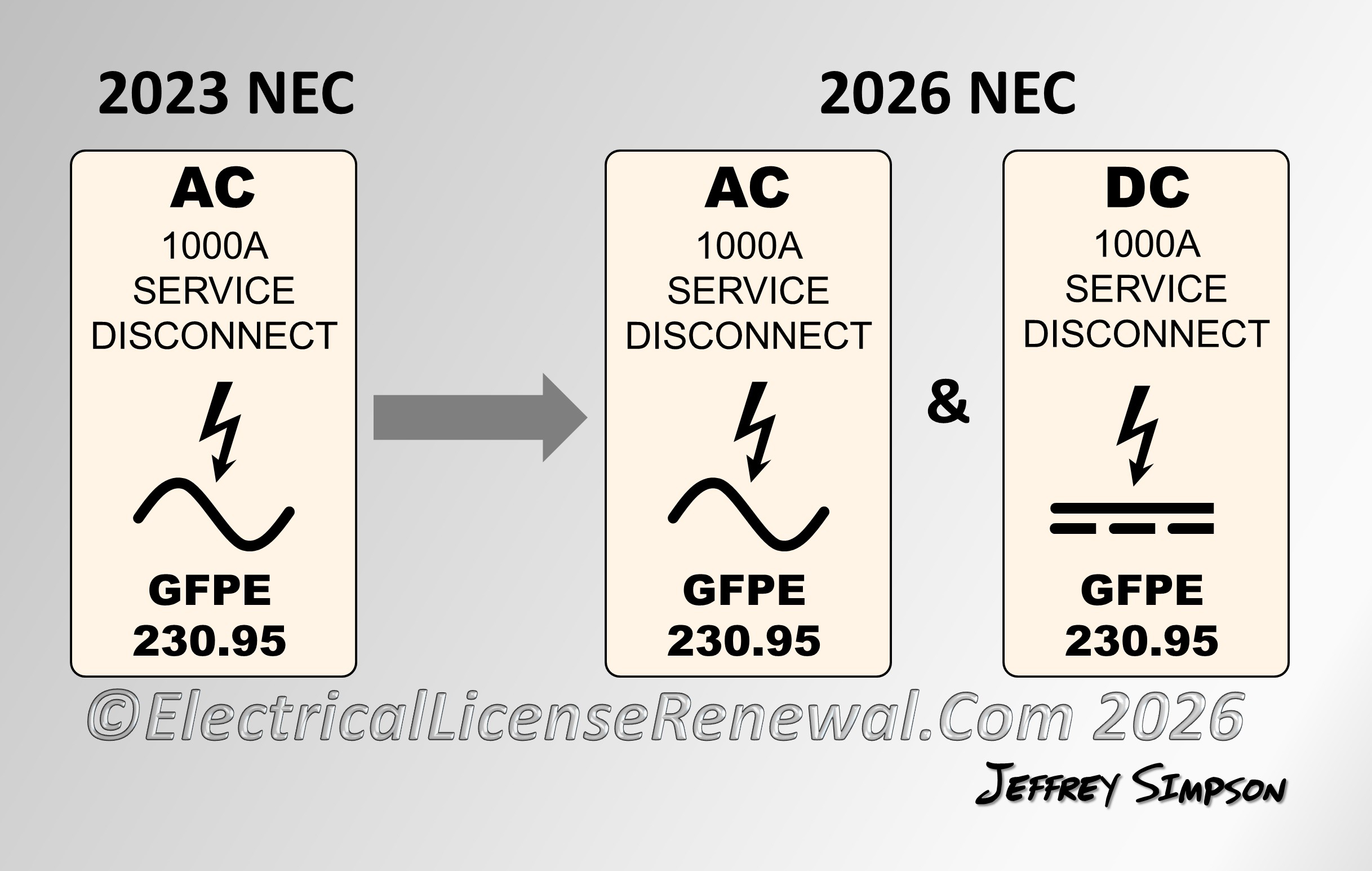
DC GFPE is required in the 2026 NEC.
Code Change Summary: The 2026 NEC® expands 230.95 to require ground-fault protection of equipment (GFPE) for certain solidly grounded DC electrical systems in addition to AC systems.
SME commentary: For decades, Section 230.95 has required ground-fault protection of equipment on large AC services because of the danger that a ground fault can escalate into a destructive arcing event. Under the 2023 NEC®, the requirement applied only to solidly grounded wye AC systems of more than 150 volts to ground but not exceeding 1000 volts phase-to-phase where the service disconnect was rated 1000 amperes or more. The 2026 NEC® continues that requirement in 230.95 under subdivision (A), while adding a new subdivision (B) that extends GFPE to solidly grounded DC services. Similar changes occurred in 210.13 for branch circuits, 215.10 for feeders, and 240.13 for overcurrent protection in general.
The expansion to DC addresses a significant gap in the Code. Ground faults and the resulting arcing faults are not limited to AC. In fact, the hazards can be more severe in DC systems because the waveform lacks a natural zero-crossing point that would otherwise help extinguish an arc. Once a ground fault evolves into an arc on a DC system, it can persist longer and release more destructive energy. With the growing use of higher-voltage DC distribution in buildings and campuses, the NEC® recognized the need to apply the same level of protection.
Subdivision (B) of the new rule in 230.95 requires GFPE for “solidly grounded dc electric services of more than 150 volts to ground but not exceeding 1500 volts dc line-to-line for each service disconnect rated 1000 amperes or more”. This upper limit of 1500 volts DC reflects the system voltages now seen in large-scale solar, battery energy storage, and DC microgrids. It aligns the NEC® with global practices that recognize 1500 volts DC as a common maximum for building-integrated and utility-scale applications.
Several high-profile demonstration projects have shown how DC distribution is being used in real-world infrastructure. The U.S. Department of Energy’s Grid-interactive Efficient Buildings initiative promotes hybrid AC/DC distribution to optimize building loads. Purdue University’s DC Nanogrid House demonstrates the energy savings and resilience benefits of an all-DC retrofit in a residential setting. Similarly, Vermont’s Salisbury Square community is being developed with a DC microgrid that can provide islanded operation during outages. These examples illustrate that DC is not a theoretical alternative but an emerging complement to conventional AC systems.
The technical requirements for DC GFPE in 230.95(B) mirror those for AC: the grounded conductor must be connected directly to ground through a grounding electrode system in accordance with 250.50, without inserting any resistor or impedance device. The service disconnect rating is defined the same way as in AC systems, based on the largest fuse that can be installed or the highest continuous current trip setting of the installed overcurrent device. As in AC applications, an exception is included for certain continuous industrial processes where a nonorderly shutdown could introduce additional hazards.
In practice, this change will create a demand for listed DC-rated GFPE devices suitable for service equipment. Installers and inspectors must be aware that existing AC GFPE products may not be appropriate for use on DC systems. Manufacturers will need to supply devices specifically tested and listed for DC applications at service-level fault currents and voltages.
The inclusion of DC in 230.95 is a forward-looking step that ensures the Code keeps pace with the diversification of building power systems. By closing this gap, the 2026 NEC® ensures that both AC and DC services above 150 volts to ground receive equivalent protection against damaging ground faults and arcing events.
Below is a preview of the NEC®. See the actual NEC® text at NFPA.ORG for the complete code section. Once there, click on their link to free access to the 2026 NEC® edition of NFPA 70.
2023 Code Language:
230.95 Ground-Fault Protection of Equipment. Ground-fault protection of equipment shall be provided for solidly grounded wye electric services of more than 150 volts to ground but not exceeding 1000 volts phase-to-phase for each service disconnect rated 1000 amperes or more. The grounded conductor for the solidly grounded wye system shall be connected directly to ground through a grounding electrode system, as specified in 250.50, without inserting any resistor or impedance device.
The rating of the service disconnect shall be considered to be the rating of the largest fuse that can be installed or the highest continuous current trip setting for which the actual overcurrent device installed in a circuit breaker is rated or can be adjusted.
Exception: The ground-fault protection provisions of this section shall not apply to a service disconnect for a continuous industrial process where a nonorderly shutdown will introduce additional or increased hazards.
2026 Code Language:
230.95 Ground-Fault Protection of Equipment.
N (A) Solidly Grounded Wye Electrical Systems. GFPE shall be provided for solidly grounded wye electric services of more than 150 volts to ground but not exceeding 1000 volts phase-to-phase for each service disconnect rated 1000 amperes or more. The grounded conductor for the solidly grounded wye system shall be connected directly to ground through a grounding electrode system, as specified in 250.50, without inserting any resistor or impedance device.
The rating of the service disconnect shall be considered the rating of the largest fuse that can be installed or the highest continuous current trip setting for which the actual OCPD installed in a circuit breaker is rated or can be adjusted.
Exception: The ground-fault protection requirements of this section shall not apply to a service disconnect for a continuous industrial process where a nonorderly shutdown will introduce additional or increased hazards.
N (B) Solidly Grounded dc Electrical Systems. GFPE shall be provided for solidly grounded dc electric services of more than 150 volts to ground but not exceeding 1500 volts dc line-to-line for each service disconnect rated 1000 amperes or more. The grounded conductor for the solidly grounded dc system shall be connected directly to ground through a grounding electrode system, as specified in 250.50, without inserting any resistor or impedance device.
The rating of the service disconnect shall be considered the rating of the largest fuse that can be installed or the highest continuous current trip setting for which the actual OCPD installed in a circuit breaker is rated or can be adjusted.
Exception: The ground-fault protection requirements of this section shall not apply to a service disconnect for a continuous industrial process where a nonorderly shutdown will introduce additional or increased hazards.
