230.85 Deletion of Emergency Dicsonnects.
Even though 230.85 was deleted in the 2026 NEC, the intent of the requirements still continue on in revised 230.70.
Code Change Summary: Section 230.85 on emergency disconnects for one- and two-family dwellings has been deleted, and the requirements have been incorporated into revised Section 230.70.
SME commentary: Since the 2020 NEC®, one- and two-family dwelling units have been required to have an emergency disconnect located outside and readily accessible. This provision was added to provide first responders with a means to quickly and safely de-energize a dwelling from outside the structure. While the safety intent was clear, the specific code language in 230.85 created ongoing debate, and revisions were made in both the 2020 and 2023 editions. By the 2026 NEC®, after many public inputs, the Code-Making Panel determined that the best way to resolve continuing confusion was to delete 230.85 entirely and consolidate the requirements into Section 230.70, which provides general requirements on service disconnecting means.
The deletion of 230.85 did not eliminate the need for exterior disconnects at one- and two-family dwellings. Instead, the 2026 NEC® provides a more direct requirement in 230.70(A)(1). Service disconnects for these dwellings must now be installed in a readily accessible outdoor location, either on the dwelling itself or within sight of the dwelling. This change provides clarity by making the requirement part of the general service disconnect rules rather than leaving it as a stand-alone section. It also ensures consistency across the Code, since 230.70 already addresses location, marking, and replacement of service disconnects.
The panel explained that the 2023 requirements in 230.85 led to uncertainty regarding what types of equipment qualified as acceptable emergency disconnects. Installers and inspectors questioned whether meter disconnects, circuit breakers, or transfer switches could meet the requirement. There was also confusion over grounding and bonding requirements when emergency disconnects were installed on the supply side of the service disconnecting means, raising questions about protection from available fault current. These issues made enforcement difficult and created inconsistent interpretations across jurisdictions.
By moving the requirement into 230.70, the 2026 NEC® simplifies compliance. Rather than referencing a separate emergency disconnect section, electricians now follow the general service disconnect requirements in one location. For one- and two-family dwellings, the service disconnect must now be in a readily accessible outdoor location, either on the dwelling unit or within sight of the dwelling unit. The service disconnect will also serve as the emergency disconnect. This approach eliminates ambiguity over what equipment may be used, ensures proper grounding and bonding under Article 250, and provides first responders with a clearly identified disconnecting means in emergencies.
The deletion of 230.85 and the relocation of its requirements into Section 230.70 represent a streamlining of the Code. The substantive safety intent remains intact: one- and two-family dwellings must have an outdoor, readily accessible service disconnect either on the dwelling or within sight of the dwelling. The revision reduces confusion, improves usability, and enhances enforcement by consolidating all service disconnecting rules into one section. This change strengthens Code clarity while maintaining critical safety for both building occupants and emergency personnel.
Below is a preview of the NEC®. See the actual NEC® text at NFPA.ORG for the complete code section. Once there, click on their link to free access to the 2026 NEC® edition of NFPA 70.
2023 Code Language:
230.70(A) Location. The service disconnecting means shall be installed in accordance with 230.70(A)(1), (A)(2), and (A)(3).
(1) Readily Accessible Location. The service disconnecting means shall be installed at a readily accessible location either outside of a building or structure or inside nearest the point of entrance of the service conductors.
(2) Bathrooms. Service disconnecting means shall not be installed in bathrooms.
(3) Remote Control. Where a remote control device(s) is used to actuate the service disconnecting means, the service disconnecting means shall be located in accordance with 230.70(A)(1).
2026 Code Language:
230.85 Emergency Disconnects. (Deleted in 2026)
230.70(A) Service Disconnect Location. The service disconnecting means shall be installed in accordance with 230.70(A)(1) through 230.70(A)(3).
(1) One- and Two-Family Dwellings. Service disconnects shall be installed in a readily accessible outdoor location in accordance with one of the following:
(1) On the dwelling unit
(2) Within sight of the dwelling unit in accordance with 110.29
Exception: The service disconnect shall not be required to be installed on or within sight of the dwelling unit when an emergency disconnect is installed in accordance with 225.41.
(2) Other than One- and Two-Family Dwellings. Service disconnects shall be installed in a readily accessible location either outside of a building or structure or inside nearest the point of entrance of the service conductors.
(3) Bathrooms. Service disconnecting means shall not be installed in bathrooms.
230.70(B) Service Disconnect Marking. Service disconnects shall be marked in accordance with 230.70(B)(1) and 230.70(B)(2).
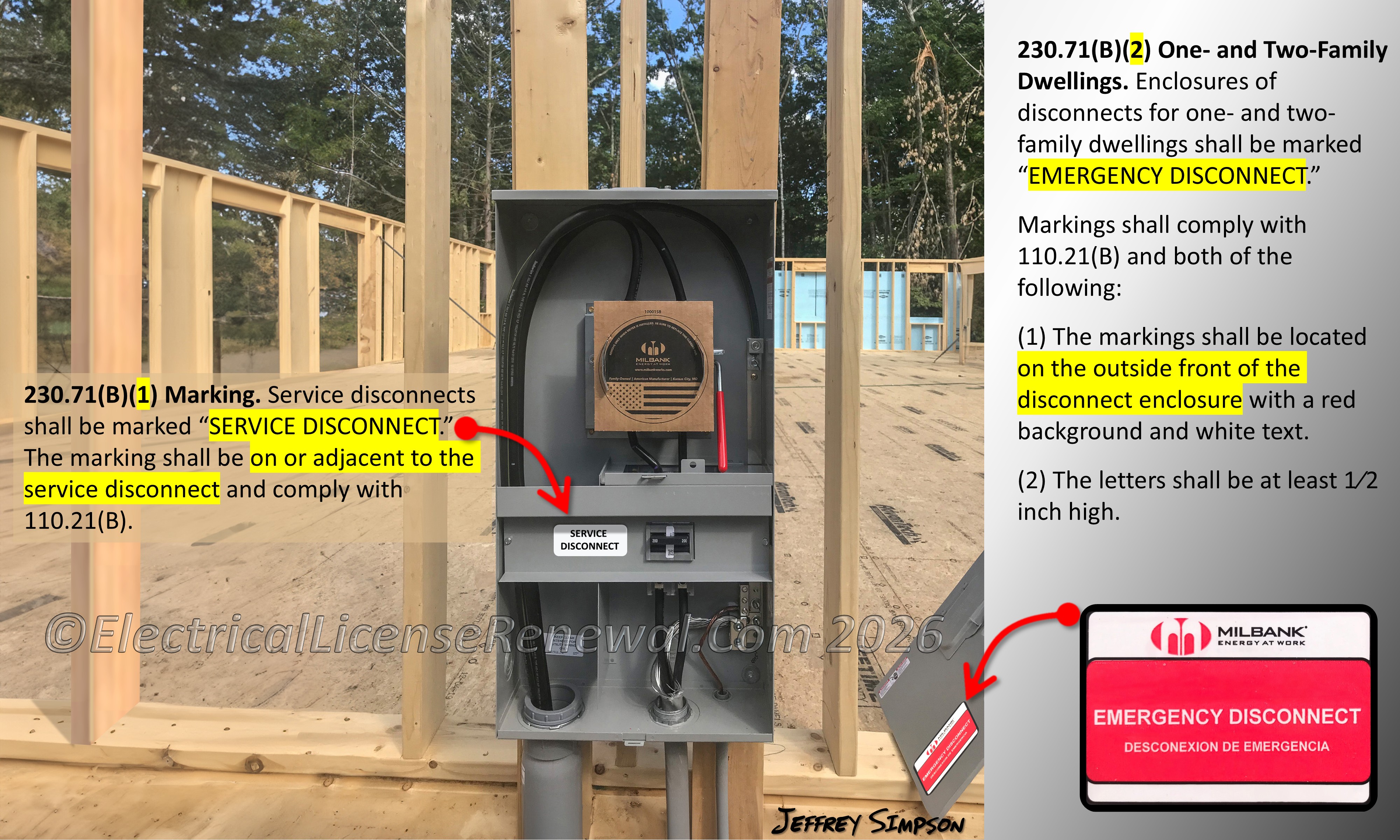
N (1) Marking. Service disconnects shall be marked “SERVICE DISCONNECT.” The marking shall be on or adjacent to the service disconnect and comply with 110.21(B).
N (2) One- and Two-Family Dwellings. Enclosures of disconnects for one- and two-family dwellings shall be marked “EMERGENCY DISCONNECT.”
Markings shall comply with 110.21(B) and both of the following:
(1) The markings shall be located on the outside front of the disconnect enclosure with a red background and white text.
(2) The letters shall be at least 13mm (1⁄2 in.) high.
N 230.70(E) Replacement. Replacement of service equipment for one- and two- family dwellings shall comply with 230.70(A), 230.70(B), and 230.70(C).
Exception: If only meter sockets, service entrance conductors, or related raceways and fittings are replaced, the requirements 230.70(A)(1) and 230.70(B)(2) shall not apply.
