230.70(A)&(B) Service Disconnect Location and Marking.
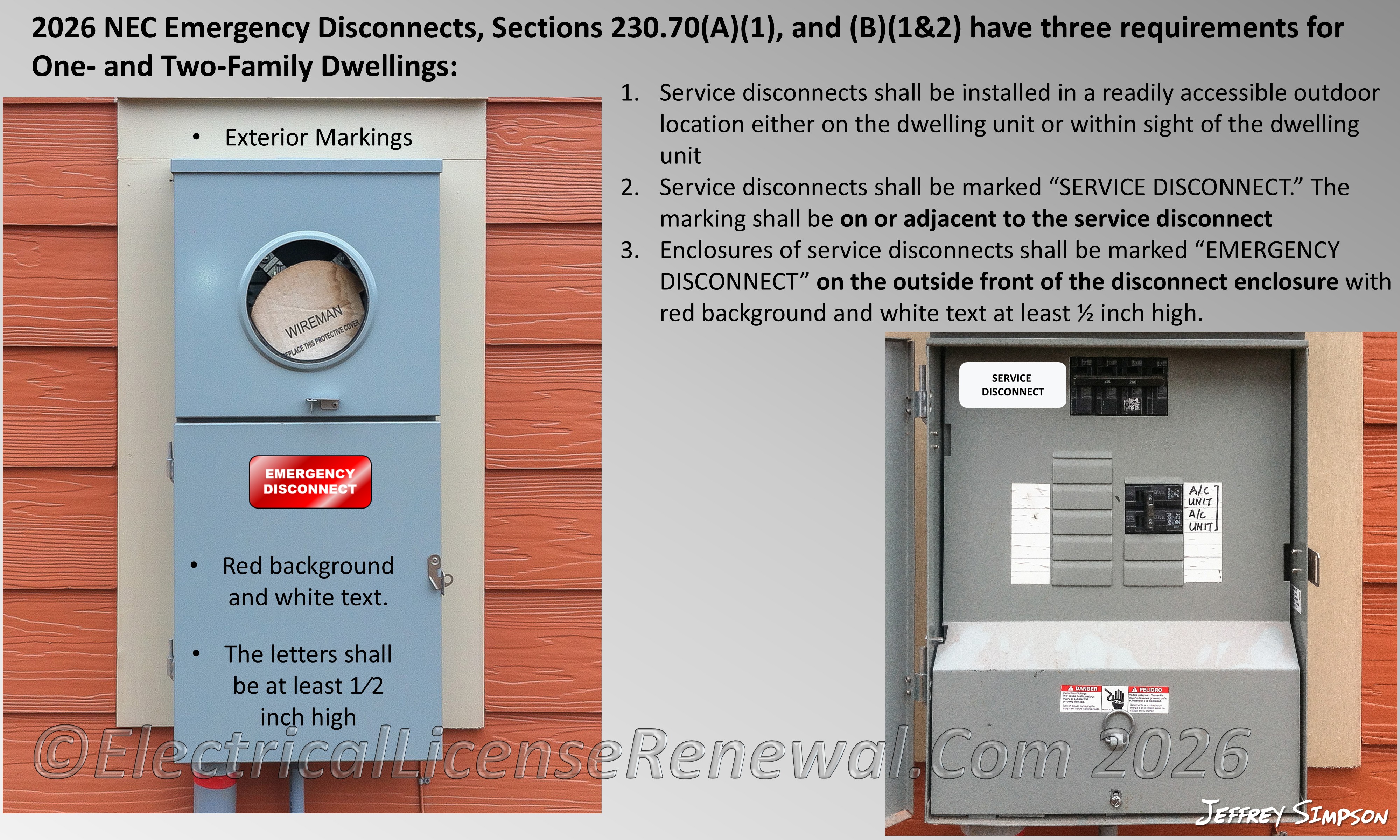
2026 NEC emergency disconnect requirements for one- and two-family dwellings.
Code Change Summary: Emergency disconnect requirements from 230.85 have been consolidated into 230.70 with significant revisions to service disconnect location and marking.
SME commentary: In the 2026 NEC®, a major restructuring occurred regarding service disconnect location and emergency disconnect requirements for one- and two-family dwellings. Previously, Section 230.85 specifically required an emergency disconnect, but this section has now been deleted, with its critical provisions consolidated into revised language in 230.70(A) and (B). This revision streamlines application, eliminates confusion, and ensures consistency with service equipment grounding and bonding requirements.
In past cycles, Section 230.85 raised several challenges. Inspectors and installers questioned what specific types of equipment qualified as an emergency disconnect, how to properly apply overcurrent protection, and how grounding and bonding rules in Article 250 applied when the emergency disconnect was installed on the supply side of the service equipment. The 2026 NEC® addresses these concerns by requiring that the service disconnecting means itself serve as the emergency disconnect. For one- and two-family dwellings, the service disconnect must now be located in a readily accessible outdoor location on the dwelling unit or within sight of the dwelling unit. By integrating the emergency disconnect into the service disconnect, issues related to equipment type, fault current protection, and grounding are resolved because service equipment is already required to be properly bonded and protected.
An exception was added for situations where an outdoor feeder emergency disconnect is provided in accordance with 225.41. In these cases, the service disconnect does not need to be installed on or within sight of the dwelling unit. This prevents unnecessary duplication of disconnecting means, especially in scenarios where the service location is significantly removed from the dwelling and the dwelling is served by a feeder.
Changes to 230.70(B) also clarify how service disconnects are to be marked. Each disconnect must now be marked as “SERVICE DISCONNECT”. This marking shall be on or adjacent to the service disconnect. Additionally, for one- and two-family dwellings, the enclosures of disconnects must also be labeled “EMERGENCY DISCONNECT.” This marking must be placed on the outside front of the disconnect enclosure with red background, white text, using letters at least 1/2 inch high. These marking requirements ensure immediate recognition during an emergency and align with the NEC’s ongoing emphasis on usability and field safety.
The consolidation of 230.85 into 230.70 simplifies the rules while strengthening enforcement. By removing ambiguity over what equipment qualifies as an emergency disconnect and requiring the service disconnect to fulfill this role, the NEC® provides both clarity for the industry and enhanced safety for occupants and first responders.
Below is a preview of the NEC®. See the actual NEC® text at NFPA.ORG for the complete code section. Once there, click on their link to free access to the 2026 NEC® edition of NFPA 70.
2023 Code Language:
230.70(A) Location. The service disconnecting means shall be installed in accordance with 230.70(A)(1), (A)(2), and (A)(3).
(1) Readily Accessible Location. The service disconnecting means shall be installed at a readily accessible location either outside of a building or structure or inside nearest the point of entrance of the service conductors.
230.70(B) Marking. Each service disconnect shall be permanently marked to identify it as a service disconnect.
2026 Code Language:
230.70(A) Service Disconnect Location. Service disconnects shall be installed in accordance with 230.70(A)(1) through 230.70(A)(3).
(1) One- and Two-Family Dwellings. Service disconnects shall be installed in a readily accessible outdoor location in accordance with one of the following:
(1) On the dwelling unit
(2) Within sight of the dwelling unit in accordance with 110.29
Exception: The service disconnect shall not be required to be installed on or within sight of the dwelling unit when an emergency disconnect is installed in accordance with 225.41.
N (2) Other than One- and Two-Family Dwellings. Service disconnects shall be installed in a readily accessible location either outside of a building or structure or inside nearest the point of entrance of the service conductors.
230.70(B) Service Disconnect Marking. Service disconnects shall be marked in accordance with 230.70(B)(1) and 230.70(B)(2).
N (1) Marking. Service disconnects shall be marked “SERVICE DISCONNECT.” The marking shall be on or adjacent to the service disconnect and comply with 110.21(B).
N (2) One- and Two-Family Dwellings. Enclosures of disconnects for one- and two-family dwellings shall be marked “EMERGENCY DISCONNECT.”
Markings shall comply with 110.21(B) and both of the following:
(1) The markings shall be located on the outside front of the disconnect enclosure with a red background and white text.
(2) The letters shall be at least 1⁄2 inch high.
