225.41 Emergency Disconnects.
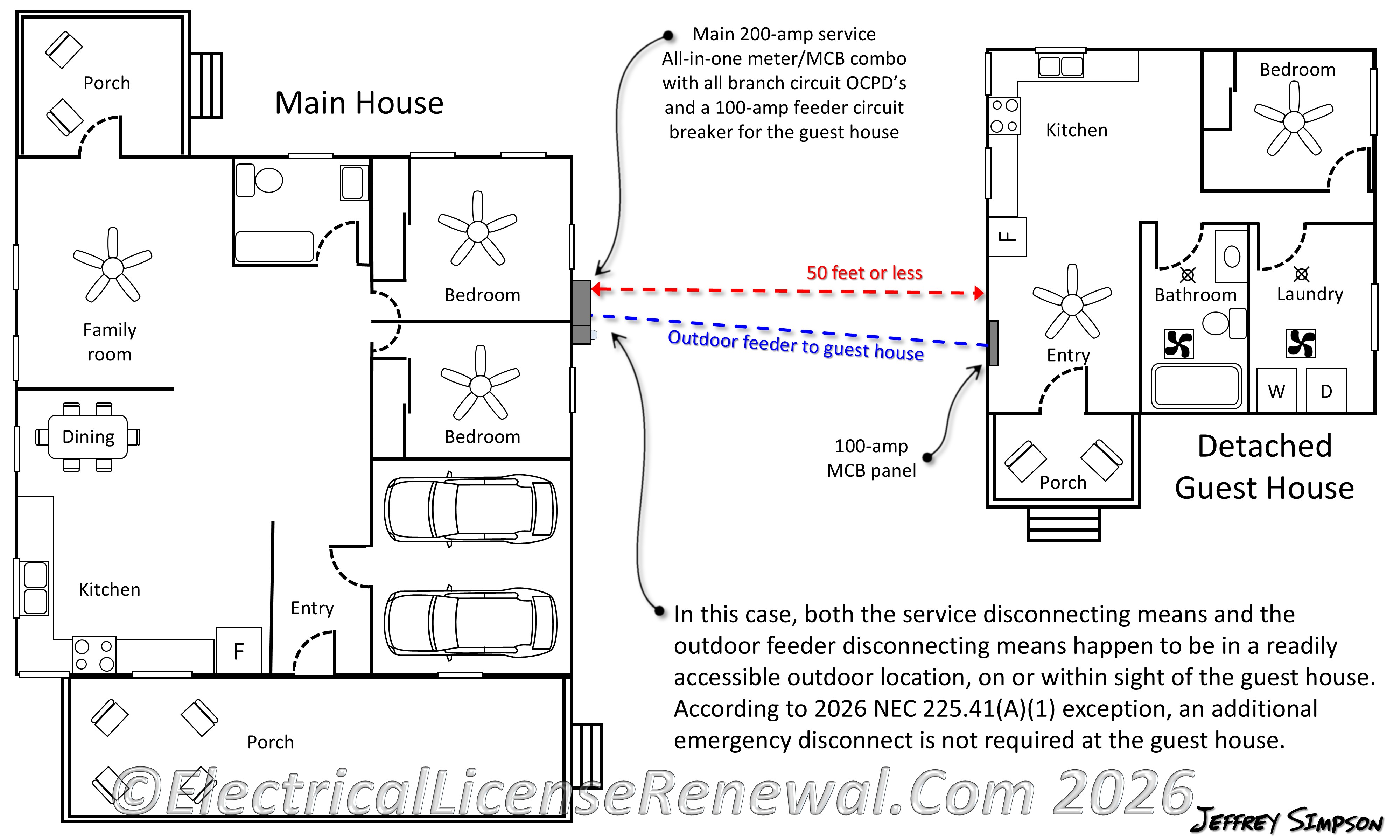
Since either the service disconnect, or the outdoor feeder disconnect are in a readily accessible outdoor location, on or within sight of the guest house an additional emergency disconnect is not required at the guest house.
Code Change Summary: An exception was added to 225.41 that eliminates the need for an additional emergency disconnect when the service or feeder disconnecting means already meets the requirements for one- and two-family dwellings.
SME commentary: The emergency disconnect requirement for one- and two-family dwellings first appeared in the 2023 NEC® under Section 225.41. Its purpose was to ensure that firefighters and other first responders had a means to quickly disconnect power to the building during emergencies such as fire, flooding, or other disasters. The code required the emergency disconnect to be installed in a readily accessible outdoor location on or within sight of the dwelling. This requirement paralleled similar service disconnect rules in Section 230.85.
While the 2023 rule established an important safety benchmark, it also created confusion in situations where a dwelling unit was supplied by a feeder rather than a direct service. Detached guest houses on the same property that qualify as a one- or two-family dwelling may be served by feeders that originate from the main house or another structure. Similarly, in some configurations, even the main dwelling can be feeder-supplied from a common service location nearby that also provides power to another dwelling unit on the same property. Under the 2023 language, these buildings could be interpreted as needing their own separate emergency disconnect, even though the upstream feeder disconnect was already located in a code-compliant outdoor and readily accessible location and within sight of the dwelling it supplies.
The 2026 NEC® clarifies this issue by adding an exception to Section 225.41(A)(1). The new language specifies that “if the service disconnecting means complies with 230.70(A)(1) or the disconnecting means in accordance with 225.31 is in a readily accessible outdoor location, on or within sight of the one- and two-family dwelling unit, an additional emergency disconnect shall not be required”. This change prevents unnecessary duplication of disconnecting means while still ensuring that emergency responders have a safe and reliable method to de-energize the dwelling.
Consider the following example: a detached single-family dwelling unit is supplied by a feeder that originates from another building on the property. If the feeder disconnecting means is already mounted outdoors at the supplying building in a readily accessible location within sight of the detached dwelling, that disconnect satisfies the intent of Section 225.41. Requiring a second emergency disconnect at the detached dwelling would add cost and complexity without significant improvement to safety. The 2026 exception resolves this redundancy by recognizing that either the service disconnect or the feeder disconnect can serve as the emergency disconnect, provided it is properly located.
It is important to note that this exception only applies when the disconnecting means already meets the requirements of being readily accessible and located outdoors on or within sight of the dwelling. If these conditions are not met, then a separate emergency disconnect at the dwelling is still required.
The 2026 revision to Section 225.41(A)(1) provides needed clarity and flexibility by aligning the emergency disconnect requirement with existing service and feeder rules. The change reduces unnecessary duplication of disconnects while maintaining first responder safety, ensuring that one- and two-family dwellings continue to have a reliable means of emergency power shutoff.
Below is a preview of the NEC®. See the actual NEC® text at NFPA.ORG for the complete code section. Once there, click on their link to free access to the 2026 NEC® edition of NFPA 70.
2023 Code Language:
225.41 Emergency Disconnects. For one-and two-family dwelling units, an emergency disconnecting means shall be installed.
(A) General.
(1) Location. The disconnecting means shall be installed in a readily accessible outdoor location on or within sight of the dwelling unit.
(2) Rating. The disconnecting means shall have a short-circuit current rating equal to or greater than the available fault current.
(3) Grouping. If more than one disconnecting means is provided, they shall be grouped.
2026 Code Language:
225.41 Emergency Disconnects. For one-and two-family dwelling units, an emergency disconnecting means shall be installed.
(A) General.
(1) Location. The disconnecting means shall be installed in a readily accessible outdoor location in accordance with one of the following:
(1) On the dwelling unit
(2) Within sight of the dwelling in accordance with 110.29
Exception: If the service disconnecting means complies with 230.70(A)(1) or the disconnecting means in accordance with 225.31 is in a readily accessible outdoor location, on or within sight of the one- and two-family dwelling unit, an additional emergency disconnect shall not be required.
(2) Rating. The equipment within which the disconnecting means is installed shall have a short-circuit current rating equal to or greater than the available fault current.
(3) Grouping. If more than one disconnecting means is provided, they shall be grouped.
