210.70 Lighting Outlets Required.
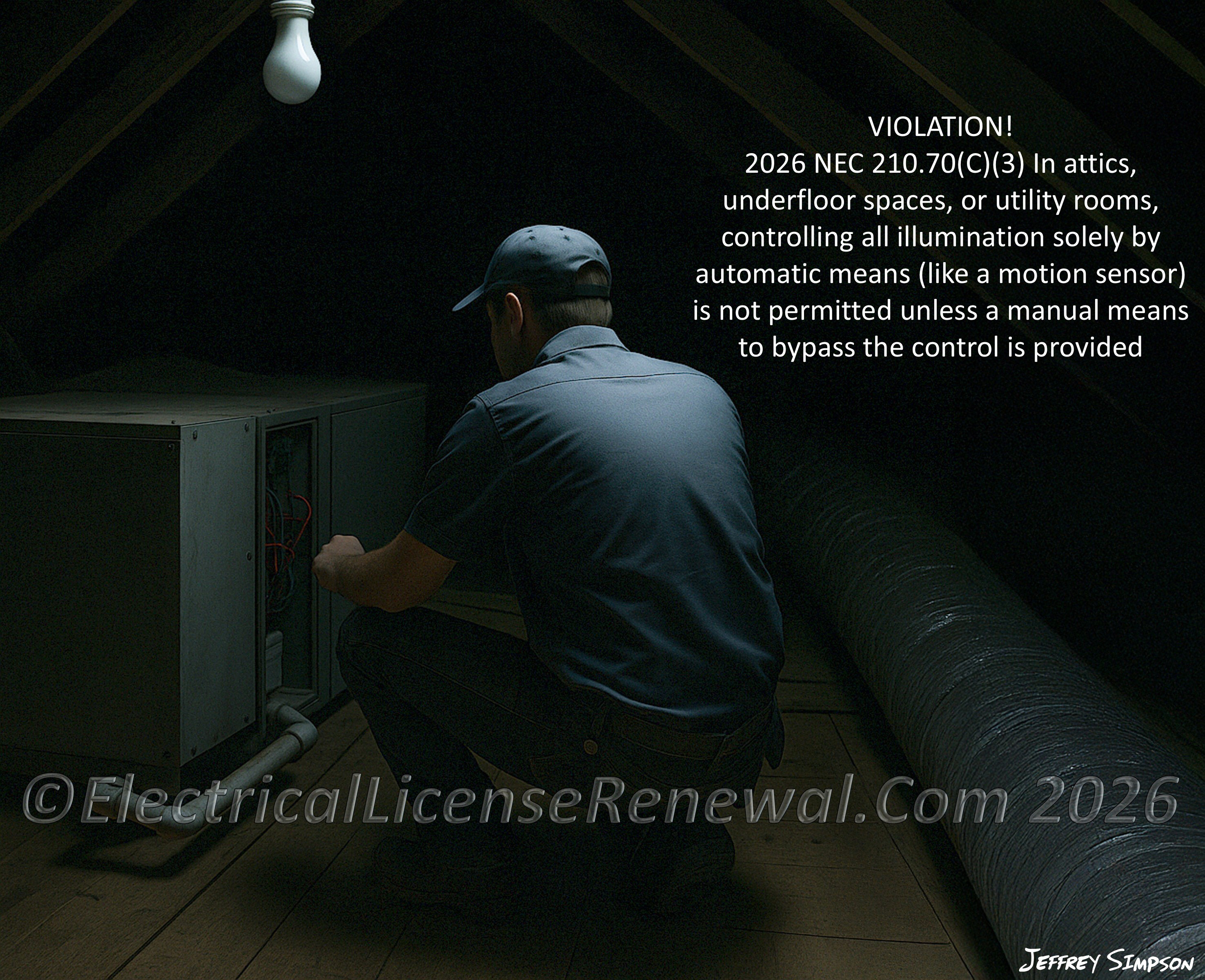
Good luck finding your way out in the dark if a motion sensor is controlling the lighting outlet and it’s nowhere near where you are working, unless there’s a manual override for it.
Code Change Summary: Revisions to lighting outlet requirements, battery-powered switch provisions, and new allowances for laundry areas.
SME commentary: In the 2026 National Electrical Code (NEC), Section 210.70 underwent notable revisions that address safety concerns, improve clarity, and provide additional allowances for challenging installation scenarios. The first major change appears in the parent text of 210.70, where the second sentence from the 2023 NEC® was deleted. That 2023 sentence read: “The switch or listed wall-mounted control device shall not rely exclusively on battery power unless it incorporates a positive means of notification of impending battery depletion.” This language was initially adopted through a Tentative Interim Amendment (TIA) in late 2023 as an improvement over earlier wording. The earlier version had allowed lighting outlets to be automatically energized upon battery failure, creating a potential electric shock hazard for anyone working on the lighting outlet at the time. The 2023 TIA attempted to mitigate this by requiring a positive notification of battery depletion, such as audible or visual signals. However, it still left open the possibility that a battery-powered control device could energize a circuit unexpectedly, exposing a worker to live conductors without warning.
Several public inputs to the 2026 Code cycle urged the deletion of this language altogether. Their reasoning was that no allowance should exist for battery-powered control devices that are capable of automatically energizing a lighting circuit upon battery failure. The committee agreed to delete the language and emphasized that a failed battery poses no greater threat to safe egress than a burned-out lamp, a tripped breaker, or a utility outage. The committee also stated that the original 2023 language (prior to the TIA) allowing automatic energization of the lighting also created a safety issue.
A second revision occurs in 210.70(A)(1) where a new Exception No. 3 was added for laundry areas. The new exception permits a lighting outlet and its control switch installed to provide illumination to the laundry area to be installed outside the laundry area where a closet houses the laundry equipment. This recognizes the practical limitations of small laundry spaces, particularly in apartments or compact dwellings where installing a luminaire directly in the room or closet may be impossible due to space limitations. By allowing the outlet and switch outside the area, safe and adequate illumination can still be achieved without imposing impractical installation requirements.
Lastly, in 210.70(C), which applies to all occupancies for spaces such as attics, basements, underfloor spaces, and utility rooms, the section was reformatted into a list for better alignment with the NEC® Style Manual, and new subsection 210.70(C)(3) was added to explicitly prohibit control of all lighting exclusively by automatic means unless a manual means to bypass the control is provided. This ensures that someone is not left in complete darkness in crawl spaces or attics if automatic controls shut off the lighting outlet unexpectedly. A motion sensor controlling the crawl space light and installed nowhere near the area someone is working under the house can create a hazard if it switches the light off after not sensing any recent motion in the immediate area. The requirement to have a manual means of control for the sensor reinforces the Code’s core principle of safeguarding people from both shock hazards and unsafe egress conditions.
The 2026 revisions to 210.70 strengthen worker safety, improve usability in difficult spaces such as laundry closets, and eliminate ambiguity surrounding automatic or battery-powered control devices. These changes strike a balance between flexibility for designers and installers while upholding the NEC’s fundamental goal of practical safeguarding.
Below is a preview of the NEC®. See the actual NEC® text at NFPA.ORG for the complete code section. Once there, click on their link to free access to the 2026 NEC® edition of NFPA 70.
2023 Code Language:
210.70 Lighting Outlets Required. Lighting outlets shall be installed where specified in 210.70(A), (B), & (C). The switch or listed wall-mounted control device shall not rely exclusively on battery power unless it incorporates a positive means of notification of impending battery depletion.
2026 Code Language:
210.70 Lighting Outlets Required. Lighting outlets shall be installed where specified in 210.70(A), 210.70(B), and 210.70(C).
210.70(A)(1) Habitable Rooms, Kitchens, Laundry Areas, and Bathrooms. At least one lighting outlet controlled by a wall switch or listed wall-mounted control device shall be installed in every habitable room, kitchen, laundry area, and bathroom. The wall switch or wall-mounted control device shall be located near an entrance to the room on a wall.
N Exception No. 3: A lighting outlet and its control switch installed to provide illumination to the laundry area shall be permitted to be installed outside the laundry area where a closet houses the laundry equipment.
210.70(C) All Occupancies. For attics and underfloor spaces, utility rooms, and basements, at least one lighting outlet containing a switch or controlled by a wall switch or listed wall-mounted control device shall be installed where these spaces are used for storage or contain equipment requiring servicing and shall comply with the following:
N (3) Control by automatic means shall not be permitted to control all illumination in attics, underfloor spaces, or utility rooms unless a manual means to bypass the control is provided.
