250.52(C)(4) Countertops and Work Surfaces.
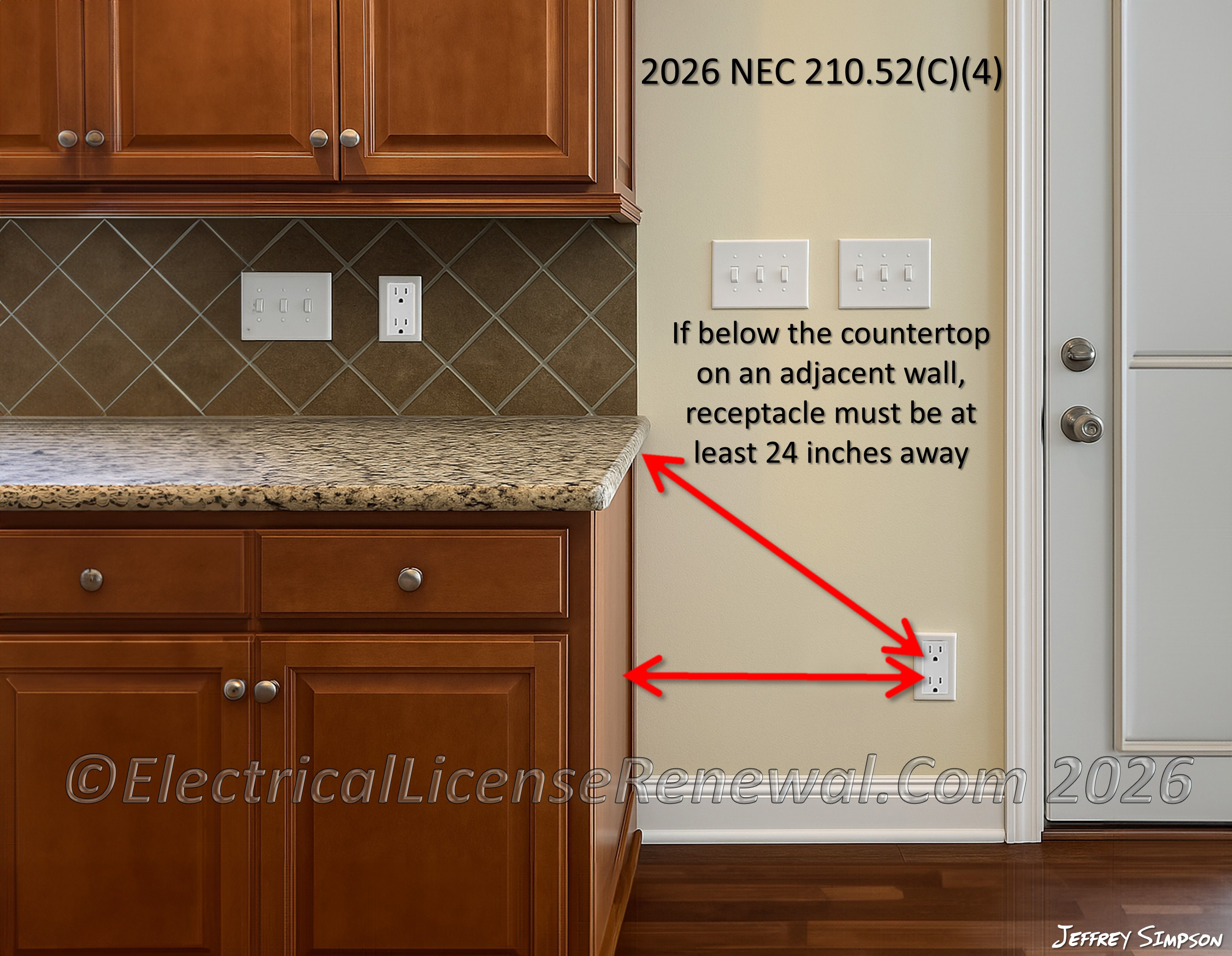
Receptacle outlets below the countertop on an adjacent wall must be at least 24 inches away.
Code Change Summary: A new provision, 210.52(C)(4), was added to the 2026 NEC® to prohibit certain receptacle outlet locations below countertops and work surfaces in order to prevent hazardous appliance cord overhangs.
SME commentary: In the 2026 National Electrical Code (NEC), new section 210.52(C)(4), was introduced to address specific safety concerns related to receptacle outlet placement beneath countertops and work surfaces. The primary goal of this change is to reduce the risk of injury from appliance cords hanging over the edge of kitchen islands, peninsulas, and similar work areas. This hazard has been documented in U.S. Consumer Product Safety Commission (CPSC) reports, which cite incidents where children pulled on dangling appliance cords, such as a crock pot, causing hot contents to spill and result in burns.
The new provision explicitly prohibits installing required or permitted receptacle outlets in certain locations that could enable such hazards:
- First, receptacle outlets are not allowed on adjacent walls extending from the base cabinets within 24 inches from the countertop or work surface edge. This prevents installations where a cord from an appliance on the counter could easily reach and connect to a receptacle in that space, creating an overhang risk.
- Second, receptacle outlets directly beneath countertops are prohibited from being located within 24 inches of the countertop or work surface. This eliminates the possibility of placing a receptacle adjacent on a cabinet face, back, or side below the edge where a short appliance cord could still reach it, potentially inviting unsafe cord routing over the counter edge.
Exception: Receptacle outlets are permitted to be installed in a drawer below countertops and work surfaces
The exception acknowledges that certain specialty installations, such as charging drawers for small appliances, can be performed safely while still keeping cords and devices out of reach and off the countertop edge.
Prior to this change, the 2023 NEC® removed the language specifically requiring a receptacle for island and peninsula countertops. While that removal addressed certain code flexibility issues, it inadvertently opened the door for receptacles to be installed in cabinet faces near these surfaces as long as they were not technically serving the countertop. This created a loophole where appliance cords could still reach a nearby receptacle and pass inspection. The new 2026 language closes that loophole by directly prohibiting receptacles in these locations, regardless of stated purpose, unless installed in a manner specifically allowed by the exception.
By establishing a minimum clearance of 24 inches from the countertop edge for receptacles located beneath, the NEC® effectively ensures that the standard 2-foot appliance cord cannot physically reach the outlet when the appliance is on the counter. This change aligns receptacle placement rules with practical safety considerations, prioritizing child safety and reducing the likelihood of dangerous accidents in residential kitchens.
Below is a preview of the NEC®. See the actual NEC® text at NFPA.ORG for the complete code section. Once there, click on their link to free access to the 2026 NEC® edition of NFPA 70.
2023 Code Language:
210.52(C)(4) This section did not exist.
2026 Code Language:
N 210.52(C)(4) Receptacle Outlet Locations Prohibited. Required and permitted receptacle outlets installed in a location that is accessible outside cabinet or wall surfaces that are below countertops and work surfaces shall comply with the following:
(1) Receptacle outlets shall not be installed on adjacent walls extending from the base cabinets within 610 mm (24 in.).
(2) Receptacle outlets beneath countertops shall not be located within 610 mm (24 in.) of the countertop or work surface.
Exception: Receptacle outlets installed in a drawer shall be permitted to be installed below countertops and work surfaces.
