210.52(A)(5) Receptacle Outlet Locations Prohibited.
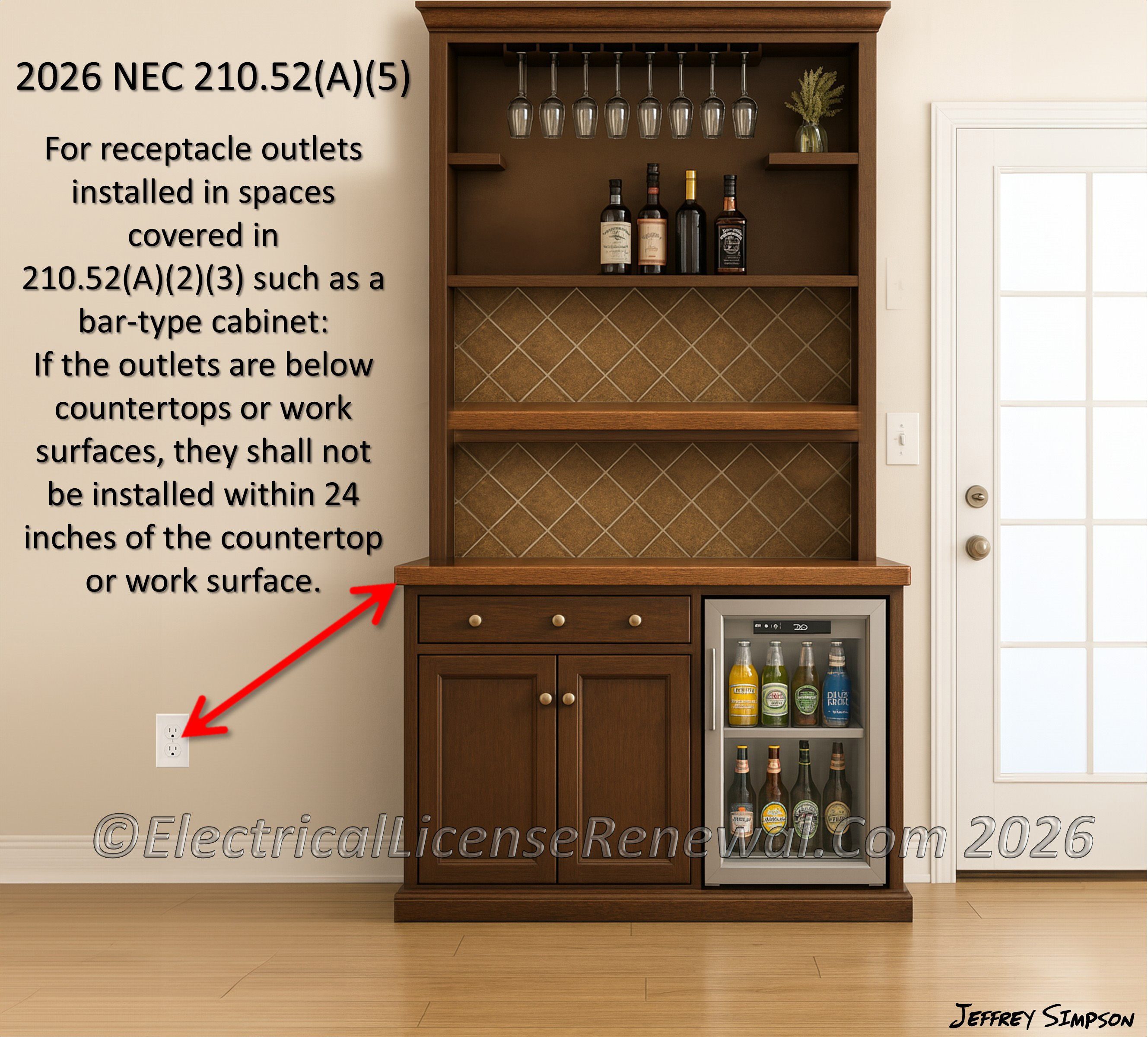
Receptacle must be at least 24 inches away from the countertop or work surface.
Code Change Summary: New section 210.52(A)(5) prohibits receptacle outlets below countertops and work surfaces for fixed room dividers unless installed more than 24 inches below the countertop or work surface.
SME commentary: In the 2026 National Electrical Code (NEC), new section 210.52(A)(5) was created to address prohibited receptacle outlet locations in fixed room dividers, such as freestanding bar-type counters, when those receptacles are located close enough to the countertop to create a potential hazard. The purpose of this addition mirrors the intent of 210.52(C)(4), which addresses the same safety concern in kitchens and similar work areas. In both cases, the change was driven by safety incidents documented by the U.S. Consumer Product Safety Commission (CPSC) involving appliance cords hanging over countertop edges where they could be pulled, resulting in hot contents spilling and causing injury.
Section 210.52(A) outlines the general provisions for dwelling unit receptacle outlet placement for 125-volt, 15- and 20-ampere receptacles. Specifically, 210.52(A)(2)(3) addresses receptacle spacing for “fixed room dividers”. The new 210.52(A)(5) builds on this by restricting receptacles in locations that could be misused for plugging in appliances such as slow cookers, coffee makers, or other hot devices. The concern is that some homes feature bar-type counters outside of typical kitchen spaces, such as in family rooms, living rooms, or open-concept living areas. If a receptacle were placed on the vertical face of a fixed room divider, such as below a bar-type countertop, the short cord of an appliance set on the countertop could still reach the receptacle, creating a tipping or pull-down hazard.
This new code section prohibits receptacle outlets below the countertop from being installed within 24 inches of the countertop or work surface. This distance ensures that a standard 2-foot appliance cord cannot reach from the appliance to the outlet while allowing the appliance to remain on the work surface. This effectively removes the possibility of unsafe cord routing over the edge of the counter.
The safety rationale is the same as for 210.52(C)(4). Without this prohibition, a receptacle outlet placed low on the face or side of a bar-type counter could be claimed to serve “other purposes” and not the countertop itself, potentially bypassing the intent of the code. This change closes that loophole, ensuring that the hazard is addressed regardless of intent or claimed use.
By explicitly including this restriction in 210.52(A)(5), the NEC® extends protection to areas outside the kitchen where fixed room dividers and counters could still be used for food preparation or appliance placement. This consistent approach between 210.52(A)(5) and 210.52(C)(4) improves clarity, closes inspection gaps, and enhances occupant safety by preventing hazardous appliance cord overhang situations throughout the dwelling.
Below is a preview of the NEC®. See the actual NEC® text at NFPA.ORG for the complete code section. Once there, click on their link to free access to the 2026 NEC® edition of NFPA 70.
2023 Code Language:
210.52(A)(5) This section did not exist.
2026 Code Language:
N 210.52(A)(5) Receptacle Outlet Locations Prohibited. Where receptacle outlets are installed in spaces covered in 210.52(A)(2)(3) and the outlets are below countertops or work surfaces, they shall not be installed within 610 mm (24 in.) of the countertop or work surface.
