210.12(B) AFCI Protection at Dwelling Units.
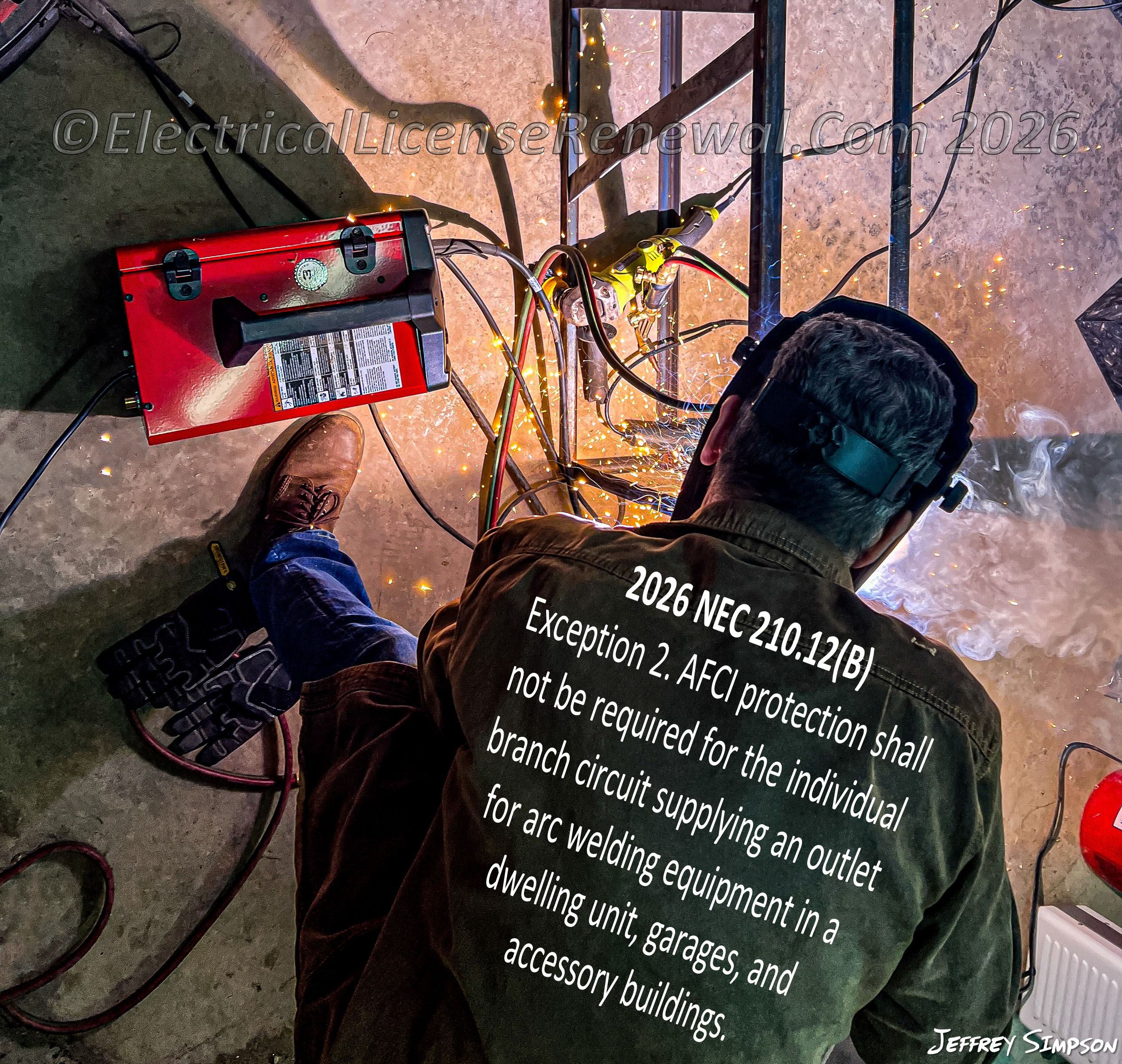
AFCI protection shall not be required for the individual branch circuit supplying an outlet for arc welding equipment in a dwelling unit, garages, and accessory buildings.
Code Change Summary: Exception 2 was modified and expands the allowance to garages and accessory buildings.
SME commentary: The 2026 National Electrical Code (NEC) makes a noteworthy adjustment to Exception No. 2 of Section 210.12(B), eliminating the January 1, 2025 expiration date and extending the scope of the exception to cover individual branch circuits supplying outlets for arc welding equipment not only within dwelling units, but also within garages and accessory buildings associated with dwellings.
Originally introduced in the 2023 NEC®, Exception No. 2 permitted a temporary allowance for an outlet serving arc welding equipment to forgo AFCI protection, but this was set to expire on January 1, 2025. The 2026 revision deletes that sunset date entirely, effectively transforming this into a permanent exception:
- Exception No. 2: AFCI protection shall not be required for the individual branch circuit supplying an outlet for arc welding equipment in a dwelling unit
until January 1, 2025, garages, and accessory buildings.
The revision is also notable for the expanded locations. Welding equipment is commonly used in dwelling unit garages and detached accessory buildings such as sheds or workshops. Recognizing this practical reality, the 2026 NEC® adds "garages and accessory buildings" to Exception No. 2. This change ensures that the exception is not limited strictly to the dwelling unit envelope but appropriately applies to typical welding setups found elsewhere on residential properties.
Public substantiation highlighted the impracticality of requiring AFCI protection for circuits where arcing is an expected and unavoidable part of the normal welding operation. Analogies were drawn to emphasize the absurdity of mandating arc-fault protection on arc-generating loads. To date, no AFCI solution has been developed or listed that accommodates the known interoperability challenges associated with welding equipment.
It is also important to note that the committee did not move forward with efforts to expand AFCI requirements to areas such as basements and garages, which were originally under consideration. Because those spaces were not added to the list of required locations for AFCI coverage in 210.12(B), there was no justification for keeping a future expiration date in Exception No. 2.
The revised 2026 NEC® language appropriately makes permanent what was once a time-limited exception and expands its applicability to align with real-world residential welding practices, improving both clarity and usability while maintaining electrical safety.
Below is a preview of the NEC®. See the actual NEC® text at NFPA.ORG for the complete code section. Once there, click on their link to free access to the 2026 NEC® edition of NFPA 70.
2023 Code Language:
210.12(B) Dwelling Units. All 120-volt, single-phase, 10-, 15-, and 20-ampere branch circuits supplying outlets or devices installed in the following locations shall be protected by any of the means described in 210.12(A)(1) through (A)(6):
Kitchens, Family rooms, Dining rooms, Living rooms, Parlors, Libraries, Dens, Bedrooms, Sunrooms, Recreation rooms, Closets, Hallways, Laundry areas, Similar areas.
Exception No. 1: AFCI protection shall not be required for an individual branch circuit supplying a fire alarm system installed in accordance with 760.41(B) or 760.121(B). The branch circuit shall be installed in a metal raceway, metal auxiliary gutter, steel-armored cable, or Type MC or Type AC cable meeting the applicable requirements of 250.118, with metal boxes, conduit bodies, and enclosures.
Exception No. 2: AFCI protection shall not be required for the individual branch circuit supplying an outlet for arc welding equipment in a dwelling unit until January 1, 2025.
2026 Code Language:
210.12(B) Dwelling Units. All 120-volt, nominal, single-phase, 10-, 15-, and 20-ampere branch circuits supplying outlets or devices installed in the following locations shall be protected by any of the means described in 210.12(A):
Kitchens, Family rooms, Dining rooms, Living rooms, Parlors, Libraries, Dens, Bedrooms, Sunrooms, Recreation rooms, Closets, Hallways, Laundry areas, Similar areas.
Exception No. 1: AFCI protection shall not be required for an individual branch circuit supplying a fire alarm system installed in accordance with 760.41(B) or 760.121(B). The branch circuit shall be installed in a metal raceway, metal auxiliary gutter, steel-armored cable, or Type MC or Type AC cable complying with 250.118 with metal boxes, conduit bodies, and enclosures.
Exception No. 2: AFCI protection shall not be required for the individual branch circuit supplying an outlet for arc welding equipment in a dwelling unit, garages, and accessory buildings.
