210.8(F) GFCI Protection for Outdoor Outlets.
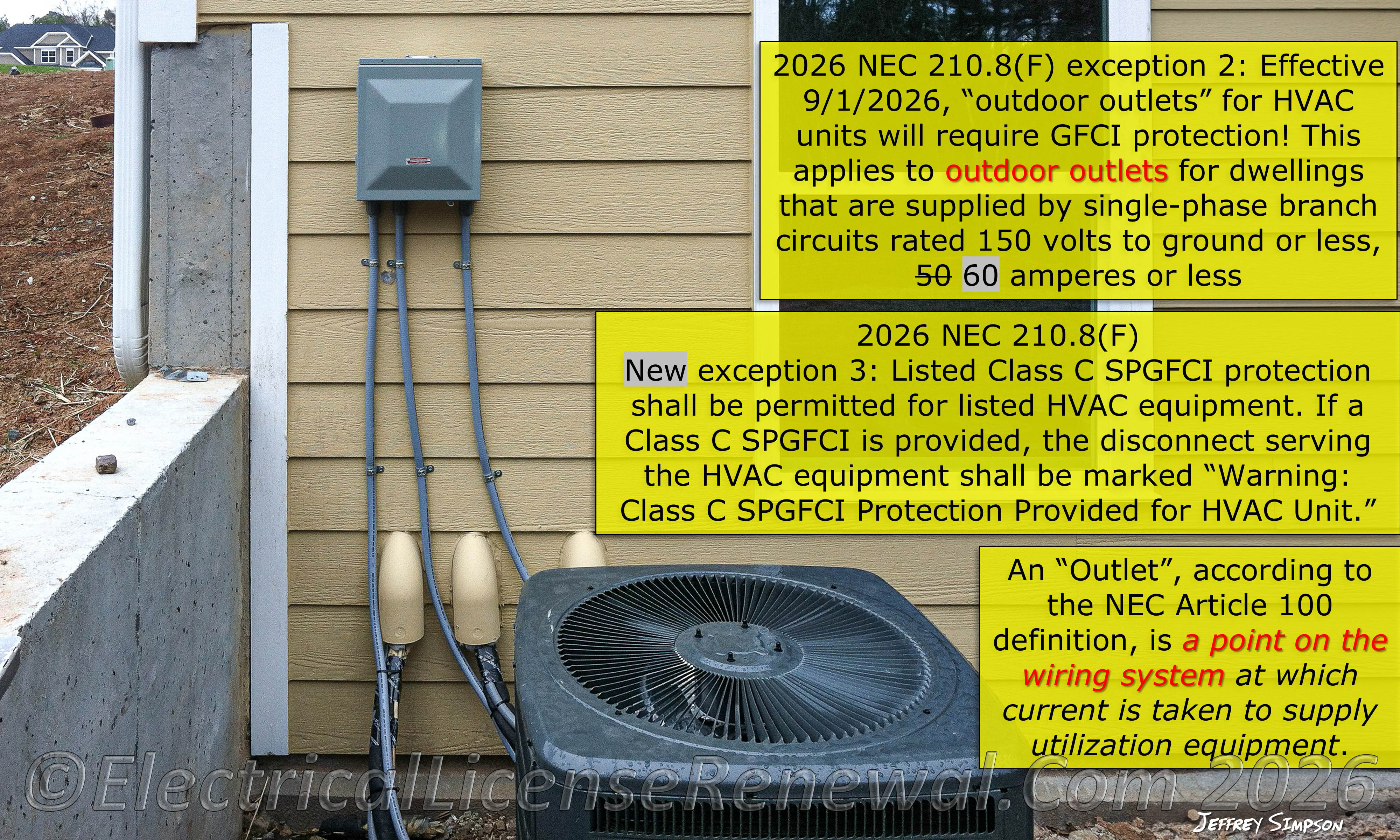
An “Outlet”, according to the NEC Article 100 definition, is a point on the wiring system at which current is taken to supply utilization equipment.
Code Change Summary: GFCI Protection for outdoor outlets at dwellings has increased to include outlets up to 60 amps.
SME commentary: In the 2026 National Electrical Code (NEC), Section 210.8(F) was revised to increase the ampere threshold for GFCI protection on outdoor outlets at dwellings from 50 amperes to 60 amperes. This change applies to all outdoor outlets, excluding those covered by 210.8(A), Exception No. 1, and includes outlets located at garages with floors at or below grade level, accessory buildings, and boathouses. Importantly, the revised language now refers to outlets installed “at” these locations, not “in” them. This helps clarify that only the outdoor outlets in these areas are subject to this rule. Indoor receptacles within those same structures remain covered under 210.8(A).
The term “outlet” in the NEC® is often misunderstood. According to Article 100, an outlet is defined as a point on the wiring system at which current is taken to supply utilization equipment. While receptacles are one type of outlet, hardwired connections such as those for surface-mounted luminaires, smoke detectors, or HVAC equipment disconnects also qualify as outlets. For example, an outdoor air-conditioning unit connected to a 60-ampere branch circuit through a disconnect is an “outlet” covered under this rule.
The change from 50 to 60 amperes was supported by a public input citing the common use of 60-ampere GFCI-type disconnects for appliances such as pool heaters, spas, and air conditioning units. The submitter argued that keeping the threshold at 50 amperes no longer aligned with current installation practices or available safety devices. Code-making panel commentary confirmed that the hazard associated with a 60-ampere outlet is no different than one rated for 50 amperes, and that GFCI protection is widely available at this rating.
In addition to the ampere threshold revision, a new Exception No. 3 was added. This exception permits the use of listed Class C Special-Purpose Ground-Fault Circuit Interrupter (SPGFCI) protection for HVAC equipment. When a Class C SPGFCI is used, the disconnect serving the HVAC unit must be marked with a label stating: “Warning: Class C SPGFCI Protection Provided for HVAC Unit.” This marking is intended to inform installers, inspectors, and maintenance personnel that the protection provided is not Class A, which has different trip characteristics. Without this marking, an assumption might be made that Class A protection is present, potentially leading to misunderstandings on the level of protection provided during installation or servicing.
Lastly, an informational note was added referencing UL 943C. This note explains that SPGFCIs marked “HF” or “HF+” are designed for loads with high-frequency leakage currents, such as those produced by inverters or variable speed drives. These devices are evaluated differently than Class A GFCIs, and the added note (below) serves as a helpful reference for product selection and field identification:
Informational Note: See UL 943C, Outline of Investigation for Special Purpose Ground-Fault Circuit-Interrupters, for further information. SPGFCIs marked “HF” or “HF+” do not trip when the frequency weighted differential current is less than the specified value for a Class C, Class D, or Class E SPGFCI.
Together, these changes improve clarity, reflect practical installation conditions, and strengthen personnel protection in outdoor dwelling applications.
Below is a preview of the NEC®. See the actual NEC® text at NFPA.ORG for the complete code section. Once there, click on their link to free access to the 2026 NEC® edition of NFPA 70.
2023 Code Language:
210.8(F) Outdoor Outlets. For dwellings, all outdoor outlets, other than those covered in 210.8(A), Exception No. 1, including outlets installed in the following locations, and supplied by single-phase branch circuits rated 150 volts or less to ground, 50 amperes or less, shall be provided with GFCI protection:
(1) Garages that have floors located at or below grade level
(2) Accessory buildings
(3) Boathouses
If equipment supplied by an outlet covered under the requirements of this section is replaced, the outlet shall be supplied with GFCI protection.
Exception No. 1: GFCI protection shall not be required on lighting outlets other than those covered in 210.8(C).
Exception No. 2: GFCI protection shall not be required for listed HVAC equipment. This exception shall expire September 1, 2026.
2026 Code Language:
210.8(F) Outdoor Outlets. For dwellings, all outdoor outlets other than those covered in 210.8(A) Exception No. 1, including outdoor outlets installed at the following locations and supplied by single-phase branch circuits rated 150 volts or less to ground, 60 amperes or less, shall be GFCI protected:
(1) Garages that have floors located at or below grade level
(2) Accessory buildings
(3) Boathouses
If equipment supplied by an outlet covered under the requirements of this section is replaced, the outlet shall be supplied with GFCI protection.
Exception No. 1: GFCI protection shall not be required on lighting outlets other than those covered in 210.8(C).
Exception No. 2: GFCI protection shall not be required for listed HVAC equipment. This exception shall expire September 1, 2026.
Exception No. 3: Listed Class C SPGFCI protection shall be permitted for listed HVAC equipment. If a Class C SPGFCI is provided, the disconnect serving the HVAC equipment shall be marked “Warning: Class C SPGFCI Protection Provided for HVAC Unit.”
Informational Note: See UL 943C, Outline of Investigation for Special Purpose Ground-Fault Circuit-Interrupters, for further information. SPGFCIs marked “HF” or “HF+” do not trip when the frequency weighted differential current is less than the specified value for a Class C, Class D, or Class E SPGFCI.
