210.8(A) GFCI Protection at Dwelling Units.
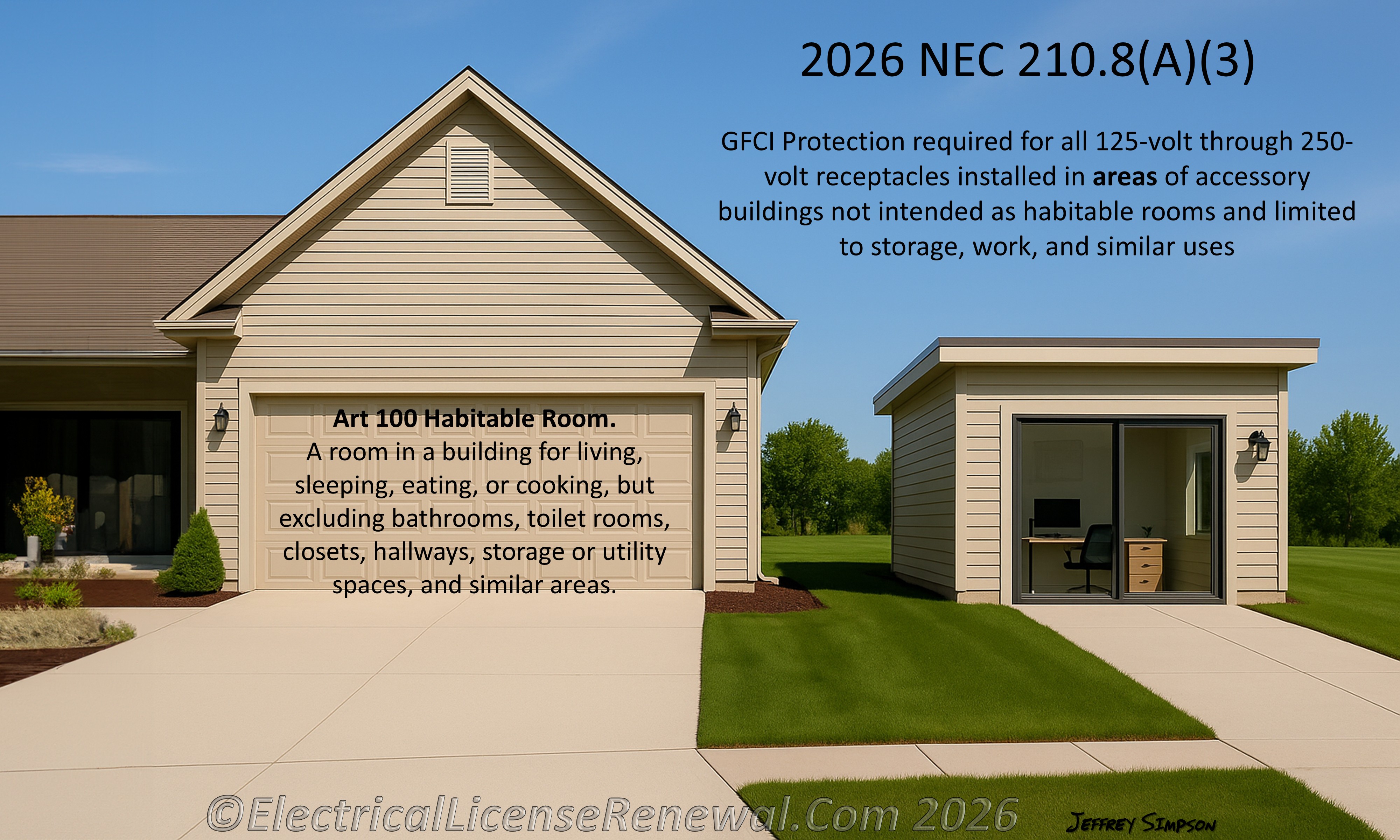
GFCI Protection required for all 125-volt through 250-volt receptacles installed in areas of accessory buildings not intended as habitable rooms such as this home office.
Code Change Summary: GFCI requirements for dwelling unit accessory buildings and exhaust fans have been revised.
SME commentary: In the 2026 NEC®, changes made in 210.8(A) now separate the rules on GFCI protection for dwelling garages from the GFCI requirements for dwelling unit accessory buildings.
Previously, 210.8(A)(2) required GFCI Protection for 125-volt through 250-volt receptacles installed in “garages and also accessory buildings that have a floor located at or below grade level not intended as habitable rooms and limited to storage areas, work areas, and areas of similar use.”
In the 2026 NEC®, List item (2) under 210.8(A) has been shortened to “Garages” and the language on accessory buildings was moved to new list item (3) as follows:
(2) Garages
(3) Areas of accessory buildings not intended as habitable rooms and limited to storage, work, and similar uses
This change narrows down the requirements to have GFCI protection for receptacles in dwelling unit accessory buildings to specific non habitable areas an accessory building rather than requiring GFCI protection for all 125-volt through 250-volt receptacles throughout the entire accessory building as required previously.
Additionally, exception 4 was modified to apply to all exhaust fans instead of only bathroom exhaust fans. This exception now allows factory-installed receptacles that are not readily accessible and mounted internally to exhaust fan assemblies to not require GFCI protection unless required by the installation instructions or listing.
Below is a preview of the NEC®. See the actual NEC® text at NFPA.ORG for the complete code section. Once there, click on their link to free access to the 2026 NEC® edition of NFPA 70.
2023 Code Language:
210.8 (A) Dwelling Units. All 125-volt through 250-volt receptacles installed in the following locations and supplied by single-phase branch circuits rated 150 volts or less to ground shall have ground-fault circuit-interrupter protection for personnel:
(2) Garages and also accessory buildings that have a floor located at or below grade level not intended as habitable rooms and limited to storage areas, work areas, and areas of similar use.
Exception No. 4: Factory-installed receptacles that are not readily accessible and are mounted internally to bathroom exhaust fan assemblies shall not require GFCI protection unless required by the installation instructions or listing.
2026 Code Language:
210.8 (A) Dwelling Units. All 125-volt through 250-volt receptacles installed in the following locations and supplied by single-phase branch circuits rated 150 volts or less to ground shall have GFCI protection for personnel:
(2) Garages
(3) Areas of accessory buildings not intended as habitable rooms and limited to storage, work, and similar uses.
Exception No. 4: Factory-installed receptacles that are not readily accessible and are mounted internally to exhaust fan assemblies shall not require GFCI protection unless required by the installation instructions or listing.
