120.83 Existing Dwelling Units.
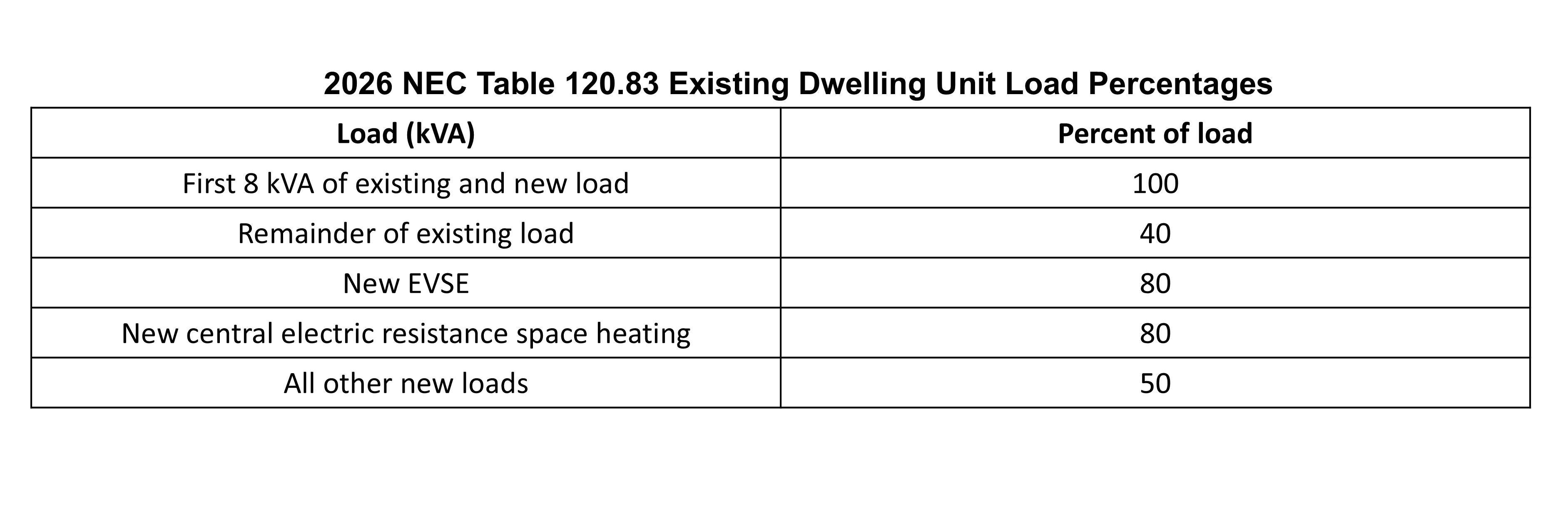
2026 NEC Table 120.83.
Code Change Summary: Section 220.83 was renumbered as 120.83 and revised to use a single load calculation method with updated demand factors for existing dwellings.
SME commentary: In the 2026 National Electrical Code (NEC), what was formerly Section 220.83 has been relocated and renumbered as Section 120.83 as part of the article reorganization that grouped all load calculation rules into a new Article 120. While the section still applies to existing dwelling units served by a 120/240-volt or 208Y/120-volt, 3-wire service or feeder, the structure and content of this provision have been significantly revised based on recent national load data.
Historically, Section 220.83 offered two different methods for evaluating additional load capacity depending on whether new air-conditioning or electric space-heating equipment was to be installed. Each method had a separate table: Table 220.83(A) and Table 220.83(B). The 2026 NEC® eliminates this split, simplifying the calculation by creating a single unified table: Table 120.83.
The rework was driven by findings from a load study conducted by Lawrence Berkeley National Laboratory (LBNL). The study analyzed thousands of homes across the United States using sub-metered load data to identify realistic demand factors for a variety of residential equipment types. With this data, the Code now applies more consistent and representative values to existing and added loads in a dwelling.
One major revision is the removal of differential treatment for additional HVAC loads. Whether or not air conditioning or electric heating is being added no longer affects the calculation. This simplification brings clarity and reflects data showing that HVAC additions do not significantly alter the demand factor when compared to other large residential loads.
The demand values for general lighting and general-use receptacles have been updated to 22 volt-amperes per square meter or 2 volt-amperes per square foot, aligning with changes elsewhere in the NEC® such as Section 120.41.
Existing load treatment remains unchanged: the first 8 kVA of existing and new loads is counted at 100%, and the remainder at 40%. However, a new baseline is established for additional loads. All new loads are calculated at 50%, which is more conservative than the prior method and reflects median demand values for items like dryers, water heaters, and miscellaneous HVAC equipment.
Two types of new loads are given distinct treatment based on their consistently high utilization observed in the load study:
- New Electric Vehicle Supply Equipment (EVSE) is calculated at 80%
- New Central Electric Resistance Space Heating is also calculated at 80%
These values recognize the high duty cycle and impact of these specific load types on residential electrical systems.
By consolidating the tables and incorporating real-world usage data, Section 120.83 now presents a streamlined, data-driven method for evaluating whether an existing service or feeder can support new loads in an existing dwelling. This not only improves accuracy but also usability for electrical professionals in the field.
