120.54 Electric Clothes Dryers -Dwelling Units.
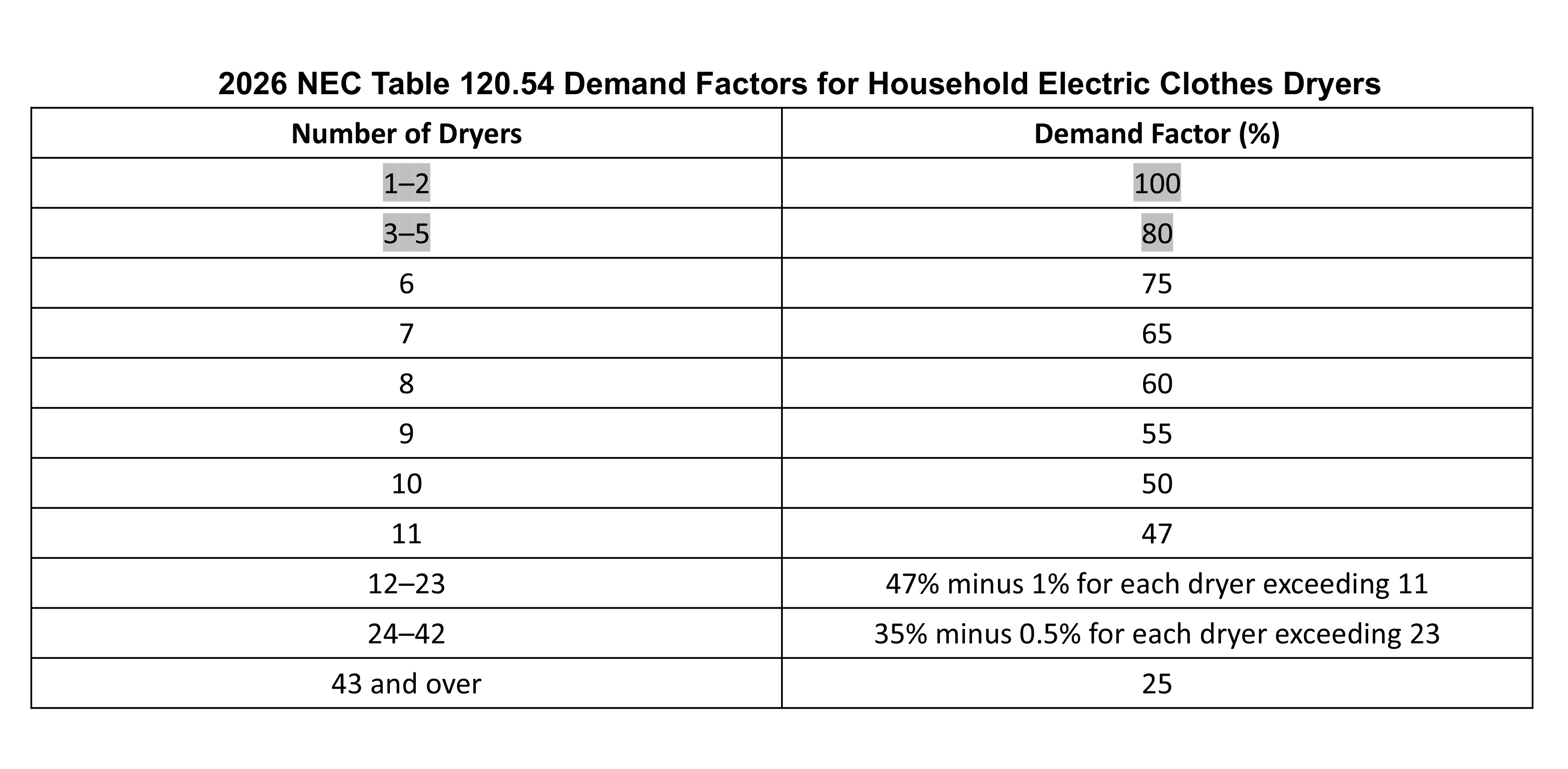
2026 NEC Table 120.54.
Code Change Summary: Revisions made to the demand factors used for calculating the clothes dryer load in dwelling units.
SME commentary: In the 2026 National Electrical Code (NEC), key updates were made to the way household electric clothes dryers are calculated in dwelling unit load calculations. The most notable change involves a revision to Table 220.54, which is now renumbered as Table 120.54 due to the reorganization of load calculation requirements into the new Article 120. This table dictates the demand factors applied when multiple dryers are installed.
Historically, the NEC® required the first four dryers to be calculated at 100 percent of their nameplate rating, with the fifth at 85 percent. This method was considered overly conservative for typical residential applications. The revised table now reflects more realistic usage patterns. Specifically, one or two dryers must be calculated at 100 percent, while a demand factor of 80 percent may be applied to installations with three to five dryers. From there, the demand factors continue to decrease progressively, reaching 25 percent for installations with 43 dryers or more. This shift better aligns the table with actual residential usage trends, especially given that most single-family homes contain one or two dryers that are often operated at the same time.
These changes are particularly relevant in modern multifamily housing, accessory dwelling units, and duplexes where two dryers may be provided. Under the 2023 NEC®, both dryers would have been required at full nameplate rating, but the revised 2026 table allows some demand diversity as the number increases, starting at three units.
In addition to the tabular updates, the parent text of Section 120.54 was revised for clarity and practicality during both plan review and inspection. The revised language explicitly clarifies how to proceed when a dryer has not yet been selected at the time of load calculation or is not installed at the time of inspection. The updated 2026 NEC® now requires that “the load for household electric clothes dryers in a dwelling unit(s) shall be the nameplate rating if available or 5000 watts (volt-amperes), whichever is larger, for each dryer served.” This helps ensure a minimum baseline is established for planning purposes while still accommodating real-world construction timelines where appliance choices may be pending.
These combined revisions result in a more flexible, accurate, and practical approach to dryer load calculations and bring NEC® methodology more in line with modern dwelling unit configurations and construction practices.
Additional Commentary on Related Change in Section 120.14(B):
Another noteworthy refinement in the 2026 NEC® affects how electric dryer loads are handled for branch circuit calculations, specifically in Section 120.14(B), which was formerly 220.14(B) in the 2023 Code. In prior editions, Section 220.14(B) permitted the use of demand factors from Table 220.54, even though Table 220.54 was located in Part 2 of the article, which addresses feeder and service calculations, not branch circuits.
This created a structural and interpretive inconsistency. Branch circuit loads were being permitted to apply diversity factors that were never intended for that level of the distribution system. Technically, under the 2023 NEC®, it was allowable to size the branch-circuit load for multiple dryers using the demand factors listed in Table 220.54, even though those factors were developed for larger-scale service and feeder calculations, not individual branch circuits.
The 2026 NEC® resolves this by removing that cross-reference. Section 120.14(B) has been revised to remove correlation to Table 120.54 (formerly 220.54) and now clearly states:
“The branch-circuit load for electric dryers shall be calculated using 5000 watts (volt-amperes) or the nameplate rating, whichever is greater, for each dryer served.”
This clarification ensures consistency across the Code and reinforces the correct use of demand factors: demand diversity is appropriate when sizing feeders and services that serve multiple appliances or units, but branch circuits must be sized conservatively, based on either the actual nameplate or the default 5000 VA minimum, whichever is larger.
Below is a preview of the NEC®. See the actual NEC® text at NFPA.ORG for the complete code section. Once there, click on their link to free access to the 2026 NEC® edition of NFPA 70.
2023 Code Language:
220.54 Electric Clothes Dryers — Dwelling Unit(s). The load for household electric clothes dryers in a dwelling unit shall be either 5000 watts (volt-amperes) or the nameplate rating, whichever is larger, for each dryer served. The use of the demand factors in Table 220.54 shall be permitted. Where two or more single-phase dryers are supplied by a 3-phase, 4-wire feeder or service, the total load shall be calculated on the basis of twice the maximum number connected between any two phases. Kilovolt-amperes (kVA) shall be considered equivalent to kilowatts (kW) for loads calculated in this section.
2026 Code Language:
120.54 Electric Clothes Dryers — Dwelling Unit(s). The load for household electric clothes dryers in a dwelling unit shall be the nameplate rating if available or 5000 watts (volt-amperes), whichever is larger, for each dryer served. The use of the demand factors in Table 120.54 shall be permitted. Where two or more single-phase dryers are supplied by a 3-phase, 4-wire feeder or service, the total load shall be calculated on the basis of twice the maximum number connected between any two phases. Kilovolt-amperes (kVA) shall be considered equivalent to kilowatts (kW) for loads calculated in this section.
