120.7 Power Control Systems.
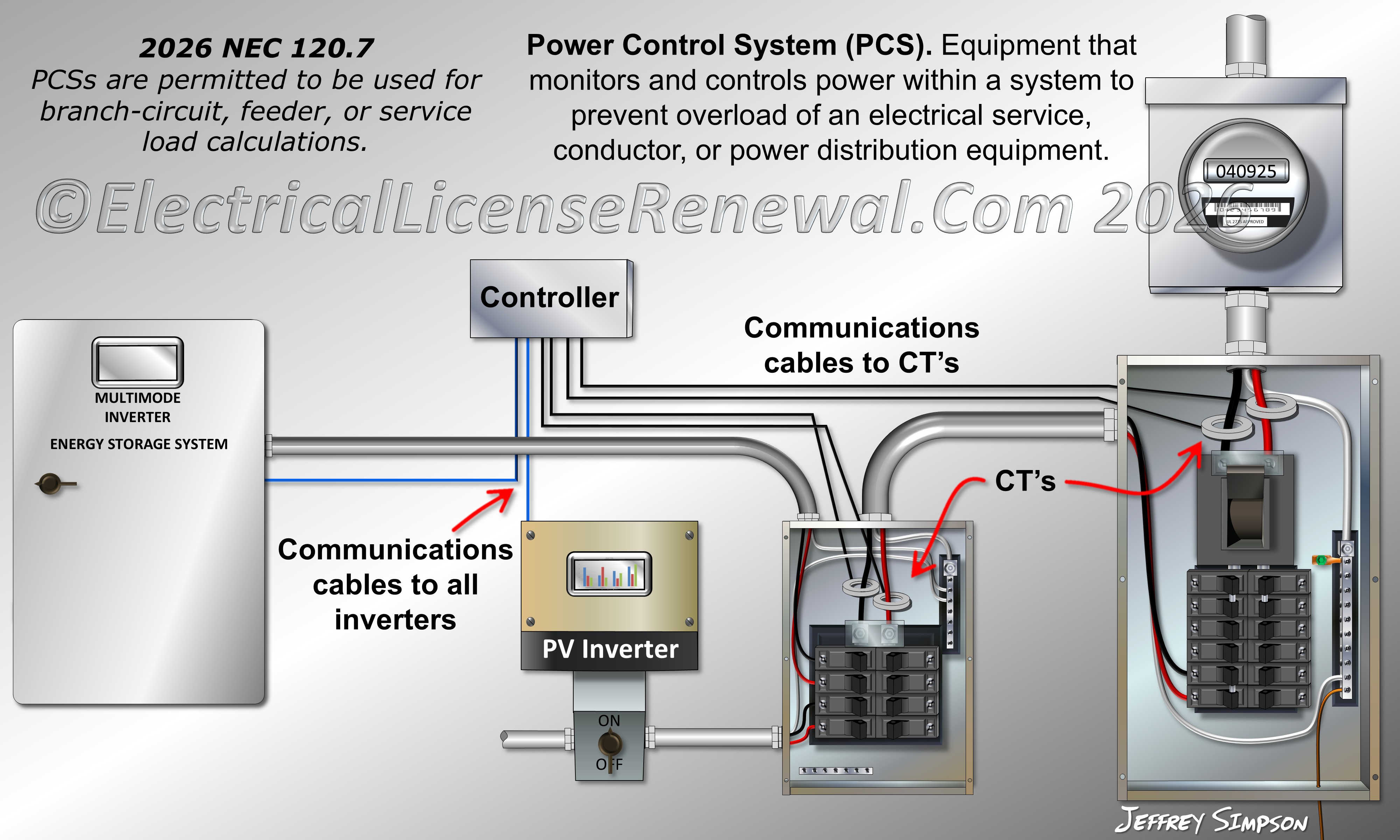
PCSs are permitted to be used for branch-circuit, feeder, or service load calculations.
Code Change Summary: Relocated and revised requirements on Power Control Systems.
SME commentary: In the 2026 National Electrical Code (NEC), structural and terminology revisions were made concerning Power Control Systems (PCS). Specifically, the requirements previously located in Section 220.70 were relocated to new Section 120.7 within Article 120, Part I. These changes reinforce that Power Control Systems are treated uniquely for load calculations throughout Article 120 and organize the rules in a way that is clearer and more consistent with emerging technologies and standards.
Relocating the requirements from Article 220 to Article 120 signals a broader application of PCS technology. Rather than being limited to load calculation methods, PCS is now acknowledged as a fundamental tool across multiple scenarios involving load monitoring and control. The revised layout of 120.7 breaks the requirements into distinct subsections, making it easier to read, interpret, and apply in real-world installations.
One of the more noticeable changes is in the terminology used. What was previously referred to as an Energy Management System (EMS) is now called a Power Control System (PCS). The updated term clarifies the difference between a system that actively monitors and limits overload conditions (a PCS) and one that simply manages energy without overload protection. The new language helps prevent confusion in design, installation, and inspection by aligning directly with the PCS product standard UL 3141.
Also worth noting is the revision of other terminology to match UL 3141. “Current setpoint” has been updated to “control setting,” and a new reference to “minimum operating current” was added. This is an important detail for scenarios where a PCS monitors both controlled and uncontrolled loads. According to the new informational note to 120.7(C)(1), minimum operating current is a value greater than or equal to zero representing the minimum current of the controlled loads.
Subsection 120.7(A) now refers to new Part II of Article 130 which identifies specific requirements for EMS devices that include overload control.
A new requirement in 120.7(B) now specifies that the PCS control setting (the point where the system steps in to reduce load) must be determined by “Qualified Persons.” This ensures that someone with the appropriate training or credentials is setting the control thresholds, helping avoid situations where incorrect configuration might jeopardize the integrity of the system.
The last significant change is an 80 percent rule in 120.7(B). This requirement ensures that the PCS control setting is set to no greater than 80 percent of the rating of the OCPD for the circuit being monitored by the PCS to provide overload control. This conservative design approach helps ensure the OCPD doesn’t get overloaded, whether the PCS is handling continuous loads or not. The clarification aligns with existing design examples shown in NEC® Annex D.
Below is a preview of the NEC®. See the actual NEC® text at NFPA.ORG for the complete code section. Once there, click on their link to free access to the 2026 NEC® edition of NFPA 70.
2023 Code Language:
220.70 Energy Management Systems (EMSs). If an energy management system (EMS) is used to limit the current to a feeder or service in accordance with 750.30, a single value equal to the maximum ampere setpoint of the EMS shall be permitted to be used in load calculations for the feeder or service.
The setpoint value of the EMS shall be considered a continuous load for the purposes of load calculations.
2026 Code Language:
120.7 Power Control System (PCS). PCSs shall be permitted to be used for branch-circuit, feeder, or service load calculations. When used in load calculations, the installation shall comply with 120.7(A) through 120.7(C).
N (A) PCS Requirements. The PCS shall comply with Article 130 Part II.
N (B) PCS Control Setting. The PCS control setting shall be determined by qualified persons and be set to no greater than 80 percent of the rating of the OCPD for the circuit being monitored by the PCS to provide overload control.
N (C) Load Calculations Using PCS. The load on the branch circuit, feeder, or service shall be the sum of the controlled loads, as determined in 120.7(C)(1), and noncontrolled loads, as determined in 120.7(C)(2).
(1) Controlled Loads. Controlled loads shall be based on the monitoring by the PCS to provide overload control and the PCS control configuration and shall comply with one or both of the following:
(1) If the PCS monitors only controlled loads, the control setting of the PCS shall be used in place of the controlled loads in load calculations.
(2) If the PCS monitors both controlled and noncontrolled loads, the minimum operating current of the controlled loads shall be used in place of the controlled loads in load calculations.
Informational Note: Minimum operating current is a value greater than or equal to zero representing the minimum current of the controlled loads.
(2) Noncontrolled Loads. Load calculations for loads not controlled by the PCS shall comply with Article 120 Parts II through VII.
