120.5 Calculations.
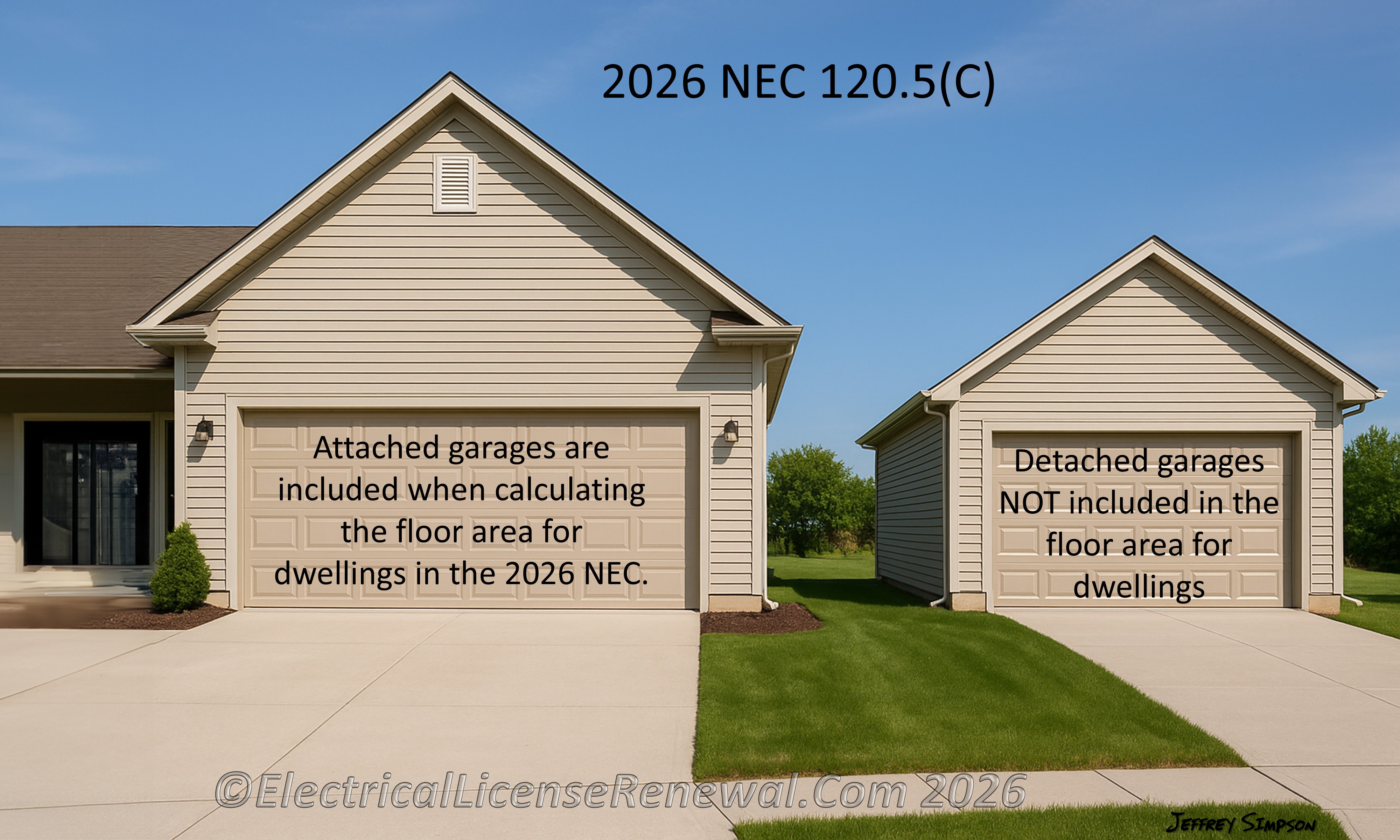
Detached garages NOT included in the floor area for dwellings.
Code Change Summary: Changes regarding floor area calculation, DC loads, and continuous loads.
SME commentary: The 2026 NEC® introduces key revisions to Section 120.5 that improve clarity and usability across multiple subsections related to load calculations. These changes affect how floor area is calculated in dwelling units, how DC loads are interpreted, and how continuous loads are treated in the context of demand factors.
The first notable revision updates the way garages are handled in dwelling unit load calculations. Prior to the 2023 NEC®, the floor area calculation in what was then 220.11 excluded open porches, garages, and unfinished areas not adaptable for future use. In 2023, the Code was revised to include garages in the floor area calculation, largely based on substantiation that garages, while not habitable, do indeed contain lighting loads and therefore contribute to the overall demand. However, this language lacked specificity, leading to confusion about whether detached garages were also included. In the 2026 NEC®, Section 120.5(C) now explicitly states that detached garages are excluded from the floor area used for dwelling unit load calculations. This revision eliminates ambiguity and aligns with the original intent to include only areas that contribute directly to the primary load of the dwelling. The revised language in 120.5(C) states that the floor area for each floor shall be calculated from the outside dimensions of the building, dwelling unit, or other area involved. For dwelling units, the calculated floor area shall not include detached garages, open porches, or unfinished areas not adaptable for future use as a habitable room or occupiable space.
Another important revision appears in new subsection 120.5(D), which addresses DC equipment. For the purposes of Article 120 load calculations, the NEC® now explicitly defines that watts (W) and kilowatts (kW) are equivalent to volt-amperes (VA) and kilovolt-amperes (kVA) respectively for DC circuits. This update acknowledges the common industry practice of rating DC equipment in watts or kilowatts rather than in VA or kVA, as is typical for AC systems. By codifying this equivalence, the Code reduces confusion for designers working with PV systems, battery storage, and other DC-powered installations.
Finally, 120.5(E) was added to clarify a persistent source of misapplication. Load calculations in Article 120 are not intended to automatically apply a 125 percent multiplier to all continuous loads. While other parts of the Code, particularly in Articles 210 and 215, may require conductor or overcurrent sizing adjustments for continuous loads, the actual demand calculation under Article 120 does not universally require this multiplier. The new provision in 120.5(E), along with its accompanying Informational Note, ensures users understand that continuous load classification affects equipment sizing, not necessarily the numerical demand in the load calculation.
Taken together, the revisions to Section 120.5 improve the consistency and clarity of load calculation methodology and help distinguish between design intent, load characteristics, and sizing requirements.
Below is a preview of the NEC®. See the actual NEC® text at NFPA.ORG for the complete code section. Once there, click on their link to free access to the 2026 NEC® edition of NFPA 70.
2023 Code Language:
220.5(C) Floor Area. The floor area for each floor shall be calculated from the outside dimensions of the building, dwelling unit, or other area involved. For dwelling units, the calculated floor area shall not include open porches or unfinished areas not adaptable for future use as a habitable room or occupiable space.
2026 Code Language:
120.5(C) Floor Area. The floor area for each floor shall be calculated from the outside dimensions of the building, dwelling unit, or other area involved. For dwelling units, the calculated floor area shall not include detached garages, open porches, or unfinished areas not adaptable for future use as a habitable room or occupiable space.
N 120.5(D) Direct Current (dc) Loads. For dc equipment, volt-amperes (VA) shall be considered equivalent to watts (W), and kilovolt-amperes (kVA) shall be considered equivalent to kilowatts (kW), for loads calculated in Article 220.
N 120.5(E) Percent Multiplier. Load calculations shall not require continuous loads to be calculated at 125%.
Informational Note: A 125-% multiplier could be required for reasons other than continuous load. Continuous loads impact the sizing of the conductor and overcurrent device but might not influence the load.
