110.29 In Sight From (Within Sight).
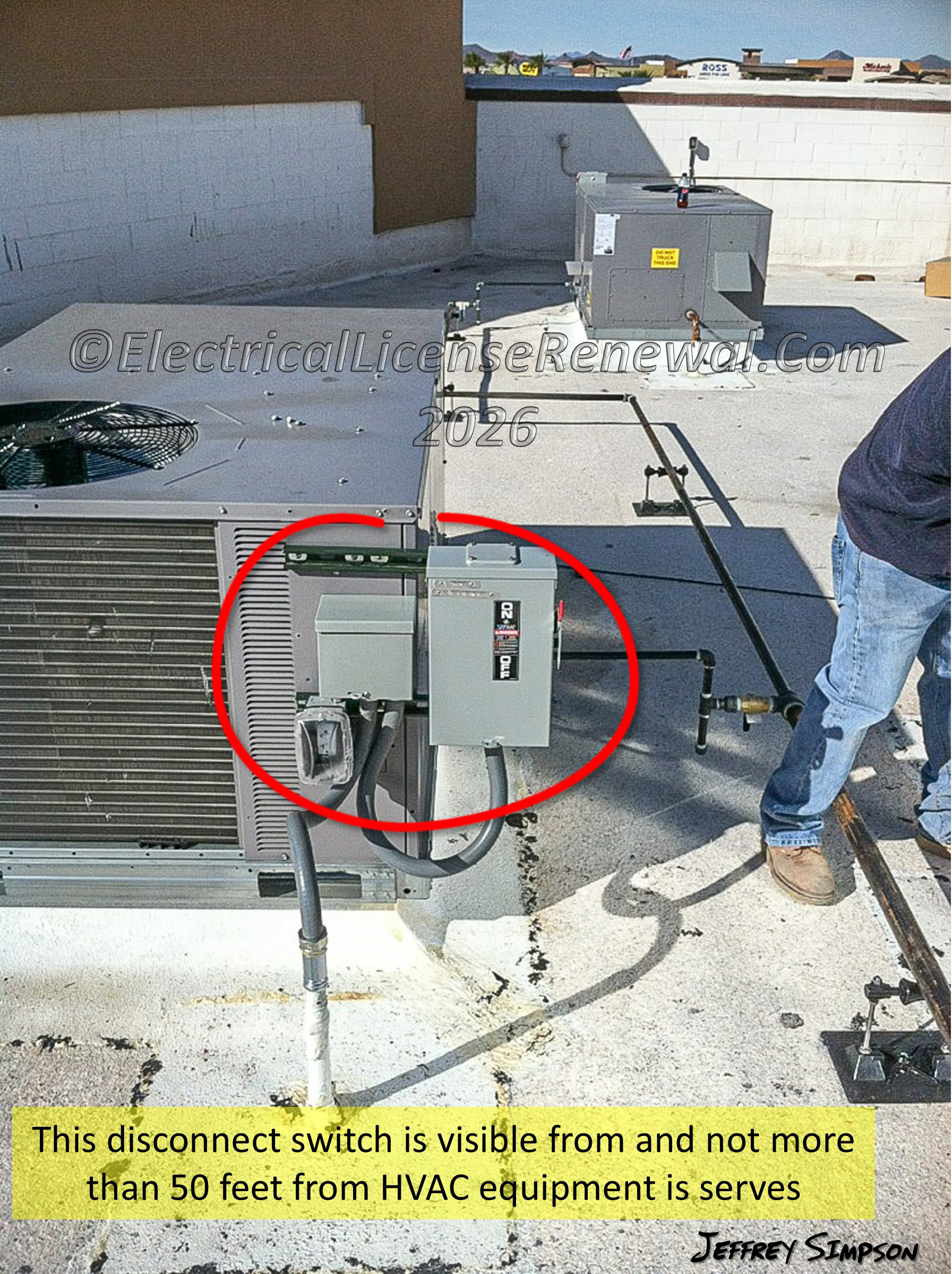
This disconnect switch is visible from and not more than 50 feet from HVAC equipment is serves.
Code Change Summary: The general requirements for equipment to be “within sight” have been expanded to include buildings and structures, and the Article 100 definition has been removed.
SME commentary: In the 2026 NEC®, the code language in 110.29 on the phrase “within sight” has seen a notable improvement. The previous definition found in Article 100 was deleted, and code users now rely solely on Section 110.29, which provides the clarified criteria.
Historically, the definition of “within sight” was limited to equipment being visible and not more than 50 feet distant. This worked well for most applications where two pieces of electrical equipment were involved, but complications began to surface as code requirements increasingly referred to visibility from a building or structure, not just another piece of equipment.
The 2026 revision to 110.29 now explicitly addresses this gap. The section clarifies that “within sight” still refers to a direct line of sight and a distance not exceeding 50 feet, but the language now includes references to both equipment and buildings or structures. This brings the text into alignment with other NEC® sections, such as 225.31(B), 230.85, and 702.12(A), where equipment must be within sight of a building or dwelling unit, not merely another piece of electrical equipment.
According to revised Section 110.29 in the 2026 NEC®, Where this code specifies that equipment shall be “in sight from,” “within sight from,” or “within sight of” a building or structure or other equipment, the specified equipment shall be visible and not more than 50 feet from the building, structure, or other equipment.
Public inputs submitted for this change highlighted that the 2023 NEC® created ambiguity in scenarios like service disconnecting means required to be within sight of the building it serves. Without explicit inclusion of buildings or structures in 110.29, users could be led to an incorrect application of the requirements.
Another important consideration is the educational impact of this change. For years, electricians, educators, and licensing boards have emphasized the definition of “within sight” found in Article 100. This definition was deeply embedded in license exams and field application. With its removal, the importance of retraining and familiarization with 110.29 becomes critical. Course developers, trainers, and test-prep materials will need to be updated to reflect the new location of this information.
By deleting the definition and clarifying the language in 110.29 to include buildings and structures, rather than just equipment, it provides better alignment with actual field applications. Electricians now look to 110.29 for all “within sight” requirements, and the NEC’s intent has been made clearer for inspectors and installers alike.
Below is a preview of the NEC®. See the actual NEC® text at NFPA.ORG for the complete code section. Once there, click on their link to free access to the 2026 NEC® edition of NFPA 70.
2023 Code Language:
110.29 In Sight From (Within Sight From, Within Sight). Where this Code specifies that one equipment shall be “in sight from,” “within sight from,” or “within sight of” another equipment, the specified equipment shall be visible and not more than 50 feet distant from the other.
2026 Code Language:
110.29 In Sight From (Within Sight From, Within Sight). Where this code specifies that equipment shall be “in sight from,” “within sight from,” or “within sight of” a building or structure or other equipment, the specified equipment shall be visible and not more than 50 feet from the building, structure, or other equipment.
