110.26(A)(1) Depth of Working Space.
Working space distances shall be measured from the enclosure front or opening, if such live parts are enclosed.
Code Change Summary: Revised language clarifies how to measure the working space depth for enclosed equipment.
SME commentary: Section 110.26(A)(1) of the 2026 NEC® includes revised language that resolves prior confusion about where to take measurements when determining the required depth of working space in front of electrical equipment. The updated text aligns more closely with the format used in Section 110.34(A), which governs medium and high voltage installations. This alignment improves consistency across voltage classes and helps avoid conflicting interpretations in the field.
Prior to this revision, the language in 110.26(A)(1) stated that distances shall be measured from the “exposed live parts or from the enclosure or opening if the live parts are enclosed.” Some users misread this phrasing to mean that either point of measurement was valid, even for equipment under 1000 volts where the live parts are typically enclosed. The concern was that the "or" could be taken to allow measurement from either the enclosure front or the actual internal components, potentially allowing a reduction in working space depth for panelboards or switchgear with enclosed components. The revised wording makes clear that when equipment has enclosed live parts, the working space depth must be measured from the enclosure front or the opening, just as it is for medium and high voltage systems.
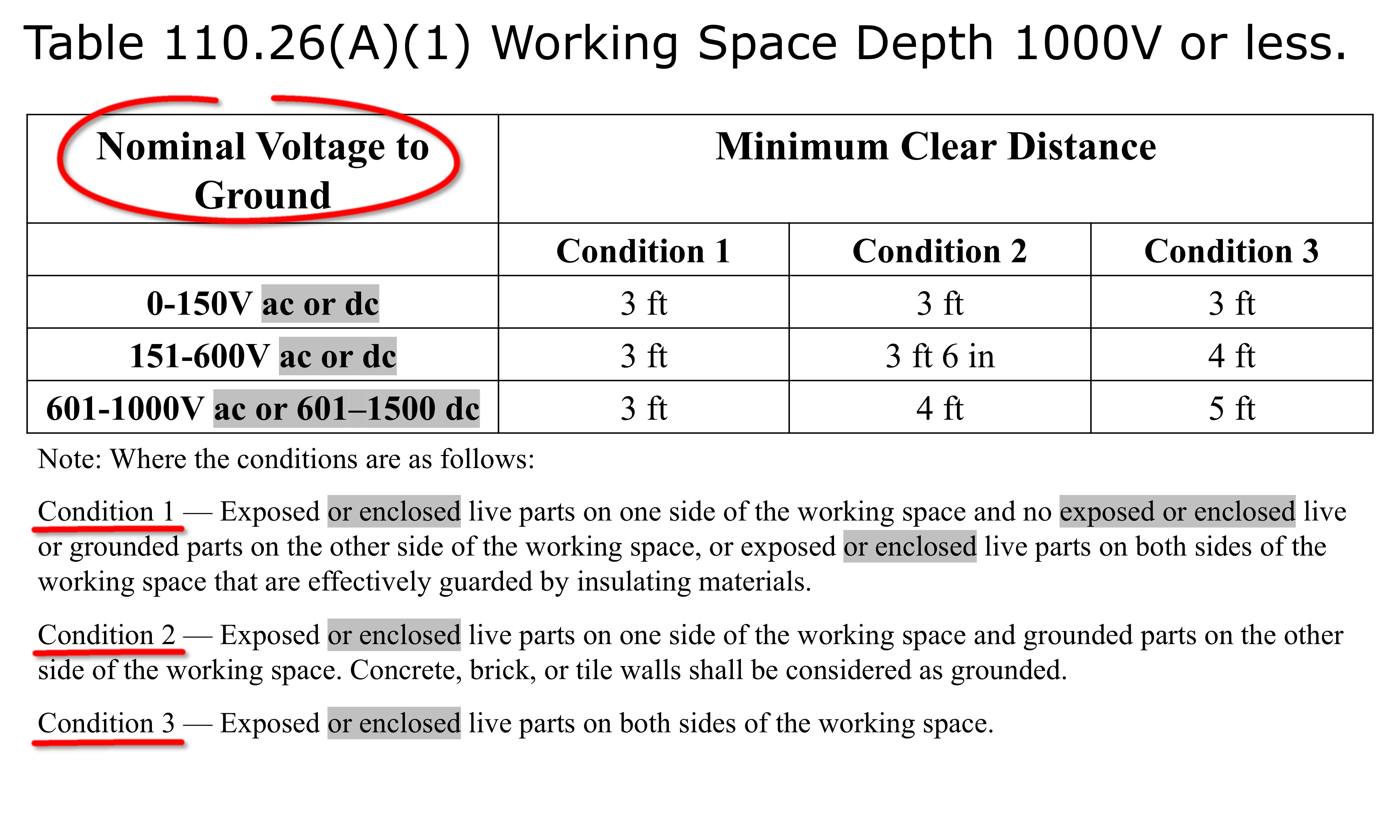
In addition to the clarification about measurement location, changes were made to Conditions 1, 2, and 3 in Table 110.26(A)(1). Specifically, the words “or enclosed” were added alongside “exposed” when describing live parts. The revised language now accurately reflects that enclosed live parts, which are common in modern installations, must still be treated as if they could become exposed during inspection or servicing. This ensures that the proper depth of working space is always maintained, regardless of whether the live components are behind a panel cover or not.
Furthermore, the table’s first column was modified to include both alternating current (ac) and direct current (dc) systems, by inserting “ac or dc” into each voltage category. This small but important revision acknowledges the growing prevalence of dc systems and reinforces that the same spatial clearances apply to both ac and dc installations.
Taken together, these revisions to 110.26(A)(1) eliminate ambiguity and better reflect actual field conditions. By drawing language from the more precisely worded 110.34(A), the revised section delivers uniform expectations for installers, inspectors, and maintenance personnel across all voltage classes.
Below is a preview of the NEC®. See the actual NEC® text at NFPA.ORG for the complete code section. Once there, click on their link to free access to the 2026 NEC® edition of NFPA 70.
2023 Code Language:
110.26(A)(1) Depth of Working Space.
The depth of the working space in the direction of live parts shall not be less than that specified in Table 110.26(A)(1) unless the requirements of 110.26(A)(1)(a), (A)(1)(b), or (A)(1)(c) are met. Distances shall be measured from the exposed live parts or from the enclosure or opening if the live parts are enclosed.
Table 110.26(A)(1) notes:
Condition 1 — Exposed live parts on one side of the working space and no live or grounded parts on the other side of the working space, or exposed live parts on both sides of the working space that are effectively guarded by insulating materials.
Condition 2 — Exposed live parts on one side of the working space and grounded parts on the other side of the working space. Concrete, brick, or tile walls shall be considered as grounded.
Condition 3 — Exposed live parts on both sides of the working space
2026 Code Language:
110.26(A)(1) Depth of Working Space.
The depth of the working space in the direction of live parts shall not be less than that specified in Table 110.26(A)(1) unless the requirements of 110.26(A)(1)(a) or 110.26(A)(1)(b) are met. Distances shall be measured from the enclosure front or opening, if such live parts are enclosed.
Table 110.26(A)(1) notes:
Condition 1 — Exposed or enclosed live parts on one side of the working space and no exposed or enclosed live or grounded parts on the other side of the working space, or exposed or enclosed live parts on both sides of the working space that are effectively guarded by insulating materials.
Condition 2 — Exposed or enclosed live parts on one side of the working space and grounded parts on the other side of the working space. Concrete, brick, or tile walls shall be considered as grounded.
Condition 3 — Exposed or enclosed live parts on both sides of the working space
