110.16 Arc-Flash Hazard Marking.
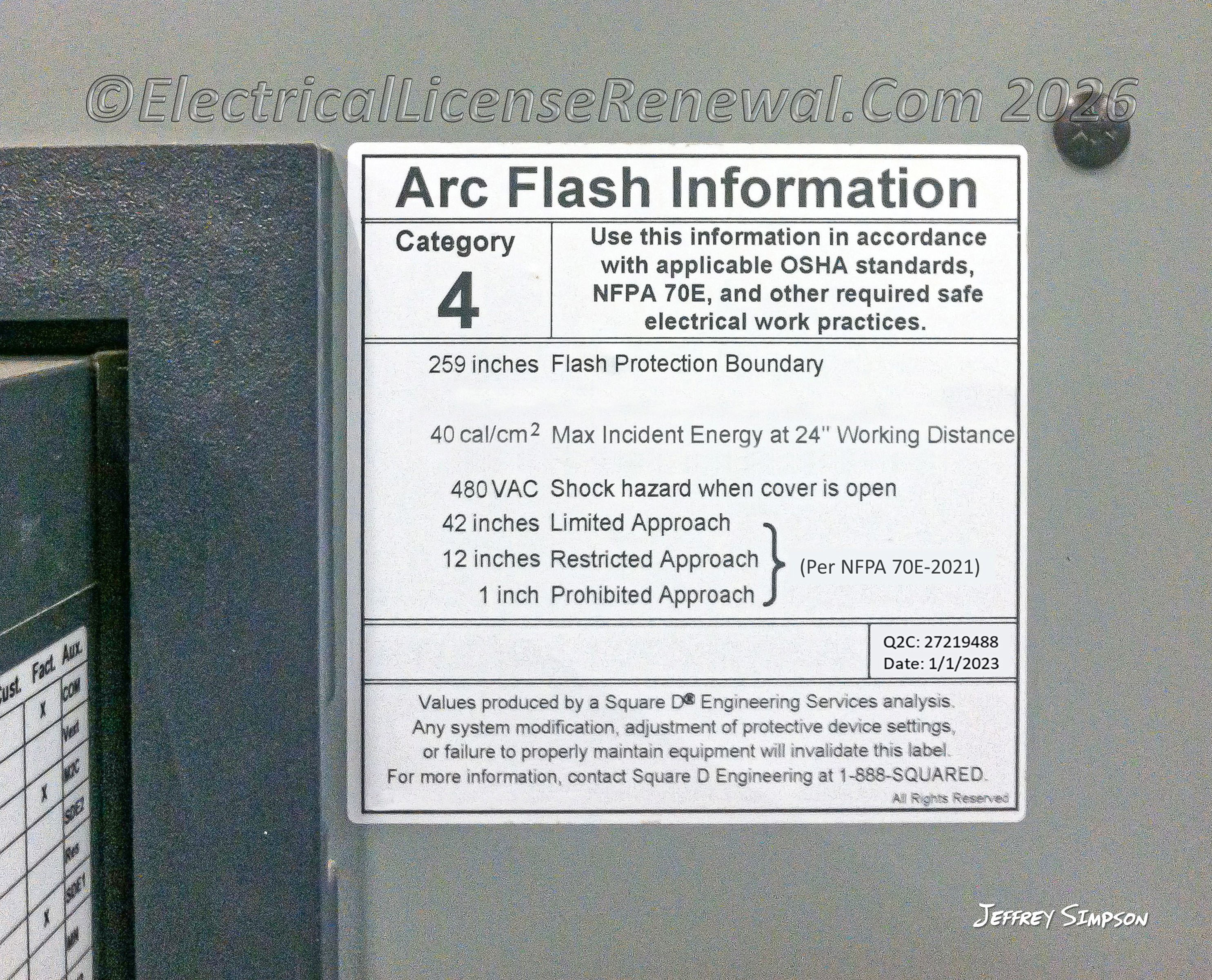
In other than dwelling units, a permanent arc flash marking shall be field or factory applied to service equipment and feeder-supplied equipment, such as switchboards, switchgear, enclosed panelboards, industrial control panels, meter socket enclosures, and motor control centers that are likely to require examination, adjustment, servicing, or maintenance while energized.
Code Change Summary: Section 110.16 was updated and now specifies 4 required components for arc-flash hazard labels.
SME commentary: In the 2026 NEC®, Section 110.16 was restructured and expanded to clarify and strengthen the requirements for arc-flash hazard labeling. While the revised language is more concise, it now carries more specific mandates that better align with NFPA 70E, particularly Article 130 on arc-flash risk assessments and labeling.
Originally introduced in the 2002 NEC®, Section 110.16 has undergone several important evolutions. By the 2017 edition, the section included requirements for labeling that addressed available fault current and even overcurrent device clearing times, and it also featured Informational Notes referencing NFPA 70E as a resource for compliance with this section. In later editions, such as 2020 and 2023, the language continued to reinforce reliance on industry standards like NFPA 70E. Still, the Code stopped short of directly requiring the specific label format outlined in Section 130.5(H) of NFPA 70E.
For 2026, the Code Panel took decisive steps to close that gap. Prompted by multiple public inputs, the panel reorganized the section into a clearly defined list. The final text in 110.16 now requires the following information to be included on arc-flash labels for certain types of service and feeder-supplied equipment such as switchboards, switchgear, enclosed panelboards, industrial control panels, meter socket enclosures, and motor control centers that may be examined or serviced while energized (excluding dwelling units):
- The nominal system voltage
- The arc flash boundary
- The available incident energy or the minimum required level of PPE
- The date the assessment was completed
This list-style format was adopted in response to concerns that field electricians might struggle to determine whether a label met “applicable industry practice,” particularly without formal training in 70E. By stating the required contents directly in the NEC®, the Code is now easier to enforce, and compliance is easier to verify.
However, the NEC® still stops short of prescribing how to determine values like arc flash boundary and incident energy. Those calculations require a documented arc-flash risk assessment (most likely done as outlined in NFPA 70E Article 130). This creates an interesting dynamic: while the NEC® now mandates that these values appear on the label, it doesn’t provide the methodology for determining them. Inspectors may now be in a position where they not only verify the presence of the label but also evaluate whether the data on it is backed by a legitimate risk assessment.
Ultimately, this change brings increased uniformity to arc-flash labeling practices and gives electrical professionals a clear checklist. At the same time, it reinforces the Code’s reliance on industry consensus standards for critical safety calculations. The evolution of 110.16 continues to reflect a growing emphasis on electrical safety in energized work conditions and a continued effort to bridge the NEC® with NFPA 70E.
Below is a preview of the NEC®. See the actual NEC® text at NFPA.ORG for the complete code section. Once there, click on their link to free access to the 2026 NEC® edition of NFPA 70.
2023 Code Language:
110.16 Arc-Flash Hazard Warning.
(A) General. Electrical equipment, such as switchboards, switchgear, enclosed panelboards, industrial control panels, meter socket enclosures, and motor control centers, that is in other than dwelling units, and is likely to require examination, adjustment, servicing, or maintenance while energized, shall be field or factory marked to warn qualified persons of potential electric arc flash hazards. The marking shall meet the requirements in 110.21(B) and shall be located so as to be clearly visible to qualified persons before examination, adjustment, servicing, or maintenance of the equipment.
(B) Service Equipment and Feeder Supplied Equipment. In other than dwelling units, in addition to the requirements in 110.16(A), a permanent arc flash label shall be field or factory applied to service equipment and feeder supplied equipment rated 1000 amperes or more. The arc flash label shall be in accordance with applicable industry practice and include the date the label was applied. The label shall meet the requirements of 110.21(B).
Informational Note No. 1: See ANSI Z535.4-2011 (R2017), Product Safety Signs and Labels, for guidelines for the design of safety signs and labels for application to products.
Informational Note No. 2: See NFPA 70E-2021, Standard for Electrical Safety in the Workplace, for applicable industry practices for equipment labeling. This standard provides specific criteria for developing arc-flash labels for equipment that provides nominal system voltage, incident energy levels, arc-flash boundaries, minimum required levels of personal protective equipment, and so forth.
2026 Code Language:
110.16 Arc-Flash Hazard Marking. In other than dwelling units, a permanent arc flash marking shall be field or factory applied to service equipment and feeder-supplied equipment, such as switchboards, switchgear, enclosed panelboards, industrial control panels, meter socket enclosures, and motor control centers that are likely to require examination, adjustment, servicing, or maintenance while energized. The marking shall comply with110.21(B), be located so as to be clearly visible to qualified persons, and be in accordance with applicable industry practice, containing the following information:
(1) The nominal system voltage
(2) The arc flash boundary
(3) The available incident energy or minimum required level of personal protective equipment
(4) The date the assessment was completed
Informational Note No. 1: See ANSI Z535.4-2011 (R2017), Product Safety Signs and Labels, for guidelines for the design of safety signs and labels for application to products.
Informational Note No. 2: See NFPA 70E, Standard for Electrical Safety in the Workplace, for applicable industry practices for equipment marking. This standard provides specific criteria for developing arc-flash labels for equipment that provides nominal system voltage, incident energy levels, arc-flash boundaries, minimum required levels of personal protective equipment, and so forth.
