110.10 Available Fault Current, Short-Circuit Current Ratings, and Other Characteristics.
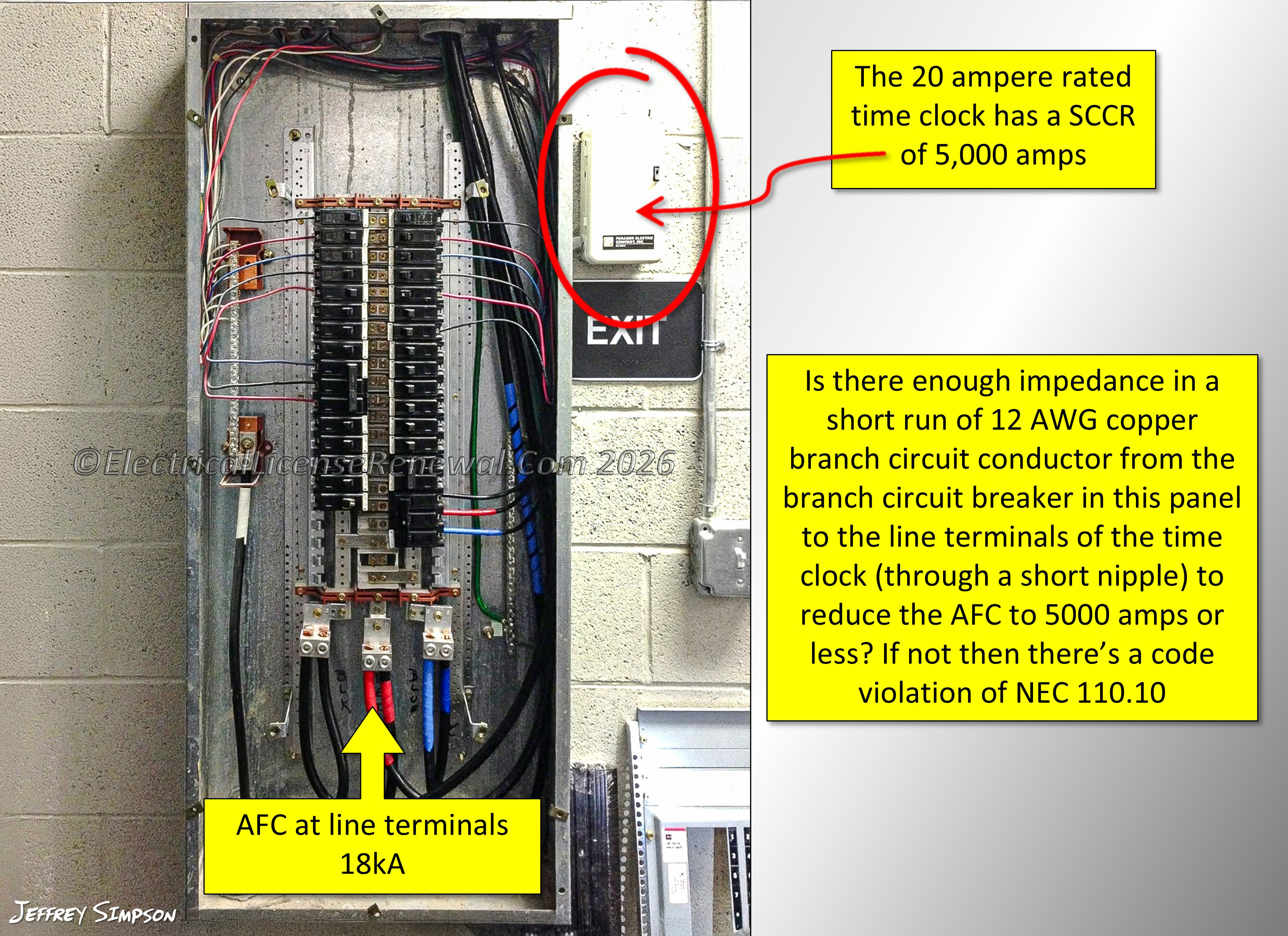
The OCPDs, equipment short-circuit current ratings, and other characteristics of the circuit to be protected shall be selected and coordinated with the available fault current to permit the circuit protective devices used to clear a fault to do so without extensive damage to the electrical equipment of the circuit.
Code Change Summary: Significant revisions were made to clean up the language on circuit characteristics.
SME commentary: In the 2026 edition of the NEC®, the wording in Section 110.10 was revised to improve clarity without altering the intent or enforcement of the rule. These revisions were based on public input submitted by an Eaton employee, who pointed out that the 2023 language was unnecessarily long and contained overlapping concepts that made it difficult to apply in the field. The updated language is cleaner, more concise, and uses NEC-defined terms to avoid ambiguity.
The revised 2026 language (in part) states: 110.10 Available Fault Current, Short-Circuit Current Ratings, and Other Characteristics. The OCPDs, equipment short-circuit current ratings, and other characteristics of the circuit to be protected shall be selected and coordinated with the available fault current to permit the circuit protective devices used to clear a fault to do so without extensive damage to the electrical equipment of the circuit…
One of the most noticeable changes is the replacement of the phrase “circuit impedance” with “available fault current.” This is more than just a wording preference, it brings the language in line with established NEC® definitions and reflects how electrical professionals actually determine system behavior during fault conditions. Available fault current inherently accounts for circuit impedance and conductor characteristics, which makes it a more inclusive and accurate term for this context. Because “available fault current” is already defined in Article 100, there is no longer a need to explicitly list related factors such as “the total impedance” or the assumed fault paths. Since these details are already baked into the available fault current calculation the code panel agreed that they do not need to be spelled out separately within 110.10.
Additionally, the entire second sentence from the 2023 version, explaining that faults should be assumed between circuit conductors or between a conductor and equipment grounding conductor, was deleted. This is because the definition in Article 100 of Available Fault Current already covers the worst-case fault scenarios by default. The updated language focuses solely on what is essential: selecting and coordinating overcurrent protective devices so they can open the circuit without causing extensive equipment damage.
It is important to emphasize that Section 110.10 applies to the electrician, not just the engineer. Like many other general requirements in Chapter 1, it assumes the installer understands core electrical principles such as impedance, current flow, and time-current characteristics. Similar to other theory-based concepts in the NEC® such as transformer protection calculations in Article 450, where the NEC® provides only the percentage values but leaves the actual current and VA math to the installer. For example, determining the full-load current of a 3-phase 75 kVA, 480V transformer first requires understanding and applying the formula (not found in the NEC) 75,000 ÷ 831 (480 × 1.732) = 90.25 amps. That knowledge is necessary to then apply the overcurrent protection percentages found in Tables 450.3(A) and (B).
Ultimately, the 2026 updates to 110.10 make the section easier to read and enforce, reduce the likelihood of misinterpretation, and preserve the existing requirement to select protective devices that will perform reliably under fault conditions. The core principle remains unchanged, coordinate the protective device so that it clears faults before significant damage occurs to the equipment.
Below is a preview of the NEC®. See the actual NEC® text at NFPA.ORG for the complete code section. Once there, click on their link to free access to the 2026 NEC® edition of NFPA 70.
2023 Code Language:
Language in red has been deleted
110.10 Circuit Impedance, Short-Circuit Current Ratings, and Other Characteristics. The overcurrent protective devices, the total impedance, the equipment short-circuit current ratings, and other characteristics of the circuit to be protected shall be selected and coordinated to permit the circuit protective devices used to clear a fault to do so without extensive damage to the electrical equipment of the circuit. This fault shall be assumed to be either between two or more of the circuit conductors or between any circuit conductor and the equipment grounding conductor(s) permitted in 250.118…
2026 Code Language:
110.10 Available Fault Current, Short-Circuit Current Ratings, and Other Characteristics. The OCPDs, equipment short-circuit current ratings, and other characteristics of the circuit to be protected shall be selected and coordinated with the available fault current to permit the circuit protective devices used to clear a fault to do so without extensive damage to the electrical equipment of the circuit...
