Article 100 Definitions. Deletion of “Panelboard Enclosed”.
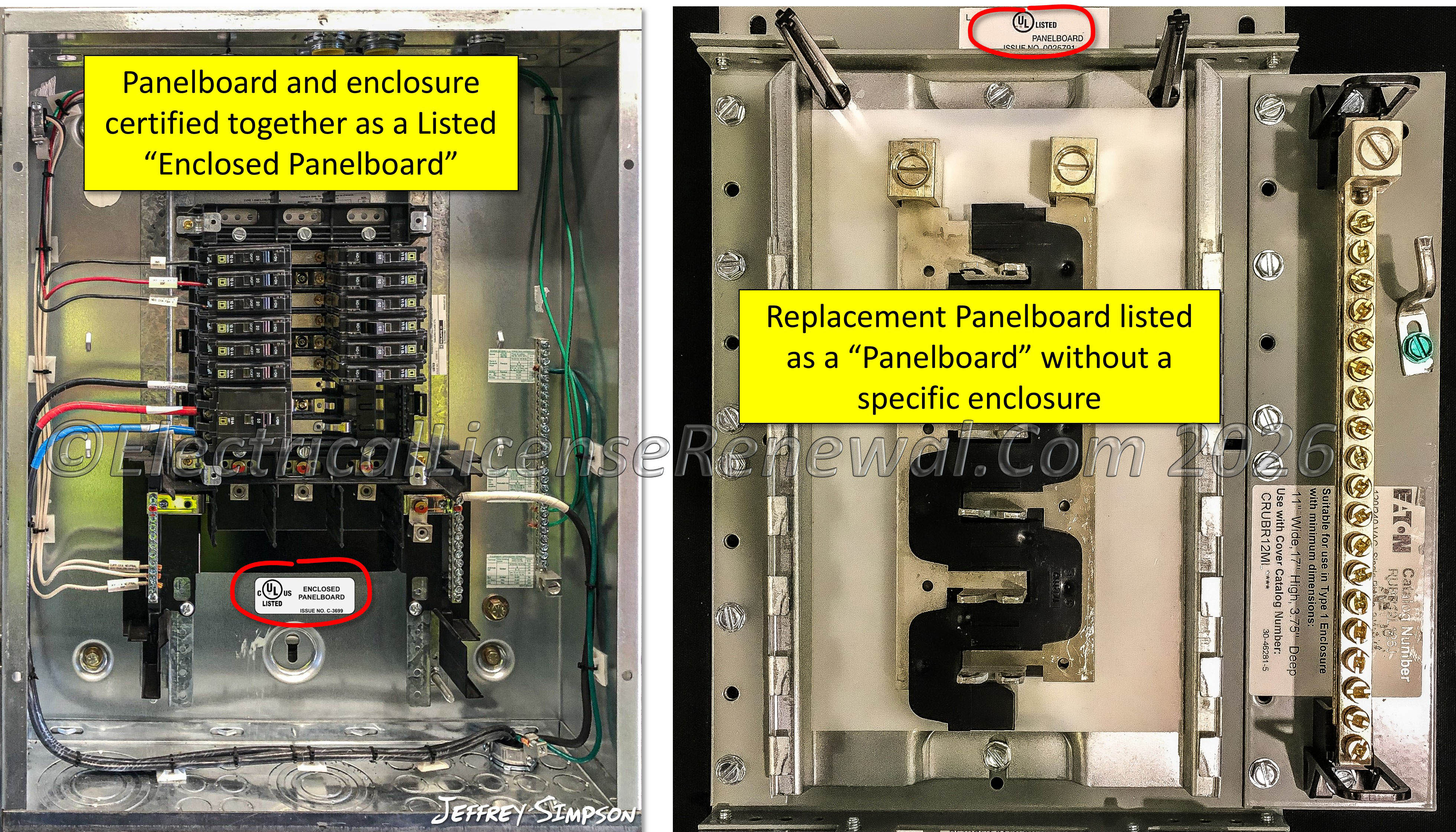
Panelboards can be listed with or without an enclosure.
Code Change Summary: The term “Enclosed Panelboard” has been deleted from Article 100.
SME commentary: The deletion of the term “Enclosed Panelboard” from the 2026 National Electrical Code (NEC) Article 100 may not seem like a big change, but it definitely removes a bit of clarity regarding assemblies and certified products being used in accordance with their listing.
The previous definition of “Enclosed Panelboard” first appeared in the 2023 NEC® and provided supporting language for assemblies where the panelboard and enclosure were evaluated together. The definition described it as “An assembly of buses and connections, overcurrent devices, and control apparatus with or without switches or other equipment, installed in a cabinet, cutout box, or enclosure suitable for a panelboard application.”
While the definitions for “Panelboard,” “Enclosed,” and “Enclosure” still remain intact in Article 100 (as seen below), the removal of “Enclosed Panelboard” marks a return to a more generic vocabulary, one that might not fully reflect all real-world application differences when it comes to panelboard installation.
Panelboard. A single panel or group of panel units designed for assembly in the form of a single panel, including buses and automatic overcurrent protective devices (OCPDs), and equipped with or without switches for the control of light, heat, or power circuits; designed to be placed in a cabinet, enclosure, or cutout box placed in or against a wall, partition, or other support; and accessible only from the front.
Enclosed. Surrounded by a case, housing, fence, or wall(s) that prevents persons from accidentally contacting energized parts.
Enclosure. The case or housing of apparatus or the fence or walls surrounding an installation, intended to prevent personnel from either unintentionally contacting energized parts or to protect the equipment from physical damage, or both.
When deleting “enclosed panelboard” from Article 100, the committee stated that the best way to describe such an assembly is simply “a panelboard in an enclosure.” On the surface, that seems fine. But this subtle shift may highlight the need to understand how these products are tested, certified, and marked.
In field terms, a “panelboard” listed to UL 67 alone is essentially just the internal components: the guts, so to speak. It does not include the enclosure as part of the product certification, and when these standalone panelboards are submitted to a Nationally Recognized Testing Laboratory (NRTL), they receive a listing label as a panelboard only. No tests are performed to see how an enclosure would interact with the panelboard under fault conditions. These products typically have a short-circuit current rating (SCCR) of no more than 10,000 amps.
On the other hand, when a panelboard is submitted for testing with an enclosure, the full assembly is subjected to additional testing, not only per UL 67, but also under UL 50 or UL 50E to evaluate the enclosure (with the E denoting environments like wet or corrosive locations). These tests evaluate aspects such as arc containment, wiring space, ventilation, and sharp edges. The result is a listed "Enclosed Panelboard" often with significantly higher SCCRs and enhanced safety under fault conditions. These differences in certification are not trivial, and in fact, were the basis for the separate requirements found in NEC® Section 408.9(A) and (B).
It's also worth pointing out that several on the code panel disagreed with removing the definition. One dissenting member noted that the although the definition of "panelboard" describes the bare components minus the enclosure, it has become common industry terminology to use the term “panelboard” when describing the most common installation which is actually an “enclosed panelboard”.
Despite the term being deleted from Article 100, electricians and inspectors must still understand the distinction between a “panelboard” and a tested “enclosed panelboard” assembly for listed products. The difference becomes especially important when replacing an obsolete panelboard in an existing enclosure. Reusing an existing cabinet that was never part of a tested assembly may downgrade the safety and short-circuit protection of the system if a listed “panelboard” is installed without verifying compatibility to the enclosure.
For field professionals and installers, it’s a reminder that while terminology might change in the industry, the core responsibility remains unchanged: always verify the product certification, the labeling, and the compatibility of the listed products.
Below is a preview of the NEC®. See the actual NEC® text at NFPA.ORG for the complete code section. Once there, click on their link to free access to the 2026 NEC® edition of NFPA 70.
2023 Code Language:
Article 100 Definitions.
Panelboard, Enclosed. (Enclosed Panelboard) An assembly of buses and connections, overcurrent devices, and control apparatus with or without switches or other equipment, installed in a cabinet, cutout box, or enclosure suitable for a panelboard application.
2026 Code Language:
Article 100 Definitions.
The definition was deleted.
