Article 100 Definitions. Electric Self-Propelled Vehicle (ESV).
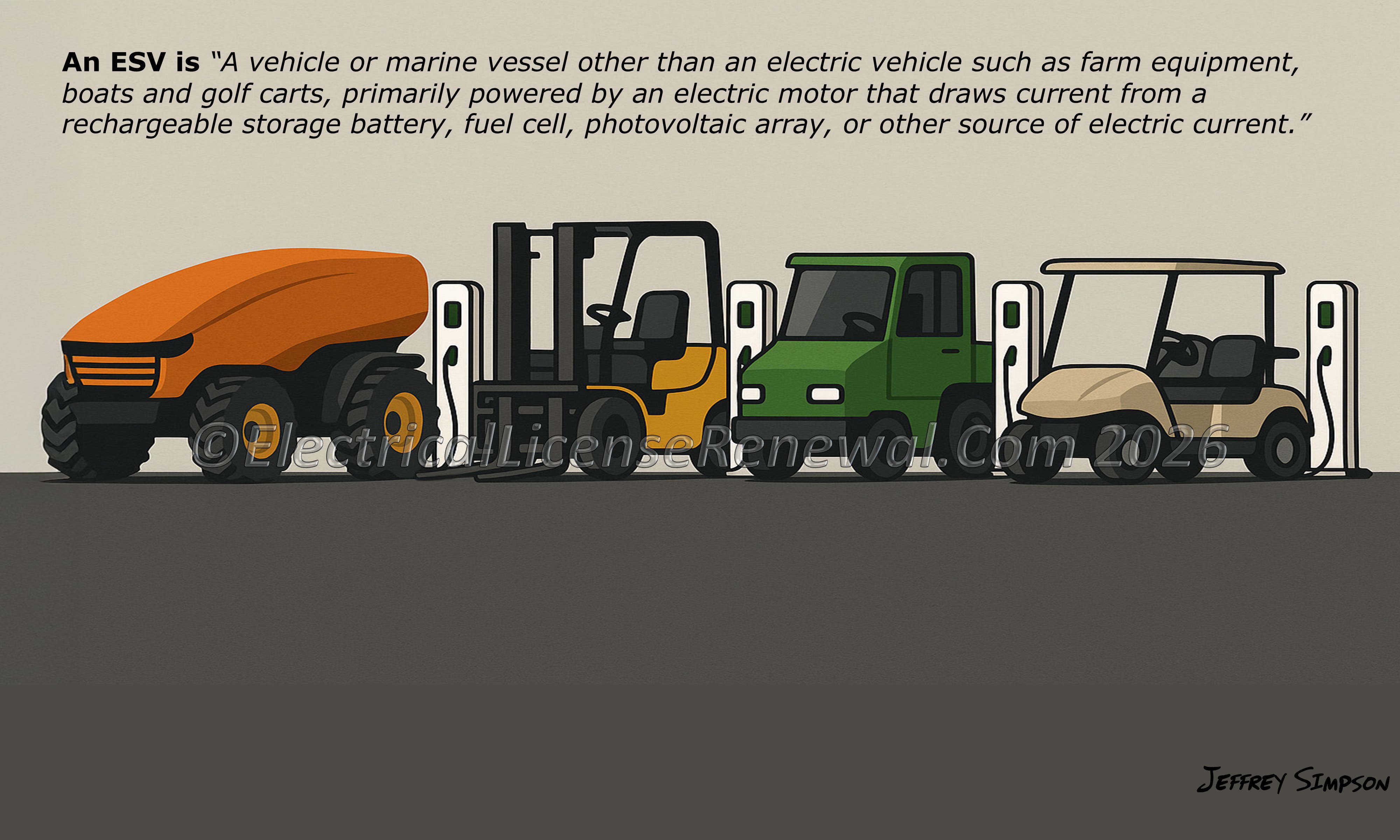
ESV’s can include battery powered autonomous farm equipment, electric forklifts, golf carts, electric airport vehicles and the like.
Code Change Summary: New definitions pertaining to Electric Self-Propelled Vehicles in Article 100.
SME commentary: The 2026 NEC® introduced a new term to Article 100 of an Electric Self-Propelled Vehicle (ESV). This new definition closes a major gap in how the NEC® addresses non-roadgoing electrified equipment. Until now, Code users only had the existing Article 100 definition of Electric Vehicle, which specifically referenced automotive-type vehicles used on-road. That meant anything else powered by batteries like airport baggage carts, electric forklifts, golf carts, or even an electric ferry was left in limbo when it came to NEC® coverage. Not anymore.
In the 2026 NEC® an ESV is “A vehicle or marine vessel other than an electric vehicle such as farm equipment, boats and golf carts, primarily powered by an electric motor that draws current from a rechargeable storage battery, fuel cell, photovoltaic array, or other source of electric current.”
This new definition is accompanied by two additional new definitions that address Electric Self-Propelled Vehicle Power Export Equipment (ESVPE), and Electric Self-Propelled Vehicle Supply Equipment (ESVSE).
The substantiation for adding the new definitions addressed a growing list of electric vehicles that aren’t highway-capable cars but still need regulated charging and power transfer systems, such as the infrastructure at an airport hangar or a commercial marina utilizing ESV technology. These aren’t plug-in passenger cars, but they require safe, code-compliant charging equipment.
The new definitions also support new Article 624, specifically for Electric Self-Propelled Vehicle Power Transfer Systems (ESVSEs). This is a parallel to Article 625, which still covers traditional road-going EVs. Article 624 provides new language for things like bidirectional charging, onboard export of power, and safety provisions tailored to ESV’s.
In the end, the new definitions do more than just clarify scope. They align the NEC® with real-world applications that have existed for years but were stuck in a regulatory gray area.
Bottom line: If it moves under electric power and it’s not a highway car, it’s likely an ESV and falls under new Article 624. Electric boats, golf carts, forklifts, and similar vehicles now have appropriate requirements in the NEC®.
Below is a preview of the NEC®. See the actual NEC® text at NFPA.ORG for the complete code section. Once there, click on their link to free access to the 2026 NEC® edition of NFPA 70.
2023 Code Language:
Article 100 Definitions.
The definitions did not exist.
2026 Code Language:
Article 100 Definitions.
N Electric Self-Propelled Vehicle (ESV). A vehicle or marine vessel other than an electric vehicle such as farm equipment, boats and golf carts, primarily powered by an electric motor that draws current from a rechargeable storage battery, fuel cell, photovoltaic array, or other source of electric current. (624)
N Electric Self-Propelled Vehicle Power Export Equipment (ESVPE). The equipment, including the outlet on the electric self-propelled vehicle (ESV), that is used to provide electrical power at voltages greater than or equal to 30 Vac or 60 Vdc to loads external to the ESV, using the vehicle as the source of supply. (624)
Informational Note: Electric self-propelled vehicle power export equipment and electric self-propelled vehicle supply equipment or wireless power transfer equipment are sometimes contained in one piece of equipment, sometimes referred to as a bidirectional electric self-propelled vehicle supply equipment (ESVSE) or bidirectional wireless power transfer equipment (WPTE).
N Electric Self-Propelled Vehicle Supply Equipment (ESVSE). Equipment for plug-in charging, including the ungrounded, grounded, and equipment grounding conductors, and the electric self-propelled vehicle connectors, attachment plugs, personnel protection system, and all other fittings, devices, power outlets, or apparatus installed specifically for the purpose of transferring energy between the premises wiring and the electric self-propelled vehicle. (624)
Informational Note: Electric self-propelled vehicle power export equipment and electric self-propelled vehicle supply equipment or wireless power transfer equipment (WPTE) are sometimes contained in one piece of equipment, sometimes referred to as a bidirectional ESVSE or bidirectional WPTE.
