Article 100 Definitions. Cable Tie. Cable Tie Fixing Device.
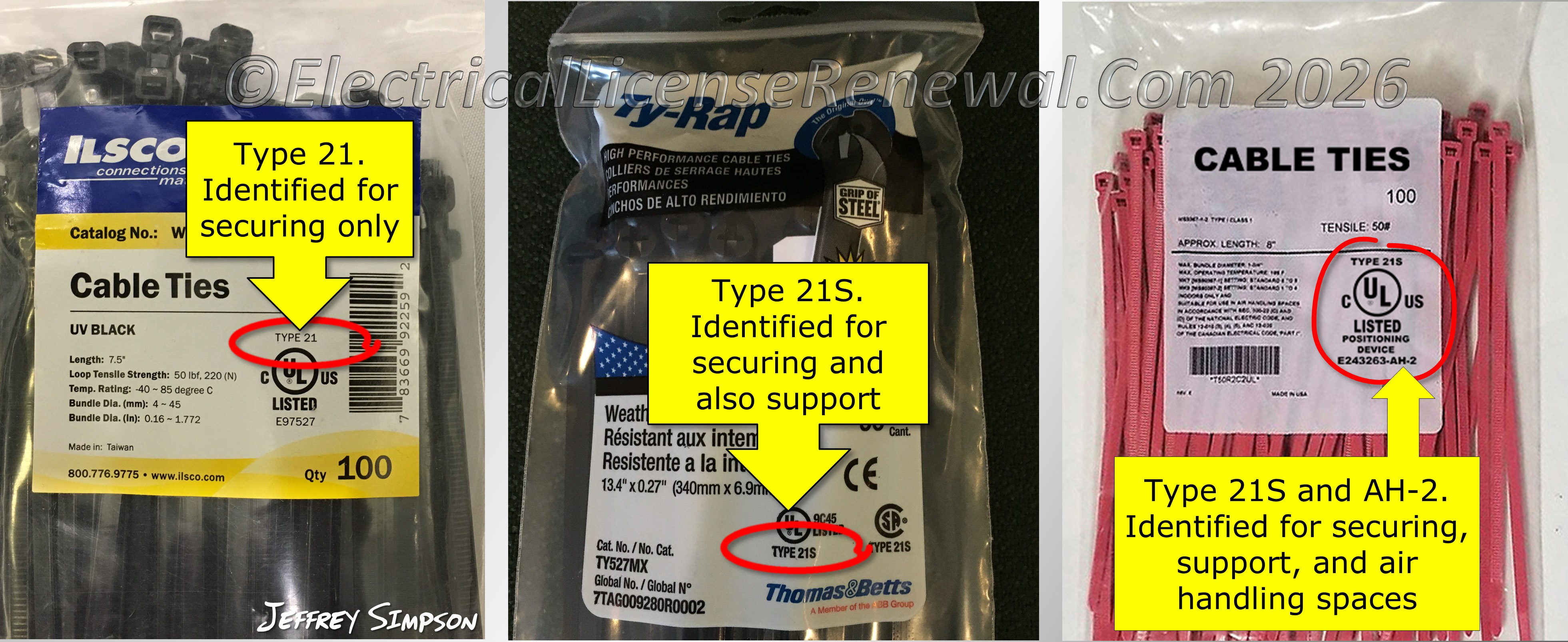
Cable ties marked 2S or 21S are evaluated for securing and supporting cable, flexible conduit, and flexible tubing.
Code Change Summary: New definitions of Cable Tie and Cable Tie Fixing Device.
SME commentary: The 2026 NEC® introduces two new definitions in Article 100: "Cable Tie" and "Cable Tie Fixing Device". These definitions provide much-needed clarity on the proper use, evaluation, and classification of cable ties in electrical installations.
Cable Tie Definition
A Cable Tie is now defined as:
A band or length of material employing a locking device, used for securing, bundling, and/or supporting cable, flexible conduit, or flexible tubing.
Previously, the NEC® lacked a formal definition of Cable Tie, despite its widespread use for cable management, securement, and support in electrical systems. This definition establishes clear language regarding what qualifies as a cable tie and ensures alignment with UL 62275, the product safety standard for cable management systems.
Additionally, an Informational Note has been added to specify the Type designations for cable ties:
- Type(s) 1, 11, 2, 21, 2S, or 21S – Evaluated for use in cable management applications.
- Type(s) 2S or 21S – Also evaluated for securing and supporting cable, flexible conduit, and flexible tubing.
Cable Tie Fixing Device Definition
A Cable Tie Fixing Device is now defined as:
A component, such as a bracket or block, specifically designed to secure cable ties to a mounting surface.
This definition clarifies the intended use of cable tie fixing devices, which serve as mounting components for securing cable ties in place. By specifying the Type designations and applications of these devices, this definition enhances consistency and usability within the NEC®.
- Type(s) 1, 11, 2, 21, 2S, or 21S – Evaluated for cable management applications.
- Type(s) 2S or 21S – Also evaluated for securing and supporting cable, flexible conduit, and flexible tubing.
By introducing these definitions, the 2026 NEC® enhances clarity in how cable ties and fixing devices are evaluated and applied in electrical installations. These changes align with UL 62275 and ensure that electrical professionals have a clear understanding of which types of cable ties and fixing devices are suitable for different applications. This ultimately improves installation practices, compliance, and safety in electrical systems.
Below is a preview of the NEC®. See the actual NEC® text at NFPA.ORG for the complete code section. Once there, click on their link to free access to the 2026 NEC® edition of NFPA 70.
2023 Code Language:
Article 100 Definitions.
The definitions did not exist.
2026 Code Language:
Article 100 Definitions.
N Cable Tie. A band or length of material employing a locking device, used for bundling, securing, and/or supporting cable, flexible conduit, or flexible tubing.
Informational Note: Below are cable tie and cable tie fixing device type designations:
(1) Type(s) 1, 11, 2, 21, 2S, or 21S are evaluated for use in cable management applications.
(2) Type(s) 2S or 21S are also evaluated for securing and supporting cable, flexible conduit, and flexible tubing.
N Cable Tie Fixing Device. A component, such as a block or bracket, specifically designed to secure cable tie(s) to a mounting surface.
Informational Note: Below are cable tie and cable tie fixing device type designations:
(1) Type(s) 1, 11, 2, 21, 2S, or 21S are evaluated for use in cable management applications.
(2) Type(s) 2S or 21S are also evaluated for securing and supporting cable, flexible conduit, and flexible tubing.
