Article 100 Definitions. Accessible, Readily. (Readily Accessible).
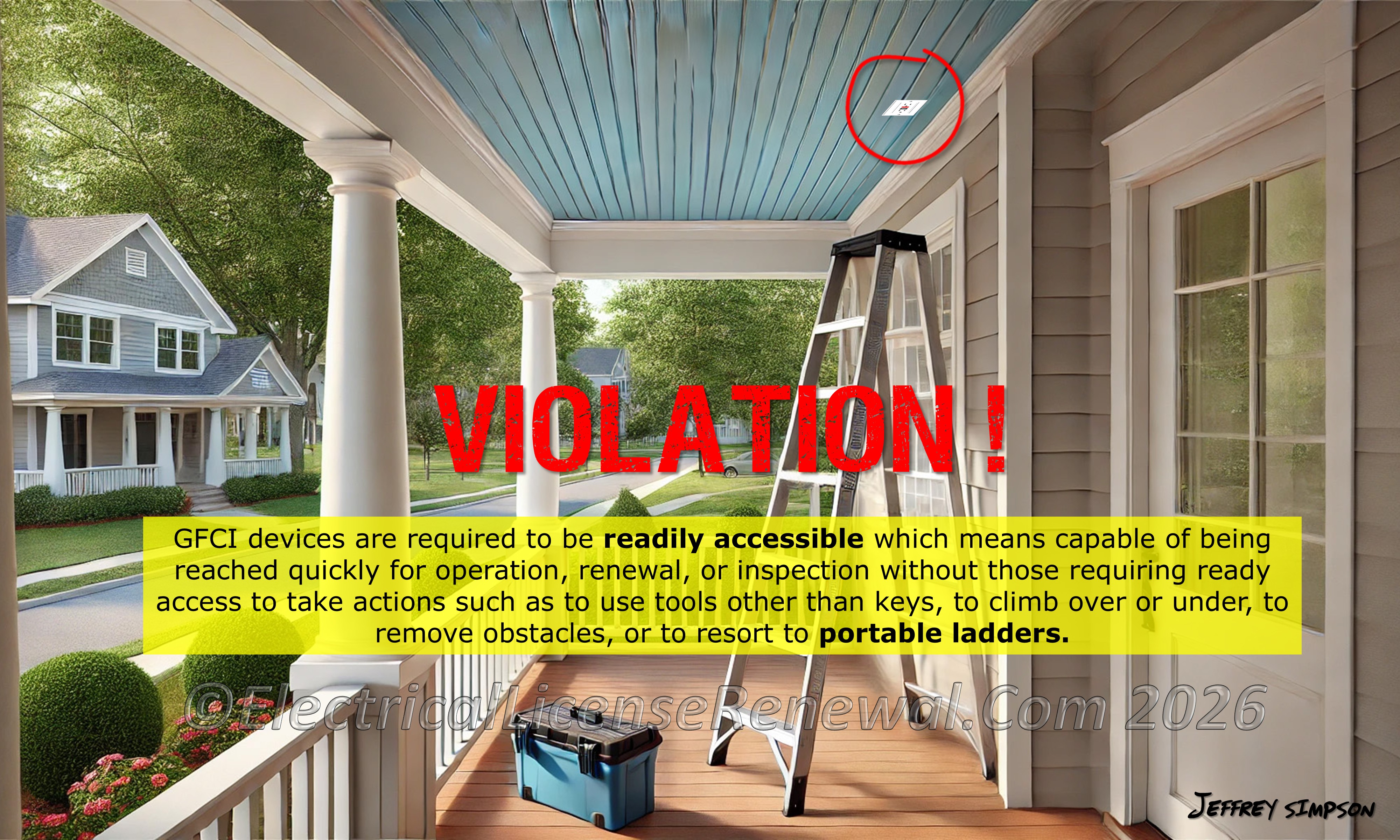
GFCI devices are required to be readily accessible which means capable of being reached quickly for operation, renewal, or inspection without those requiring ready access to take actions such as to use tools other than keys, to climb over or under, to remove obstacles, or to resort to portable ladders.
Code Change Summary: The definition of “readily accessible” has been simplified for readability.
SME commentary: The 2026 NEC® revision to the definition of "Accessible, Readily (Readily Accessible)" was made to improve readability and clarity without changing the intent of the requirement. The previous definition used more complex phrasing, such as "requiring those to whom ready access is requisite," which has now been simplified to "without those requiring ready access."
Additionally, the phrase "and so forth" was removed, making the definition more concise while maintaining the original intent. These changes align with ongoing efforts to streamline NEC® language for better usability without altering enforcement or application.
The NEC® does NOT require all electrical equipment to be readily accessible. Below are two examples in the NEC® where electrical devices or equipment are required to be “readily accessible”.
- 210.8 Ground-Fault Circuit-Interrupter Protection for Personnel. A listed Class A GFCI shall provide protection in accordance with 210.8(A) through (F). The GFCI shall be installed in a readily accessible location.
- 230.70(A)(1) Readily Accessible Location. The service disconnecting means shall be installed at a readily accessible location either outside of a building or structure or inside nearest the point of entrance of the service conductors.
Flowchart: Determining if Electrical Equipment is "Readily Accessible" (2026 NEC® Definition)
Start Here → Evaluate the following criteria for specific equipment or devices the NEC® requires to be readily accessible:
1 Can the equipment be reached quickly for operation, renewal, or inspection?
- ✅ Yes → Proceed to Question 2
- ❌ No → Not Readily Accessible
2 Can the equipment be accessed without the use of tools (other than keys)?
- ✅ Yes → Proceed to Question 3
- ❌ No → Not Readily Accessible
3 Can the equipment be reached without climbing over or under an obstruction?
- ✅ Yes → Proceed to Question 4
- ❌ No → Not Readily Accessible
4 Can the equipment be accessed without removing obstacles?
- ✅ Yes → Proceed to Question 5
- ❌ No → Not Readily Accessible
5 Can the equipment be accessed without the use of a portable ladder?
- ✅ Yes → Equipment is Readily Accessible
- ❌ No → Not Readily Accessible
Conclusion:
✅ If "Yes" is answered to all five questions, the equipment is considered "Readily Accessible" per the 2026 NEC®.
❌ If "No" is answered to any question, the equipment is NOT considered "Readily Accessible."
Below is a preview of the NEC®. See the actual NEC® text at NFPA.ORG for the complete code section. Once there, click on their link to free access to the 2026 NEC® edition of NFPA 70.
2023 Code Language:
Article 100 Definitions:
Accessible, Readily (Readily Accessible). Capable of being reached quickly for operation, renewal, or inspections without requiring those to whom ready access is requisite to take actions such as using tools (other than keys), to climb over or under, to remove obstacles, or to resort to portable ladders, and so forth.
2026 Code Language:
Article 100 Definitions:
Accessible, Readily. (Readily Accessible). Capable of being reached quickly for operation, renewal, or inspection without those requiring ready access to take actions such as using tools other than keys, to climb over or under, to remove obstacles, or to resort to portable ladders.
